How do you build an app for a nonprofit?
France has 1.3 million nonprofits, and 71% of them face digital obstacles. Jam Solidaire generated €1 million in revenue in two years, with an average donation 27% above the national average.

Article summary
- France has 1.3 million nonprofits, 22 million members, and 16 million volunteers, and 71% of nonprofits face digital obstacles.
- 81% of nonprofits fund their digital transformation with their own money.
- Jam Solidaire generated €1 million in revenue in two years, with an average donation 27% above the national average.
- From the V1, a donations app plans for Apple Pay or Google Pay and an automatic tax receipt. Donations to a nonprofit recognized as being of general interest open a 66% tax reduction.
- The FDVA subsidizes digital-modernization projects for nonprofits, including the development of mobile tools.
Summarize this article with
There are 1.3 million nonprofits in France. 22 million members. 16 million volunteers. It is one of the densest local networks in the world, and it is massively under-digitized.
71% of nonprofits face digital obstacles in 2025. 81% fund their digital transformation with their own money, with no outside help. And yet 56% of French people say they made donations to nonprofits in the first months of 2025, and 50% plan to give more than the previous year (Ipsos, March 2025).
That paradox says everything: the intention to give is there, the nonprofit structures are there, but the tools to connect the two are often missing. Building an app for a nonprofitis precisely how you answer this problem. Not with a generic tool, but with a product designed for the specific needs of the nonprofit sector.
firstapp worked with Jam Solidaire, a multi-nonprofit donations app, from design to launch. This guide draws on that concrete experience and on the most recent data in the sector.
1. The French nonprofit sector: an under-digitized giant
France has 1.3 million active nonprofits, of which 167,000 employ staff. This nonprofit fabric represents 3.5% of GDP and mobilizes 16 million volunteers. It is a considerable civic force, and it has very few mobile tools adapted to its needs.
The Solidatech study on the place of digital in the nonprofit project (November 2025) draws a precise picture of this reality. Only 47% of nonprofit leaders consider that their organization is "on the right track" in its digital practices. 71% face obstacles, mainly human ones: a lack of skills, dependence on a single volunteer who is the "digital referent", and no shared digital culture in the organization.
On digital donations, the figures are revealing:
Recurring donations on a mobile bill grew by 54% in 2025 (af2m, France générosités). Donation by RCS, the new alternative to SMS, generates an average donation of €14 to €15 versus €8.72 by classic SMS, a nearly 65% increase in the average donation amount simply by changing the channel (The Media Leader, May 2026).
Info: November and December concentrate the highest donation peaks of the year for French nonprofits. A donations app published in October captures these natural end-of-year flows of generosity. An app launched in January misses them entirely. Launch timing is a strategic decision, not a logistical one.
What this data indicates for a founder of a nonprofit project: there is a pool of active and growing donors, generosity looking for practical channels, and a nonprofit sector that does not yet have the tools to take full advantage of it.
For the general context of the mobile market, our guide on building a mobile app for a startup is a useful complementary read.
Newsletter
Once a week.
Last issue
We opened 10 apps to see how they sell a subscription.
+534 people read us each week
2. The 5 types of apps for nonprofits
An app for a nonprofit does not look like a standard commercial app. The goals are not the same (social impact rather than profit), the users are different (donors, volunteers, members, beneficiaries), and the technical and regulatory constraints have their own specifics.
There are five main families of apps for the nonprofit sector.
The donation-collection app
This is the most direct segment: letting donors give to one or more nonprofits in a few seconds, from their phone. A simplified donation form, secure payment, an automatic tax receipt, a history of contributions. This is the Jam Solidaire model, which we detail in the next section.
The added value compared with a simple payment link on a website: the fluidity of the mobile experience (payment in two taps with Apple Pay or Google Pay), regularity (programmable recurring donations), and transparency on impact (what the donation concretely pays for).
The volunteer-management app
Recruitment, scheduling, availability management, communication between coordinators and volunteers, tracking of volunteer hours. Nonprofits with dozens or hundreds of volunteers have a real need for coordination tools that are not an unstructured WhatsApp group.
This type of app brings immediate measurable value: fewer last-minute dropouts, better visibility on availability, a history of volunteer contributions for annual reports.
The member-management app
Online membership, dues payment, a member directory, management of renewals and automatic reminders. Nonprofits that manage hundreds or thousands of members lose a considerable amount of time on these administrative tasks. A dedicated app automates these processes and frees the teams for what matters.
The nonprofit events app
Event registration, ticketing, the program, notifications, welcoming participants, post-event feedback. Nonprofits that regularly organize events (collections, solidarity festivals, training, conferences) have a specific need that generalist tools like Eventbrite do not always cover well.
The awareness and communication app
Sharing the nonprofit's content, integrated newsletters, news from projects in the field, highlighting the concrete impact of donations and volunteering. This type of app turns passive supporters into active ambassadors, by giving them direct access to the life of the organization and to shareable content.
3. Jam Solidaire: what we built and what it produced
firstapp client case, the agency's first and longest-standing client.
Jam Solidaire is a mobile app for donations to multiple nonprofits. The principle: one app, several nonprofits supported, a donation path simplified to a few seconds. The user chooses the cause or causes they care about, sets their donation (one-off or recurring), and receives a tax receipt directly in the app.
What firstapp did: the full UX and UI design, React Native development for iOS and Android, and post-launch follow-up over time. Jam Solidaire is our first client, the one with which we built a large part of our expertise on social-impact projects.
The results: €1 million in revenue in two years. An average donation of €13 to €14, when the national average across all channels sits around €11. That is 27% above the market, on one of the most important metrics for a donations app.
This result is not due to chance. It comes from precise design decisions on onboarding, the donation path, and how impact is presented. Three concrete lessons:
Clarity of impact increases the donation amount. A donor who understands precisely what their money pays for (funding 3 meals for a family in difficulty, planting 10 trees, funding 2 hours of tutoring) gives more than a donor facing a simple transfer form. On Jam Solidaire, each nonprofit presents its impact in concrete, measurable terms, with simple visual equivalents.
Reduced friction increases frequency. Every extra step in the donation path drops the completion rate. Moving to Apple Pay or Google Pay in a single tap, without re-entering bank details, had a direct impact on the conversion rate. Fluidity is not comfort. It is generosity removed when it is missing.
Recurring donation is under-offered in the sector. The majority of nonprofits present the one-off donation as the main option. Jam Solidaire puts the monthly donation forward, with suggested amounts calibrated around impact (€10/month, €20/month) rather than arbitrary amounts. The result: a recurring-donation rate above the sector median, and revenue predictability for partner nonprofits.
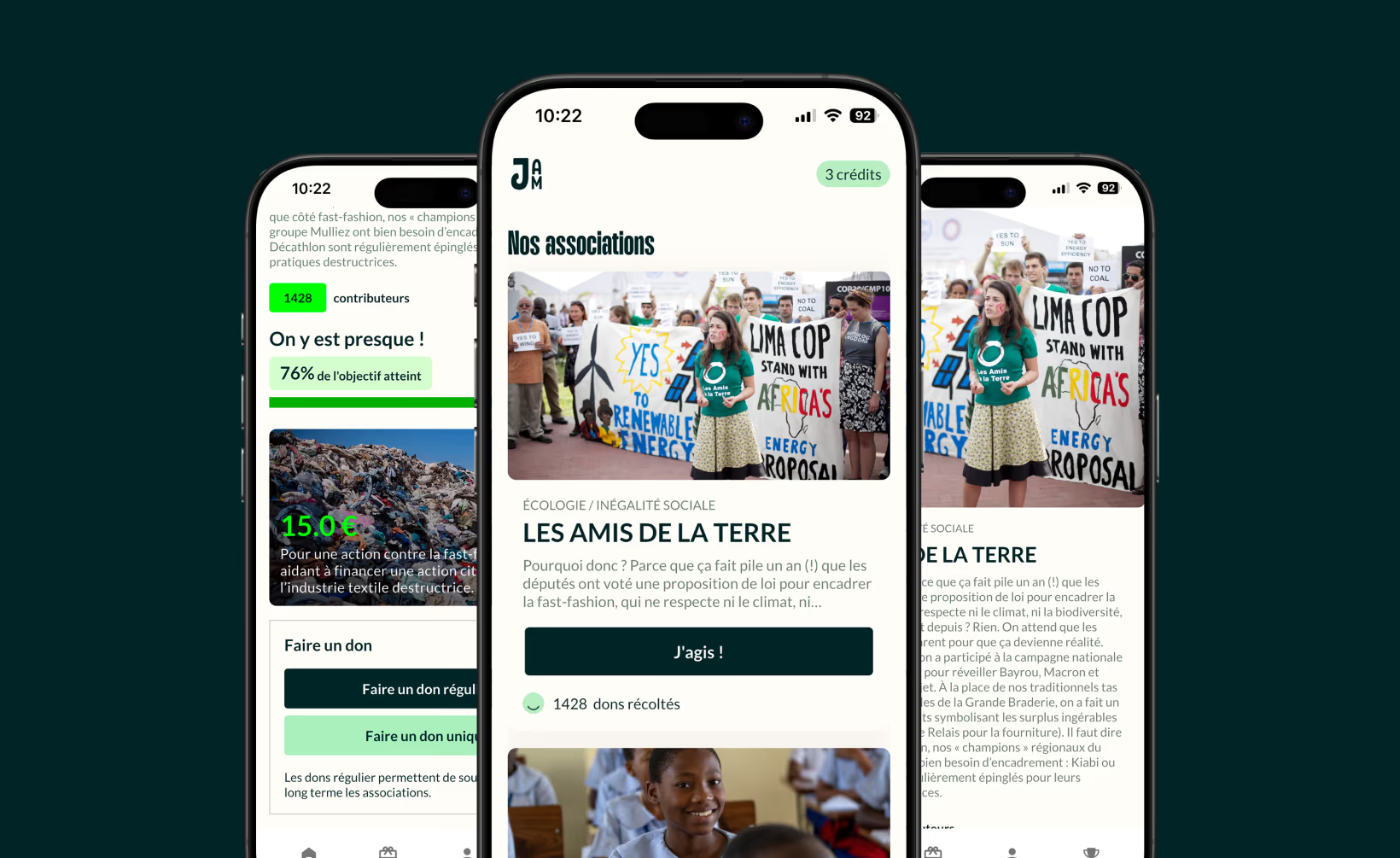
Features of a donations app
What a donations app has to have from the V1
Native mobile payment. Apple Pay and Google Pay have to be integrated from the V1. On mobile, a bank-card form to fill in by hand is a dropped path. Payment in one tap, with the amount and the cause already selected, multiplies conversion rates.
The automatic tax receipt. In France, donations to 1901-law nonprofits recognized as being of general interest open a right to a tax reduction of 66% (75% for certain causes). This reduction is one of the first arguments of the regular donor. Automatic issue of the Cerfa receipt (form 2041-RD) in the app, with no manual action by the nonprofit, is a non-negotiable feature.
Presenting the impact. Each nonprofit, each cause, has to be presented with a measurable, concrete impact. Not only a general description of the mission, but tangible equivalents: "with €15, you fund one night of emergency housing." This language of impact is the main lever of the average donation amount.
The contribution history. A personal space where the donor sees all their past donations, their tax receipts, and the cumulative impact of their contributions. This personal recap creates a sense of belonging and loyalty to the app and to the causes supported.
Contextual notifications. A reminder of a recurring donation before the charge, an impact notification after a donation (the cause was funded thanks to dozens of donors like you), an alert on an urgent campaign. These notifications, designed to bring value rather than to create friction, improve donor retention and loyalty.
What sets a nonprofit app apart from a simple donations site
The difference is not technological. It is in the experience. A donations site asks you to browse on a mobile browser, to enter your information every time, and gives you no follow-up on impact. A native app remembers the profile, activates payment in one tap, sends news of the causes supported, and creates a relationship over time between the donor and the nonprofit.
That relationship over time is what turns a one-off donor into a regular donor, and a regular donor into an ambassador.
Constraints of a nonprofit app
Building an app for a nonprofit imposes specific constraints that do not exist in commercial apps. Ignoring them at the start generates significant compliance costs afterwards.
Donation tax rules
Only nonprofits recognized as being of general interest or of public utility can issue tax receipts for donations. Before building a donations app, checking the tax status of the nonprofit (or of the partner nonprofits) is a mandatory step.
Tax receipts have to follow the Cerfa 2041-RD format and must mention: the name and address of the nonprofit, its SIREN number, the date and amount of the donation, and a mention of its tax status. In an app, these receipts are generated automatically and stored in the donor's personal space, with the option to download them as a PDF.
GDPR and donor data
Donor data (name, email, bank details, donation history) is personal data subject to the GDPR. A donations app has to have a clear privacy policy, an explicit legal basis for each processing, and bank data must never be stored in clear text by the nonprofit. It is handled by a certified payment provider (Stripe, PayPlug, HelloAsso).
Payment providers compatible with nonprofits
HelloAsso is the payment solution specialized in French nonprofits: no commission taken on donations, features dedicated to nonprofits (fundraising, ticketing, membership). Stripe and PayPlug are robust alternatives with a more flexible mobile integration for custom payment experiences. The choice of payment provider directly affects transaction fees and the user experience.
Apple App Store compliance for donation apps
Apple imposes specific rules for donation-collection apps. In particular, donations to recognized nonprofits are not subject to the 30% commission on in-app payments, provided the app is categorized correctly and the charitable nature is documented. This exemption has to be requested explicitly from Apple before submission.
6. How to fund your nonprofit app
The budget of a mobile app is often seen as an obstacle for the nonprofit sector. There are nevertheless several specific funding sources that many nonprofits do not know.
The FDVA, Fonds pour le Développement de la Vie Associative
The FDVA is a French state subsidy scheme dedicated to the operation and modernization of nonprofits. It funds digital-transformation projects in particular, including the development of mobile tools. Applications are filed annually with regional prefectures. For a donations app or a volunteer-management app, the FDVA is a direct funding lead to explore first.
Corporate sponsors and foundations
Many corporate foundations (Fondation de France, Fondation Orange, banking foundations) fund nonprofit modernization projects, notably in digital communication and collection tools. The average ticket of a corporate-foundation grant for a digital project sits between €5,000 and €30,000.
Skills sponsorship
A company can make its employees' skills available to a nonprofit as skills sponsorship, which is tax-deductible. Tech companies that want to commit to impact projects can fund part or all of the development of a nonprofit app through this mechanism.
You have an app project for your nonprofit? Get an estimate in a few minutes: Request a quote ↗
7. What firstapp would do on your nonprofit project
The nonprofit sector is the one firstapp knows best from the inside. Jam Solidaire is our first client. This project taught us things commercial projects do not teach: the budget constraint, the importance of measurable impact, and the need to convince donors who are not looking for a product but for a reason to give.
What we think differently about on nonprofit projects
Impact before features. In a commercial project, the product is a solution to a problem. In a nonprofit project, the product is a vehicle for impact. The question is not "which features should we build?" but "how do we maximize impact for the beneficiaries and donor engagement?" This difference of angle changes everything in the design decisions.
The donor path as an obsession. Every point of friction between the intention to give and the act of giving is a lost donation. We analyze the path from A to Z, from opening the app to confirmation of the tax receipt, to remove everything that is not strictly necessary. On Jam Solidaire, this obsession is what produced an average donation 27% above the market median.
Seasonality as a launch lever. Donations concentrate in the last months of the year. An app launched in October has every chance of being listed and indexed before the November–December peak. We set the development schedule around this window.
The growth loops specific to nonprofit apps
Sharing impact. "I funded 3 meals for people without housing tonight. Join me on Jam Solidaire." After each donation, the app generates a shareable visual card with that kind of line. This format, shareable in one tap to Instagram stories or WhatsApp, creates organic acquisition on every transaction.
Collective giving. Letting a group (family, team, circle of friends) set a shared donation goal and track its progress. This format creates a collective dynamic that increases the amounts and the frequency of contributions.
The donation challenge. "I am taking on a 30-day running challenge, and each kilometer generates a donation." Apps like Charity Miles have proved that linking a physical activity to a donation creates powerful engagement. This mechanic can be designed into any donations app with a simple tracking module.
8. FAQ
Can a nonprofit get the development of its app funded?
Yes. The FDVA (Fonds pour le Développement de la Vie Associative) subsidizes digital-modernization projects for French nonprofits. Corporate foundations, skills sponsorship from tech companies, and some regional schemes complete this funding picture. The process takes preparation and patience, but it is accessible to most mid-sized nonprofits.
What is the difference between HelloAsso and Stripe for a nonprofit donations app?
HelloAsso is specialized in the French nonprofit sector: no commission taken on donations (operating costs are covered by an optional tip asked of donors), and features specific to nonprofits (fundraising, membership, ticketing). Stripe is more generalist, more technically flexible for a custom integration, but it takes a commission (1.5% to 2.9% depending on the type of transaction). For a V1, HelloAsso is often the natural entry point. For a more sophisticated app with a fully customized payment UX, Stripe is the technical choice.
Is mobile donation really more effective than classic online donation?
The data confirms it. Donation by RCS (a new mobile communication format) generates an average donation of €14 to €15, versus €8.72 by traditional SMS (The Media Leader, 2026). And well-designed donations apps, such as Jam Solidaire, which firstapp worked with, generate an average donation of €13 to €14, which is 27% above the national average. The fluidity of the mobile path, combined with Apple Pay and Google Pay, removes the friction that lowers donation amounts and frequency.
Does a small nonprofit need a native app, or is a mobile site enough?
It depends on the expected frequency of use. If your nonprofit organizes occasional collections (once or twice a year), an optimized mobile website with a HelloAsso integration can be enough. If you want to build a lasting relationship with regular donors, send personalized notifications, and offer one-tap payments, a native app brings an experience the mobile web cannot reproduce. The general rule: an app is worth the investment when the user has a reason to open it regularly, not only once a year.
Also read
Jam Solidaire: how David built €1M in revenue in 2 years by digitizing his own trade
Jam Solidaire is €1M in revenue in 2 years, 15,000 active donors, and an average basket 30% above the market average. It is also our first client, and the story of a non-technical founder who sold everything before he had an app.
Outsource your CTO for a mobile app?
Hiring a CTO takes 3 to 9 months and costs €80,000 to €130,000 in gross annual salary, plus charges. Outsourcing hands architecture, the roadmap, and product evolution to a partner.
How do you automatically generate tax receipts in a donations app?
The tax receipt (Cerfa form 2041-RD) has to mention the donor's name and address, the nonprofit's name and SIREN, the date and amount of the donation, and the mention of the tax status that allows the tax reduction. In an app, this receipt is generated automatically on every transaction, as a PDF, stored in the donor's personal space and sent by email. Providers such as HelloAsso and Stripe handle generation of these documents natively in some cases, or through a specific integration.