Jam Solidaire: how David built €1M in revenue in 2 years by digitizing his own trade
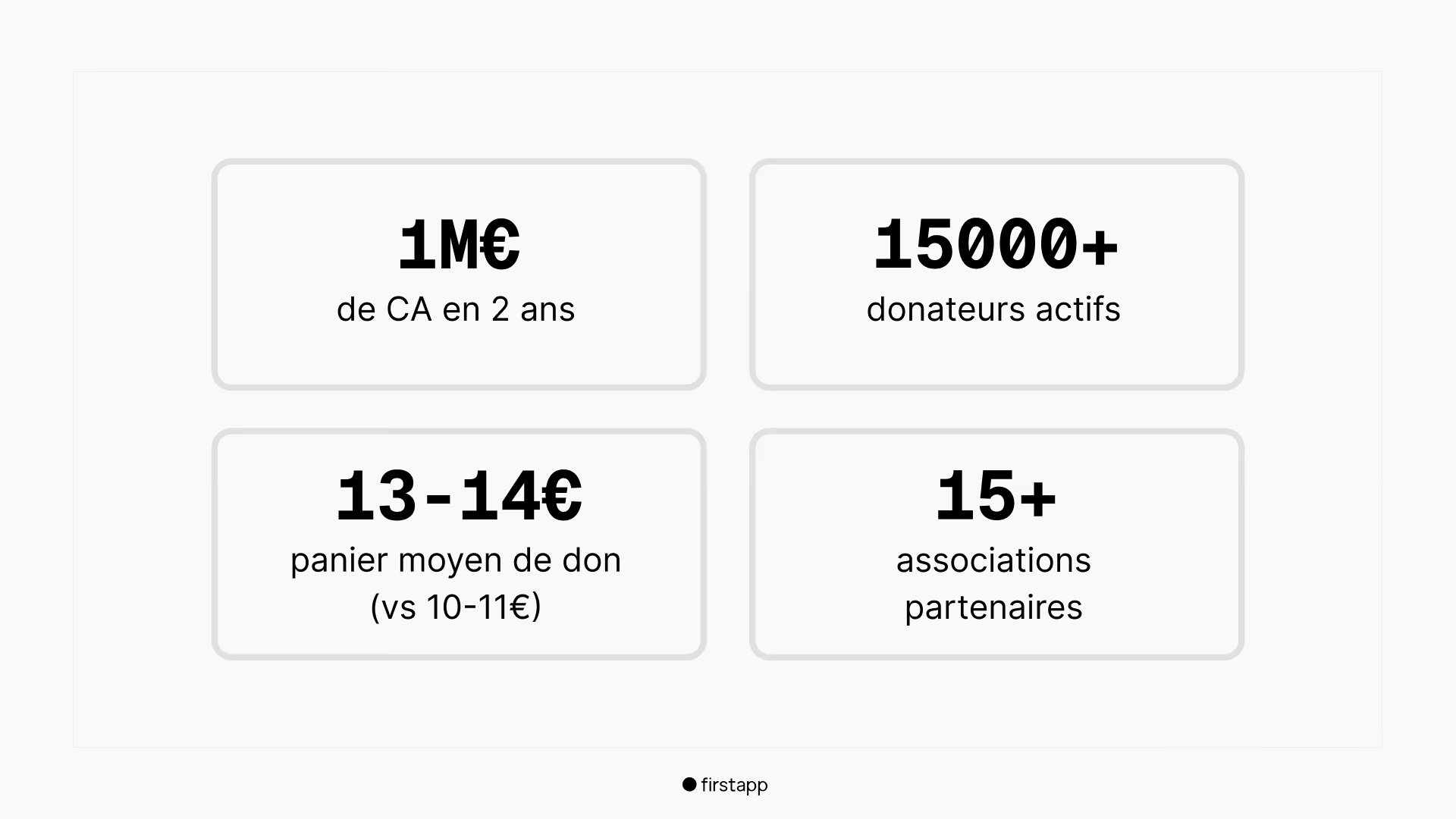
Jam Solidaire is €1M in revenue in 2 years, 15,000 active donors, and an average basket 30% above the market average. It is also our first client, and the story of a non-technical founder who sold everything before he had an app.

Article summary
- Jam Solidaire reaches €1M in revenue in 2 years, with 15,000 active donors.
- At the first launch, David had already signed about ten charities, with no product demo.
- The prototype that centralized payments was refused. The version that shipped lets each charity keep its own system.
- The market average online donation is €10 to €11. Jam Solidaire is at €13-14, which is 30% more.
- David carried sales and firstapp carried the technical side, with field feedback applied to the product immediately.
Summarize this article with
firstapp has worked with Jam Solidaire from day one, even before the company was created. Three prototypes, radical pivots, nights spent tearing everything down and rebuilding it in a few days, and at the end of the road: €1M in revenue, 15,000 active donors, and an average donation basket 30% above the market average. Here is the full story.
Jam Solidaire's path
Newsletter
Once a week.
Last issue
We opened 10 apps to see how they sell a subscription.
+534 people read us each week
David, a donor recruiter who wants to digitize his market
David is not a tech entrepreneur. He does not know how to code, he has never started a startup, and he knows nothing about mobile development. What he does know is charitable giving, because he spent years making it his trade.
Before Jam Solidaire, David worked as a donor recruiter for charities. His daily work: going out to meet people, understanding their values, and convincing them to support causes that matter to them. A field job, built on conviction and human relationships.
That is where the idea for Jam Solidaire was born, not in an incubator, not after a market study, but in direct contact with the problem. Every day David saw how fragmented, outdated, and inefficient fundraising was for charities that could not afford the tools. He had a vision of digitizing that market. And he came to us with that vision, with no company created, no prototype, no set budget. Just a conviction and a knowledge of the market you do not find in books.
This is the founder profile we prefer at firstapp: someone who knows their market better than any developer, who has a strong conviction about the problem to solve, and who is looking for a technical partner to make it real. Not someone looking for a vendor to execute a specification.
The principle that changed everything: sell before you build
David's first strategic decision was not to wait for an app before going into the field. While firstapp worked on the first prototypes, David went knocking on charities' doors.
Not to show them an app. To understand their problems, qualify their interest, and get concrete commitments. He used exactly the same skills that made him a good donor recruiter: listening, conviction, and the ability to build trust quickly.
"Most founders wait until they have a perfect product before they go out and sell it. David did the opposite. He was selling while we were coding. At launch, the market already existed." - Clément Parot
By the first launch, David had already signed about ten partner charities. He had not needed to convince them with a product demo. He had convinced them with his vision and his knowledge of the sector. The app came to confirm what he had already sold, not the other way around.
That is the most important lesson in the Jam Solidaire story: the product is not the starting point. Distribution is.
The 3 prototypes: learning by tearing everything down
Jam Solidaire did not ship on the first try. Far from it. There were three prototypes before the version that runs today, and each one taught something fundamental.
Proto 1 - "Does the concept interest anyone?"
The first prototype was deliberately simple, fast, and visually basic. The goal was not to have something beautiful. It was to test whether the Jam Solidaire approach sparked interest. No crafted onboarding, no optimized paywall, no technical performance on the day. Just enough to show the main mechanic and watch the reactions. The verdict: yes, the concept interests people. We could go further.
Proto 2 - The payment-system wall
The second prototype tried to industrialize fundraising by handling payments in-house, a centralized system that would have let every charity go through the same infrastructure. On paper, it was logical. In the field, it was a disaster. Every charity wanted to use its own payment system. Some had contracts with specific vendors, others had legal obligations, others still had internal processes that could not be bypassed. The resistance was total.
Proto 3 - The pivot that changed everything
We tore everything down and rebuilt it in a few days. The new approach: let each charity choose its own payment system, and integrate those systems case by case into the platform. It is not the most scalable solution on paper, but it is the one the market accepted. And because the partner charities are clients of significant size, custom work is economically viable. This is the prototype that gave birth to the current version of Jam Solidaire.
The ability to tear everything down and rebuild it in a few days is not a sign of disorganization. It is a skill. Most teams spend weeks debating a pivot. At firstapp, we were convinced that a fast failed test is worth more than a slow certainty. Jam Solidaire is the proof.
The decisive pivot: adapt to the market rather than forcing the market to adapt
The payments pivot is worth stopping on, because it illustrates a truth many founders refuse to hear: sometimes the market is right and your product hypothesis is wrong.
The initial hypothesis was reasonable: centralize payments to simplify the user experience and build a scalable infrastructure. That is what any good product manager would have done. The problem is that charities do not work like startups. They have legal constraints, partnership histories, and internal processes frozen for years. Asking them to change their payment system to join a new platform was asking them to take a risk they were not ready to take.
The solution was counterintuitive: instead of simplifying for everyone, we accepted making things more complex in order to adapt to each one. Custom integration for each charity, case by case, system by system. Tedious work on the surface, but it unlocked adoption all at once.
This is the lesson few founders actually apply: your product has to adapt to the market, not the other way around. Especially when your clients are institutions with their own constraints. Flexibility is not a weakness. It is what lets you enter the market.
The split of roles that made the difference
What made the development of Jam Solidaire particularly effective was a split of roles of absolute clarity: David handled sales, firstapp handled the technical side. No overlap, no confusion, no endless meetings about decisions that did not need to be made together.
David knows his market. He knows how to talk to charities, understand their needs, and build relationships of trust in a sector where trust is everything. Asking him to get involved in technical decisions would have been a waste of time for everyone.
firstapp knows mobile development, onboarding, and monetization. Getting involved in David's commercial strategy would have been presumptuous and counterproductive.
"The best partnership we have had with a client is when each person does what they know how to do, and trusts the other for the rest." - Clément Parot
In practice: while David went out to sign charities in the field, firstapp iterated on the product. David's feedback after his field visits fed development decisions directly. No delays, no filters, no prioritization meetings, a direct feedback loop between sales and engineering.
That mechanic is what made the three fast pivots possible. When David came back from the field with critical information, "the charities do not want to change their payment system," we could act immediately. Not the following week. Not after a validation meeting. Immediately.
Jam Solidaire's results, and what comes next
Two years after the launch of the final version, the results speak for themselves:
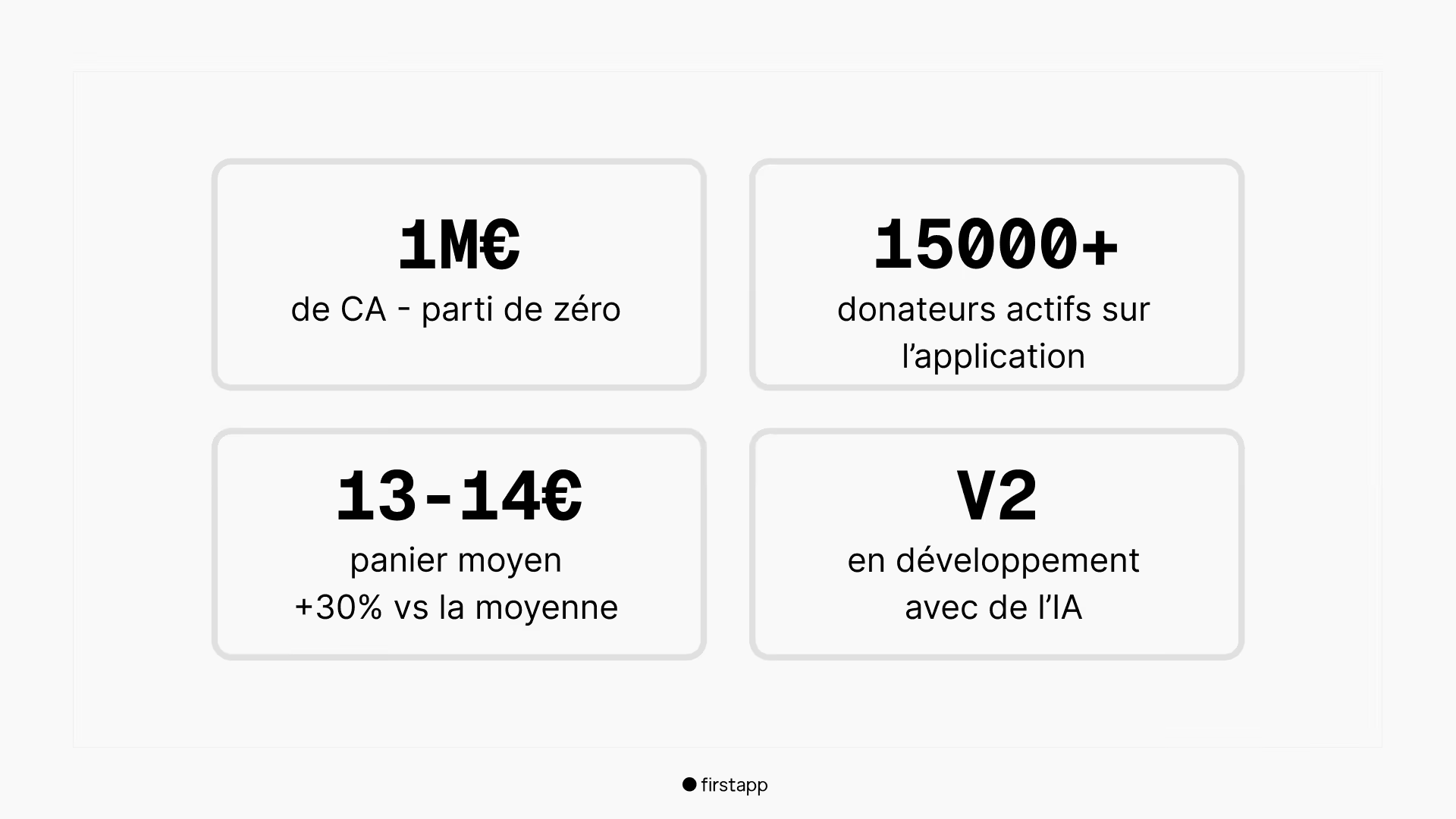
The average basket is perhaps the most revealing figure. The market average for online donations sits around €10 to €11. Jam Solidaire is at €13-14, which is 30% above. That is not an accident. It is the result of a user experience that builds trust, a donation flow that is smooth and well thought through, and a presentation of the charities that makes people want to give more.
Today, firstapp is still alongside Jam Solidaire, in maintenance and continuous optimization mode, to make sure everything works perfectly as the platform grows. And we are already preparing the next step: a v2 with integrated artificial intelligence, to go further on donation personalization and donor engagement.
Lessons from Jam Solidaire
Lesson 1: Sell before you build, not after
David did not have an app when he signed his first partners. He had a vision and knowledge of the market. The product came to confirm what was already sold. That is the order it should always happen in.
Lesson 2: Ugly prototypes are a feature, not a bug
Jam Solidaire's first two prototypes were visually basic. That was intentional. The goal was not to convince. It was to learn. An ugly prototype that teaches you something fundamental in 2 weeks is worth infinitely more than a perfect app that takes 6 months.
Lesson 3: Adapt to the market rather than forcing the market to adapt
The payments pivot was counterintuitive, more complex technically, less scalable on the surface. But it is what the market accepted. Flexibility in the face of your clients' constraints is not a weakness. It is what lets you get in and stay.
Lesson 4: Clarity of roles multiplies execution speed
David on sales, firstapp on the technical side. No overlap, no useless meetings. Each person in their area of expertise, with a direct feedback loop between the two. That is what made three fast pivots possible where others would have spent months thinking.
Lesson 5: The right technical provider is a partner, not an order-taker
firstapp did not execute a specification. We co-built a product, made decisions together, and took on radical pivots when the market asked for them. The difference between an agency that ships code and a partner who thinks product with you is exactly what this collaboration illustrates.
If the Jam Solidaire story speaks to you, we have written in detail about the principles behind its success: how to validate your idea before spending a single euro on development, how to generate your first revenue in the launch month, and our complete guide on building a mobile app for a startup, from idea to launch.
Jam Solidaire is our first and oldest client. This collaboration sums up what we do at firstapp: not just mobile development, but a partnership that thinks product, distribution, and growth together, from the first prototype to a million euros in revenue.
FAQ
How much has Jam Solidaire generated?
€1M in revenue in two years, 15,000 active donors, and an average donation basket 30% above the market average. firstapp worked with David even before the company was created.
Did David know how to code?
No. He was a donor recruiter for charities. He arrived with no company, no prototype, and no set budget, with knowledge of the field. David kept sales. firstapp kept the product.
Why three prototypes?
The first checked interest, with no crafted onboarding or paywall. The second failed: centralized payment ran into each charity's contracts and constraints. The third let each charity keep its own system, integrated case by case. That is the version that runs.
Should you wait for the product before you sell?
David did the opposite. He went to see charities while the app was being built. At the first launch, about ten charities were already signed. The app confirmed what was already sold.
Also read
How do you build an app for a nonprofit?
France has 1.3 million nonprofits, and 71% of them face digital obstacles. Jam Solidaire generated €1 million in revenue in two years, with an average donation 27% above the national average.

How do you validate a mobile app idea before building it?
42% of startups fail because they built something nobody wanted. Validation happens through concrete commitments, before the first line of code.