How do you validate a mobile app idea before building it?
42% of startups fail because they built something nobody wanted. Validation happens through concrete commitments, before the first line of code.


Article summary
- 42% of startups fail because they built a product nobody wanted. Building then costs between €11,000 and €50,000.
- The useful question is not "would you use the app". It is "would you pay".
- A landing page above 20% sign-ups on cold traffic is a strong signal. Under 5%, the message or the idea needs another look.
- Ten concrete commitments are worth more than 1,000 "that's a good idea". Jam Solidaire signed about ten associations before any code.
- Competitors' 1-star and 2-star reviews say what users are looking for and not finding.
Summarize this article with
42% of startups fail because they built something nobody wanted. Not because the idea was bad, because nobody tested it before spending. firstapp explains how not to be part of that statistic.
To validate a mobile app idea, here are the 5 elements to take into account
1. Study the existing market: analyze your competitors and their App Store reviews to identify opportunities.
2. Know your audience: go talk directly to the people who have the problem you want to solve.
3. Test your idea with your target audience: a pre-launch landing page, direct conversations, selling before you build.
4. Estimate development costs: understand your investment before you start so you can calibrate your validation.
5. Think about monetization: if nobody wants to pay to solve this problem, the idea is not validated yet.
Newsletter
Once a week.
Last issue
We opened 10 apps to see how they sell a subscription.
+534 people read us each week
There is no bad idea, there are bad executors
This is the first myth to tear down. Founders spend months wondering whether their idea is good, original, unique. They look for validation in their circle. They compare it with what already exists. They hesitate.
That is a waste of time. The quality of an app idea is not measured in a living room or a LinkedIn thread. It is measured in the field, in front of real potential users, with direct questions and a method.
"There is no good or bad idea. There are founders who validate and founders who assume. The first build products people want to buy. The second build perfect products nobody is waiting for." - What we tell every new client at firstapp
Uber, Airbnb, Dropbox: these apps had nothing extraordinary on paper. Stay with strangers? Share your car with people you do not know? Ideas that seemed risky. What made them win was not the brilliance of the idea. It was execution, speed, method, and the ability to test and learn fast.
Your app idea does not need to be revolutionary. It needs to be validated. And validated fast.
Why validation changes everything
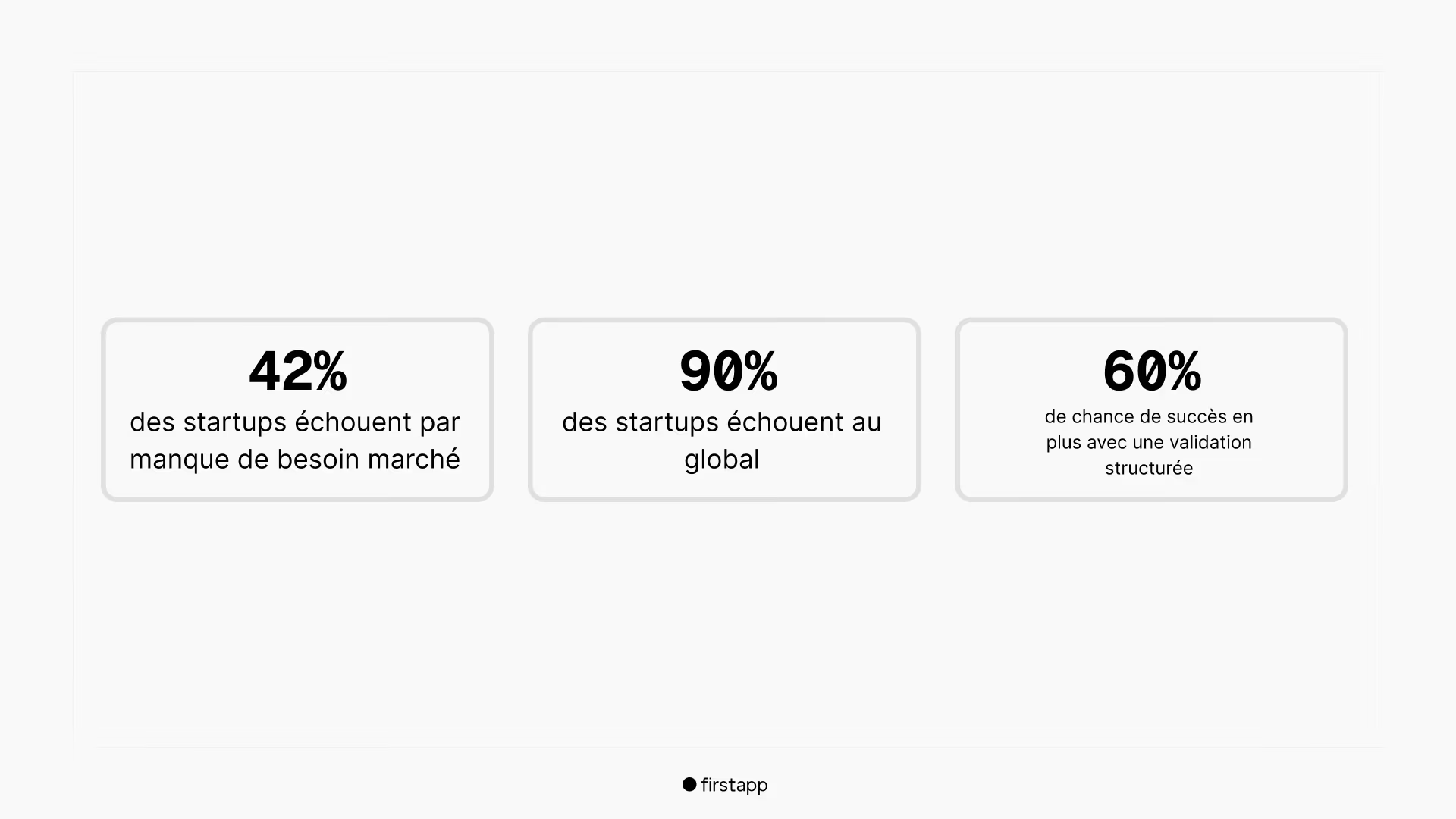
These numbers are not here to discourage you. They are here to give you actionable information: the main reason an app fails is building something nobody wants. And that cause of failure is entirely avoidable, if you ask the right questions before you start coding.
Building an app costs between €11,000 and €50,000 depending on complexity. That is the budget you will spend before you even have a single paying user. Validation is the insurance that this investment goes in the right direction, and it costs infinitely less.
The classic trap: spending 6 months building the perfect app, launching it, and discovering that users do not understand the value or are not ready to pay. At that point the budget is gone and morale is at its lowest. Validating upstream avoids exactly that scenario.
Source: CB Insight - The top 9 reasons startups fail
The 5 concrete validation methods
Here are the methods that actually work. No theory, precise actions you can launch this week.
1. Go see people directly, the most powerful method
Before any other tool, before any landing page, before you even have a mockup: go talk to the people who have the problem you want to solve. Not your friends. Not your family. Real potential users.
Real case of the Jam Solidaire app - David, the founder of Jam Solidaire, did not start by coding. He went and knocked on the doors of associations, one by one, in person. He explained his idea, asked whether it answered a real problem, and got their first commitments before he had a single line of code. Result: at launch, he already had about ten partner associations and validated demand. The market had said yes before the product existed.
How to run these conversations
1. Identify 20 people who match your target exactly: not people close to you, strangers who have the problem.
2. Ask the right questions: "How do you solve this problem today?" and "What does it cost you not to have a solution?" not "Would you use my app?"
3. Look for strong signals: if the person asks when the app will be available, gives you their email spontaneously, or offers to pay, it is validated.
4. Distrust weak signals: "that's a good idea", "I think it could work" are worth nothing. What you are looking for is concrete commitment, not politeness.
Never ask "would you use my app?" People say yes out of politeness. Ask instead: "would you pay €X/month for this?" The answer to that question is the only one that counts.
2. The pre-launch landing page: test intent with real traffic
A simple web page that describes the problem you solve, presents your solution in a few lines, and collects emails from interested people. No need for app mockups. No need for screenshots. Just a promise and a form.
✓ Build the page in 1 day with Carrd, Webflow, or Framer. A sharp title, a clear promise, an email capture form.
✓ Send targeted traffic to it: €50-100 of Facebook or TikTok ads on your target. If you already have an audience, just post the link.
✓ Measure the sign-up rate. A rate above 20% on cold traffic = a strong signal. Below 5% = revisit the message or the idea.
Dropbox validated its idea with a simple 3-minute video before writing a line of code. Result: 75,000 sign-ups in one night. You do not need a product to validate demand.
3. Sell before you build, the ultimate test
This is the most demanding method, and the most reliable. Offer the app for sale - early-bird access, a pre-launch price, a client commitment - before you have even started building. If people pull out a card for something that does not exist yet, you have your answer.
That is exactly what David did with Jam Solidaire: he "sold" his solution to associations before he had the app. They did not pay in euros, but they gave their commitment, their name, and their trust. Those are proofs as solid as a payment for validating demand.
1. Create a pre-launch offer: free beta access in exchange for a commitment to use it, or a reduced price for the first 50 sign-ups.
2. Go offer it directly to your target, in person, by email, on LinkedIn. Not through an ad.
3. Count the commitments. 10 concrete commitments are worth more than 1,000 "that's a good idea".
Once it is validated, the next step: How to generate your first revenue in the launch month
4. Analyze what already exists: the competition is your best source of information
If similar apps exist and have users, that is proof the problem is real and that people are ready to pay to solve it. Competition is not an obstacle. It is free market validation.
✓ Read your competitors' App Store reviews. 1-star and 2-star reviews are a gold mine: they tell you exactly what users want and are not finding. Those are your differentiation opportunities.
✓ Look at downloads and estimated revenue. Tools such as AppTweak or Sensor Tower give traction estimates per app.
✓ Identify the gaps. What do existing apps not do well? That is where you have a chance to differentiate.
A niche with no competition is not necessarily an opportunity. Sometimes it is a signal that the market is too small, or that nobody has managed to monetize it. Be wary of "virgin markets".
5. The TestFlight beta: validate usage before the public launch
Before you submit the app to the App Store, distribute a beta to 20 to 50 people via TestFlight. Not to collect compliments, to observe real behavior. Where do they stop? What do they not use? What makes them come back?
1. Recruit beta testers in your target, not your friends: real potential users. Reddit communities, LinkedIn, niche Facebook groups.
2. Install an analytics tool from the beta. Mixpanel or Amplitude show you exactly where users drop off. Every friction point is an improvement opportunity before launch.
3. Do post-beta interviews. 5 calls of 20 minutes with beta testers will teach you more than 500 anonymous installs.
Before you submit, check that everything is in order: App Store checklist: avoid rejection and pass review on the first try
6. What you absolutely should not do
Ask people close to you. Your family and friends say yes out of affection or politeness. Their validation is worth nothing. Look for strangers who have the problem.
Run an online survey. "Would you use an app that does X?" The answer is always yes. Stated intentions do not predict real behavior. Only concrete commitments count.
Hunt for an original idea at all costs. Originality is not a success criterion. Execution is. A fitness app in a saturated market with a better experience beats a poorly executed "revolutionary" idea every time.
Validate with a single source. 10 conversations in a single group do not represent a market. Look for confirmation across several channels, several profiles, several contexts.
Confuse validation with polishing. Validation answers one question: is this problem real, and would people pay to solve it? This is not the moment to refine the app. It is the moment to confirm it is worth building.
Real case: from zero to €1M in revenue in 2 years
Jam Solidaire is an online donations app for associations. David, its founder, could have spent months building the perfect app before showing it to the world. He did the opposite.
Before writing a line of code, he went and knocked on the doors of associations one by one. He presented his idea, asked whether it answered a real need, and got their first commitments. Result: at launch, he already had about ten partner associations, solid social proof, and demand validated in the field.
Two years later: €1 million in revenue, more than 15,000 active donors, and growth built on solid foundations, not on assumptions. David did not have a better idea than the others. He had a better method.
The lesson: David did not invent online giving. He validated that associations had a real problem, that donors were ready to use a new solution, and that the market existed, before spending a single euro on development. That is what being a good executor means.
firstapp's role after validation
Validation is your job. Nobody can go talk to your future users in your place. You are the one who knows the problem, the market, and the people to target.
Once validation is done, once you have confirmation that the idea holds and that people are ready to pay, that is where we step in. firstapp handles everything that comes after validation: development, onboarding, the paywall, ASO, the review strategy. So you can focus on distribution and communication from day one.
What we see with founders who succeed is a clear split of roles: they validated the market and keep managing their audience. We build and optimize the product. The two workstreams move in parallel. And launch arrives with a product that is ready and demand that is already there.
To go further on onboarding and monetization, we wrote 2 articles:how to optimize mobile onboarding to reach 20% conversion and how to monetize your app: freemium, subscription, or one-time purchase?
Frequently asked questions about validating a mobile app idea
The questions we get most often, even before starting:
How can I patent my app idea?
In France and in Europe, it is not possible to patent an app idea as such. Ideas are not patentable. What can be protected is the source code (automatically protected by copyright from the moment it is created), an innovative technical process (through a patent if the inventiveness criterion is met), or a trademark (the app's name and logo via the INPI). In practice, the best protection for a mobile app is fast execution and distribution: move faster than potential copycats, build a user base, and create a competitive advantage that is hard to reproduce.
What budget does it take to create a mobile app?
The budget to create a mobile app varies with complexity and the provider. At a specialized French agency, count between €8,000 and €25,000 for a simple MVP, between €25,000 and €60,000 for an app with a subscription and a paywall, and between €60,000 and €150,000+ for a complex project. At firstapp, creation is on request. On top of that development budget, add recurring costs: third-party tools (€100 to €200/month), and user acquisition.
How do you make sure nobody steals your app idea?
The fear of idea theft is very common and very overestimated. In practice, ideas alone are worth nothing without the execution that goes with them. What really protects an app is speed of execution, product quality, and the user base you build. For practical precautions: sign NDAs with your technical providers, protect your trademark via the INPI, and deposit your source code with the APP (Agence pour la Protection des Programmes). But the best protection is still to build and launch fast. A competitor who copies your idea 6 months after your launch will always be behind on your experience, your user data, and your installed base.
Also read
Building a mobile app MVP: method and budget
The word MVP covers both two screens and an €80,000 app. A V0 is the first version that monetizes: core value, onboarding, and paywall.
How do you find your first 100 app users?
More than 14,700 subscription apps launch every week. The ones that last recruit their first 100 users one by one, and only open acquisition once retention is proven.
How can I validate my app idea?
To validate an app idea, follow 5 concrete steps: analyze the existing market and competitors' negative reviews, go talk directly to 20 people who have the problem you want to solve, create a pre-launch landing page to measure real interest, estimate development costs to calibrate the market proof you need, and test monetization by asking directly whether people would pay for your solution. Solid validation rests on concrete commitments - emails, pre-sign-ups, agreements in principle - not on surveys or "that's a good idea".