Mobile app monetization: the 5 models that work in 2026
A hard paywall converts at 10.7% download-to-paid at D35, a freemium at 2.1%. Founders who set the model before they code convert on average 2 to 3 times better.


Article summary
- The hard paywall converts at 10.7% median at D35, versus 2.1% for freemium, with an RPI at D14 of $2.32 versus $0.27.
- Trials of 17 days or more convert at 42.5%, versus 25.5% for trials of 4 days or less.
- 55% of cancellations of a 3-day trial happen on day 0, before any use.
- Choosing the model in the design phase makes conversion on average 2 to 3 times better than adding it after launch.
- In productivity, the monthly subscription weighs 77% of revenue. In health & fitness, the annual plan weighs 68%.
Summarize this article with
The choice of model is made before you code
$167 billion. That is the total revenue generated by mobile applications in 2025 (Sensor Tower 2026). But downloads grew by only 0.8% over the same period. The conclusion is unambiguous: the market has entered an era of monetization, not acquisition. Whoever converts better wins: not whoever gets more downloads.
firstapp sees it on every project: founders who choose their monetization model in the design phase convert on average 2 to 3 times better than those who add it "after." This guide gives you the real data to make that choice correctly.
To go further on the metrics to track once the model is in place, our article on first revenue at launch covers the concrete steps.
Newsletter
Once a week.
Last issue
We opened 10 apps to see how they sell a subscription.
+534 people read us each week
Hard paywall: the model that converts best
A hard paywall blocks access to the main features behind a subscription or a trial. No free version, no partial access. The user chooses from the start.
The figures
According to the RevenueCat SOSA 2026 report: 115,000 applications, 1 billion transactions: the download-to-paid conversion rate at D35 for a hard paywall is 10.7% median, versus 2.1% for freemium. The top quartile reaches 20%. The P90 exceeds 38%.
In Revenue Per Install (RPI), the gap is even sharper: $2.32 at D14 for a hard paywall, versus $0.27 for a freemium app. That is 8 to 9 times more revenue per install.
💡 What that means in practice: for the same acquisition budget, a hard paywall generates between 5 and 9 times more revenue from D14. That is not trivial when you have a CAC to optimize.
The right use of the trial in a hard paywall
The trial is the most underestimated variable. Trials of 17 days or more convert at 42.5% median, versus 25.5% for short trials of 4 days or less (RevenueCat SOSA 2026). Yet the majority of apps use trials of 3 to 7 days.
55% of cancellations of a 3-day trial happen on day 0: before the user has used anything. A 3-day trial is not a trial. It is a cancel button with a delay.
When to use the hard paywall
The hard paywall suits apps with clear, immediate value (fitness, productivity, education), targeting an audience ready to pay. In North America, median conversion is 2.6% versus 1.4% in India and SEA. The indispensable condition: a strong onboarding that justifies the ask for payment from the first session.
Freemium: when it works and when it does not
Freemium gives access to a limited version for free. Premium features sit behind a contextual paywall, triggered by usage.
The figures
Median freemium conversion is 2.1% at D35: but 23% of conversions arrive after 6 weeks. Freemium plays a long game. 1-year retention is almost identical between hard paywall and freemium (~27-28%), which means subscriber quality is comparable: but you have 5 times fewer of them.
Freemium works when the volume of free users creates value in itself (network, generated content, data) or when the app needs time to demonstrate its value.
When freemium is a bad idea
Freemium is a bad idea when you choose it because it "seems more accessible": accessible does not mean profitable. It is also a bad idea when you do not have enough volume for the 2% conversion to represent viable revenue, or when the free version is so generous that users have no reason to go premium.
⚠️ Warning: a badly calibrated freemium is the worst situation. You carry the cost of thousands of free users with no revenue to absorb them. If your freemium LTV is not at least 3x your CAC, the model is not viable.
In-app purchases: the right use
In-app purchases (IAP) are one-off transactions inside an application. Content, features, credits, lives: each purchase is independent.
When IAPs work
IAPs dominate in gaming (82% of gaming revenue in weekly IAP according to RevenueCat SOSA 2026) and in creative apps where the user buys assets or features as needed. In those contexts, the IAP captures value at the exact moment the user feels the need.
Why IAPs alone are risky for a solo founder
IAP revenue is unpredictable. A good month, an empty month. Subscriptions generate MRR (monthly recurring revenue), predictable and valuable. For a startup that is raising or looking to sell, a pure IAP model is structurally less attractive than a subscription model.
For B2C apps targeting retention and LTV, our guide on the choice between freemium, subscription, and one-time purchase details the use cases and the decision criteria.
In-app advertising: the conditions for profitability
Advertising generates revenue on each impression or click. It asks for no commitment from the user: that is its only advantage.
Why it is often the wrong choice for a B2C app
To be profitable, an ad app needs volume. With an average eCPM of €2 to €8 per 1,000 impressions in France, an app at 10,000 DAU that shows 3 ads per session generates about €600 to €2,400 per month. To reach 10K DAU, you have already invested tens of thousands of euros in acquisition.
Ads are relevant for content apps (news, weather, casual games) with a massive audience. They are counterproductive for apps that want to create a premium experience and maximize LTV per user.
Hybrid model: combining without getting lost
A hybrid model combines several revenue sources. The classic example: freemium + premium subscription + occasional IAP.
When hybrid is a good idea
When you have several user segments with different buying behaviors. A casual user who will never pay for a subscription can still buy a sticker pack at €2.99. A heavy user will take the annual subscription. Hybrid captures both.
When hybrid becomes a trap
When you try to do everything at once because you have not decided on your model. A poorly defined paywall + intrusive ads + random IAPs = a degraded experience and fragmented revenue. The rule: one primary model, one or two secondary sources at most.
How to choose according to your category
RevenueCat data shows that models do not perform the same way depending on the category.
| Category | Dominant model | Median annual retention | Key signal |
|---|---|---|---|
| Productivity | Monthly subscription (77% of revenue) | 85.6% | Best retention of every category |
| Health & Fitness | Annual subscription (68% of revenue) | ~30% | The annual plan maximizes LTV on this segment |
| Business | Hard paywall + trial | ~35% | Median download-to-trial at 9.1%, the highest |
| Travel | Hard paywall + trial | ~39% | Trial-to-paid at 43.5%, best category |
| Social & Lifestyle | Freemium + IAP | ~25% | Weaker retention, volume required |
| Gaming | IAP + weekly (82% of revenue in weekly) | Variable | A model apart, a different logic |
💡 Presenting the annual plan as "per month" increases trial starts by 30% and the annual take rate by 10% (RevenueCat SOSA 2026). It is not manipulation. It is clarity. "€2.08/month" is more readable than "€24.99/year" for a user who is comparing.
To go further on the structure of a paywall that converts, our complete paywall guide covers presentation and pricing mechanics in detail.
Monetization figures in 2026
Before choosing a model, you have to understand the market you are in. And the 2026 data is unambiguous on one thing: the subscription has won.
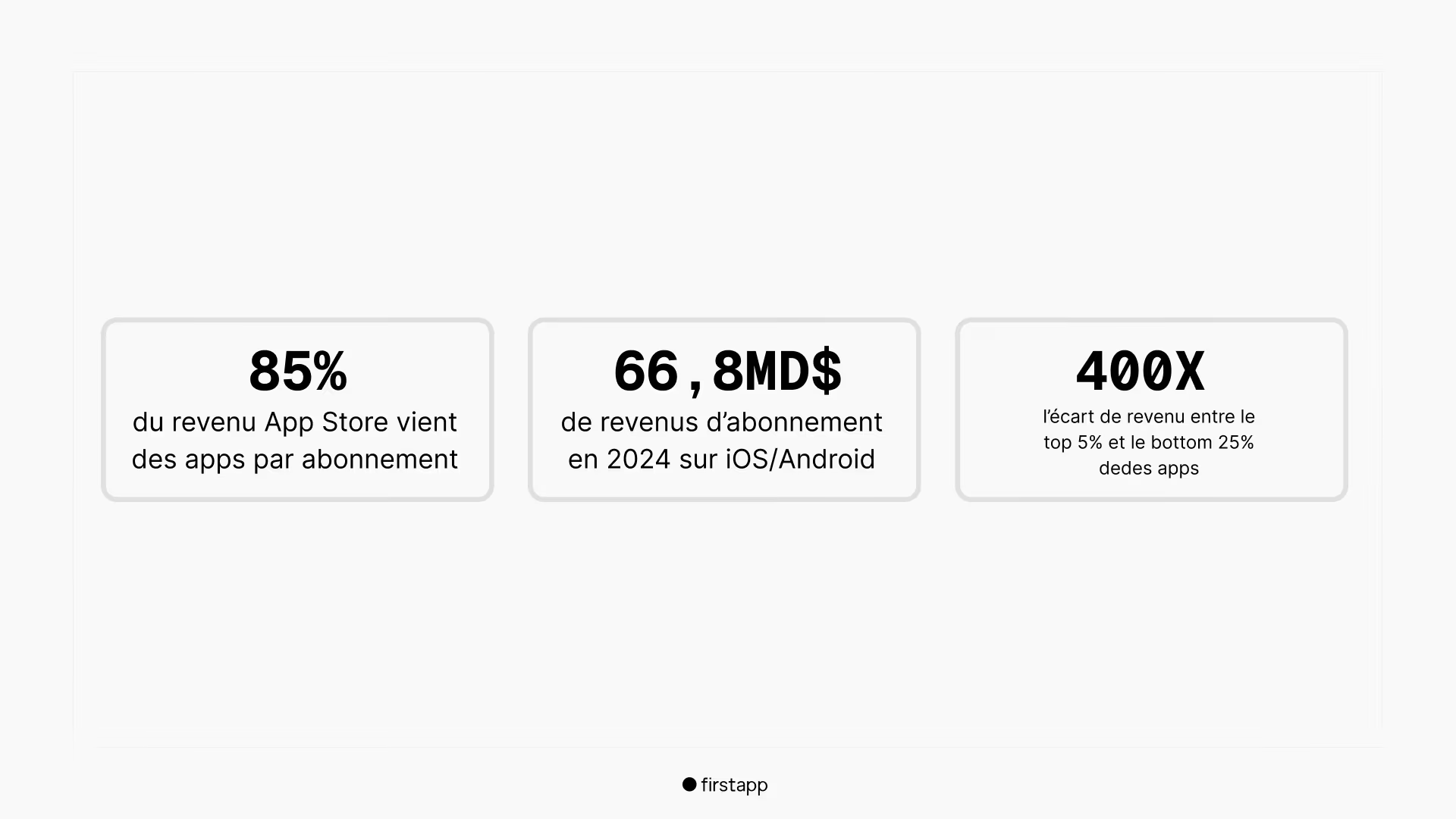
But these figures hide a more nuanced reality: the dominant model is not necessarily the right one for your app. The subscription is the most profitable model on average, but freemium remains unbeatable for certain specific cases, and the one-time purchase has not said its last word in specific niches.
The real question is not "which model is the best?" but "which model fits my product, my market, and my stage of growth?"
The one-time purchase, simple but limited
The one-time purchase is the simplest model: the user pays once, and owns the app for life. No churn, no retention to manage, no ongoing value to deliver.
One-time purchase
Simple, but revenue is capped and acquisition is hard
The most transparent model for the user. No surprise, no recurring billing. But for the developer, it is the most fragile model: every month starts from zero, and it is impossible to finance growth on predictable revenue.
Strengths
- Minimal purchase friction for the user
- No churn to manage
- A transparent model that people appreciate
- Ideal for "buy once, use forever" tools
Weaknesses
- Revenue capped, no recurrence
- Impossible to finance major updates
- Every month starts from zero
- Unsuited to apps with ongoing server costs
The one-time purchase works well on very specific tool apps, with a clear value proposition and non-recurring use. Facetime, professional photo-retouching apps, games without a live service, products where the value is entirely in the download.
Subscription benchmarks by category
Health & Fitness: median LTV: $16.44 · RPI D60: $0.63
Business: median LTV: $14.82 · P90: $52.41
Education: median RPI D60: $0.27 · long trials (5-9 days)
Gaming: median RPI D60: $0.08 · very short trials (≤4 days)
Definitions:
LTV (Lifetime Value): total revenue generated by a subscriber over the entire length of their subscription. A median LTV of $16.44 means that half of Health & Fitness subscribers bring in more than $16.44, and the other half less.
RPI D60 (Revenue Per Install at D60): average revenue generated per install 60 days after download. An RPI D60 of $0.63 means each download brings in $0.63 on average over the first two months.
P90: the 90th percentile. A P90 of $52.41 in Business means the top 10% of Business apps generate more than $52.41 of LTV per subscriber. It is the indicator of the category's high-end potential.
Timing is everything. 55% of trial cancellations happen the same day, on D0. The user who does not see the value immediately in their first session will not come back to look for it. Onboarding and the paywall are inseparable.
Choosing a monetization model
There is no universal right answer. But there are questions that steer the choice reliably:
Question 1
Does your app deliver value continuously or occasionally?
If the value is continuous (regular content, evolving features, cloud sync) → the subscription is justified and expected. If the value is entirely in the download → the one-time purchase is more honest and converts better.
Question 2
Does your app need network effects or virality to work?
If yes → freemium is often indispensable. More users = more value for each user. Paying to enter an empty network makes no sense.
Question 3
Do you have recurring server or infrastructure costs per user?
If yes → pure freemium is dangerous. Every free user costs money. The subscription or the hybrid becomes an economic necessity, not a choice.
Question 4
What stage are you at?
Early stage with few users → freemium helps acquire a critical mass. A mature product with traction → the hard paywall or the hybrid maximizes profitability. The monetization strategy can evolve with growth.
Question 5
Is your value immediately perceptible, or does it need time?
Immediate value → a hard paywall is possible. The user understands from the first session why they should pay. Value that reveals itself over time → a long free trial or freemium. The user has to live in the app before paying.
The rule for AI apps in 2026: if your app has inference costs (API calls, generation), the pure freemium model is economically non-viable. RevenueCat recommends 75% of revenue in predictable subscription + 25% usage-based for AI apps.
Monetization models seen with clients
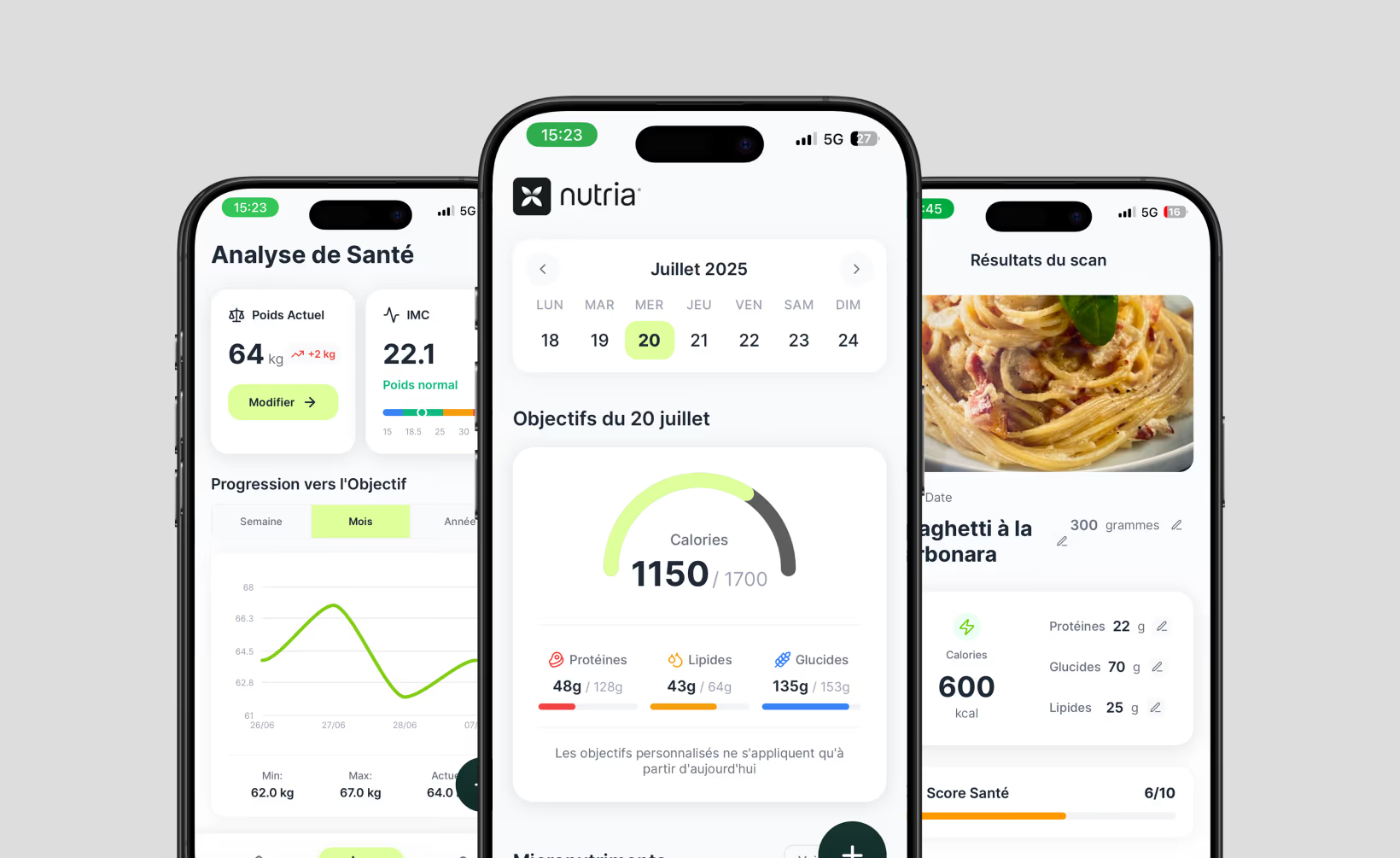
Calyra (ex-Nutria) is a nutrition app with a hard paywall. It is impossible to access the app without paying. For that to work, the onboarding is long and carefully built: it gradually brings the user to understand their nutritional situation, identify their goals, and perceive the product's value before they reach the paywall. The user does not pay to "try." They pay because they are already convinced.
Result: a churn rate of 2%, among the best benchmarks in the sector, and €30,000 in revenue from the first month.
What we observe consistently on the apps we work with:
1. The default model is expensive. Many founders choose freemium "because that is what the other apps do." Without volume, that is a choice that caps revenue from the start.
2. A well calibrated free trial changes everything. A 7-day trial on an app whose value shows up in 2 minutes is often enough. A 3-day trial on a habit app is not. The length has to match the time needed to reach the aha moment.
3. The hard paywall is not the enemy. Calyra (ex-Nutria) proves it: when the onboarding does its job, the user arrives at the paywall convinced. Conversion follows naturally, and churn stays low because subscribers have a real intention to use the product.
The right monetization model is not the most popular one. It is the one that fits your product, your market, and your stage of growth. If you want us to audit your monetization strategy and rework your paywall, that is exactly what we do at firstapp.
FAQ
Which monetization model should you choose for a first mobile app?
For a first mobile application, the hard paywall with a trial is the most recommended model in 2026. It converts 5 times better than freemium in the short term, generates predictable MRR, and simplifies product decisions (you know what is paid, with no need to calibrate what is free). The exception: if your app needs a critical mass of users to create value (social network, marketplace), freemium is required for the first months.
Freemium or subscription: which do the best apps choose?
The best apps choose according to their category, not by default. Productivity and fitness apps dominate with the subscription. Social and gaming apps use freemium or IAPs. The RevenueCat 2026 data is clear: the most effective mobile app monetization is the one that matches your category's real usage behavior: not the one that "seems more accessible."
Can you change model after launch?
Yes, but it is costly. Moving from freemium to a hard paywall after launch means managing existing users, reworking the onboarding, and accepting a temporary drop in installs. It is doable. Several apps have done it successfully: but it is much simpler to choose the right model from the start. Our guide on app idea validation includes a section on validating the business model before you code.
Is in-app advertising compatible with a premium subscription?
Barely. Showing advertising to users who pay for a subscription degrades the experience and generates churn. The coherent model is: advertising for free users, an ad-free experience for subscribers. It is the model of Spotify or YouTube Premium. If your app cannot offer a premium ad-free experience, advertising is not your model.
How do you monetize a free mobile application?
Monetizing a free mobile application mainly goes through four models. The subscription (freemium): the app is free to download but the main features are reserved for paying subscribers. It is the dominant model in 2026, with a median conversion rate of 2.1% according to RevenueCat. In-app purchases: the user buys features, content, or credits one by one. In-app advertising: revenue generated by showing ads to free users. And the hybrid model, a combination of subscription and in-app purchases. Our recommendation at firstapp: the subscription with a hard paywall from launch. The data shows it converts 5 times better than classic freemium.
What is freemium monetization?
Freemium monetization is a model where the application is available for free with basic features, and where advanced features are accessible through a paid subscription. The idea is to attract as many users as possible with the free version, then convert part of them into paying subscribers. In practice, the freemium conversion rate sits around 2.1% according to RevenueCat 2026 data, which means 97.9% of users never pay. It is the most widespread model, but not necessarily the most effective. The hard paywall, which asks for payment from the start after a free trial, converts on average 5 times better. Freemium is relevant only if your free users create real network value for the paying ones.
Also read
Hard paywall vs soft paywall: how to choose
According to RevenueCat, a hard paywall converts at about 10.7% from install, versus 2.1% for freemium. Adapty, which measures the paywall view, gives the advantage to the soft paywall.
Hybrid monetization: why this model is becoming the norm
95% of users of a subscription app do not become paying subscribers. Hybrid monetization adds advertising, credits, or affiliation, and only 10% of apps have already adopted it.
How do you know if your monetization model is well calibrated?
Three metrics to watch. One: your RPI (Revenue Per Install) at D14: it should exceed $1 for a hard paywall. Two: your LTV/CAC ratio: it should be above 3 to be viable. Three: your monthly churn rate: it should stay under 5% for a monthly model. If one of these three figures is outside the norms, your monetization model has a structural problem.