How do you build a women's health app?
87% of women's health apps share their users' data with third parties, and only 52% ask for explicit consent. The women's health app market is estimated at $5.2 billion in 2025.

Article summary
- 87% of women's health apps share personal data with third parties, and only 52% ask for explicit consent.
- The women's health app market is estimated at $5.2 billion in 2025, with annual growth of 17.6%.
- Flo passed $200 million in annual revenue in 2024, with 380 million downloads and 70 million monthly active users.
- Menopause and perimenopause are the most open niche: price tolerance there is much higher than among women aged 20–30.
- Building a cycle-tracking or fertility app is scoped on request.
Summarize this article with
87% of women's health apps share their users' personal data with third parties. Only 52% ask for explicit consent before collecting anything.
That single figure sums up why the market for women's health apps is one of the most promising in mobile in 2026, and one of the most poorly served. Millions of users entrust their cycle, fertility, pregnancy, and mental health data to apps, most of which monetize that data without transparency. The next app that will win trust by doing the opposite has not been built yet.
At firstapp, we work with founders on projects where user data is at the heart of the product. This guide explains what you need to know before you enter this vertical: the market, the rules, the real opportunities, and the traps to avoid at all costs.
1. The femtech market in 2026: the numbers that make your head spin
The global market for women's health apps is estimated at $5.2 billion in 2025, with annual growth of 17.6%, a market projected at $16.3 billion by 2032 (Persistence Market Research, 2025). By comparison, it is one of the fastest-growing segments of digital health, well ahead of general medicine or classic mental health.
The reason: this market was structurally underserved for decades. Women make up more than half of the world's population and make the health decisions in most households, but digital health tools were long designed by men, for men, or neutrally in the most generic sense of the word.
Info: The reproductive health segment (menstrual cycle, fertility, pregnancy, menopause) alone represents 43.9% of global femtech market revenue, more than $26 billion across the whole sector (Grand View Research, 2024). The cycle-tracking apps account for 39.2% of app market share.
This market is massive and it is growing fast. It is also dominated by a few established players, but those players have important flaws on trust and privacy that we detail further down. Those flaws are precisely what creates room for well-positioned new entrants.
For a complete view of the global mobile market this sector sits in, our guide on building a mobile app for a startup lays the essential foundations.
Newsletter
Once a week.
Last issue
We opened 10 apps to see how they sell a subscription.
+534 people read us each week
2. The 5 segments of a women's health app
Before you code the first line, one non-negotiable question: which precise problem are you solving, for which woman, at which moment of her life?
The femtech market covers five main families. Each answers a distinct need, with a different audience, different expectations, and different monetization models.
Cycle and reproductive health tracking
This is the most mature segment. Flo, Clue, Period Tracker, Natural Cycles: the competition is strong, and established players have years of data. But it is also the segment with the highest volume of users: hundreds of millions of women look for an app of this type every year. Clear differentiation (a clean interface, guaranteed privacy, a focus on a precise symptom such as PCOS or endometriosis) can be enough to find a place.
Fertility and the desire for pregnancy
The fertility journey is one of the most anxiety-inducing moments in a woman's life. Apps in this segment - ovulation prediction, basal temperature tracking, support through fertility treatment - answer a need with very high emotional value. Users are highly engaged, and willingness to pay is high.
Pregnancy and postpartum
Week-by-week pregnancy tracking, birth preparation, postpartum and breastfeeding management: this segment benefits from a naturally long usage duration (9 months minimum) and an excellent conversion rate, because pregnant women actively look for reliable tools. The challenge: postpartum retention, once the pregnancy is over.
Menopause and perimenopause
The most underserved and fastest-growing segment. Flo said in 2024 that it wanted to invest heavily in this subject. Yet the number of apps dedicated to menopause remains very limited. Women aged 40 to 55 have high purchasing power, are poorly represented in the world of health apps, and suffer from a glaring lack of clear information on their symptoms (hot flashes, sleep disorders, hormonal changes). This is the niche with the best opportunity-to-competition ratio in 2026.
Global women's wellness
Nutrition by cycle, sleep, mental health linked to the hormonal cycle, energy according to cycle phases: this is the "wellness" segment in the broad sense. Apps in this family speak to women who are not necessarily looking to treat a medical problem, but to better understand and optimize their body. Competition is more diffuse, and content and coaching models work well here.
3. What the apps that dominate do: Flo, Clue, Natural Cycles
As in the fitness sector, the apps that won each chose a precise angle and defended it over time.
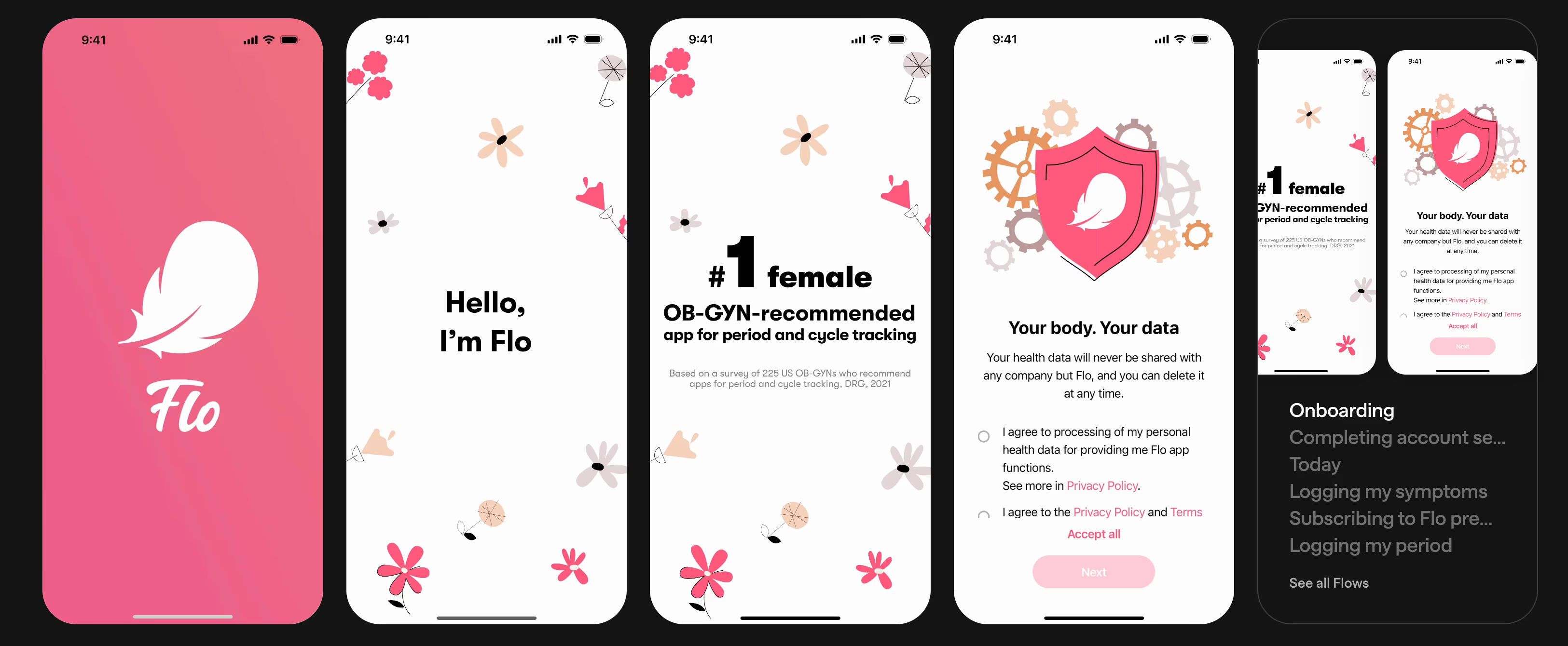
Flo: the women's health super-app
Flo was launched in 2015 by two Belarusian brothers as a simple cycle tracker. In 2026, it is the first European femtech unicorn, with 380 million downloads, 70 million monthly active users, and more than $200 million in annual revenue (2024). Five million subscribers pay for Flo Premium.
What made Flo: the decision not to stay a simple tracker. The app progressively integrated fertility tracking, pregnancy, perimenopause, a closed moderated community, and a medical AI ("Ask Flo") backed by more than 120 medical experts. Each new feature extended the user's lifetime in the app, from the first cycle to menopause.
Flo's flaw: the app was sanctioned by the FTC in 2021 for sharing sensitive health data with Google and Facebook without consent, and settled a class action for $56 million in 2025. That trust liability is an opening for any new entrant that puts privacy at the center of its product.
Clue: the scientific positioning
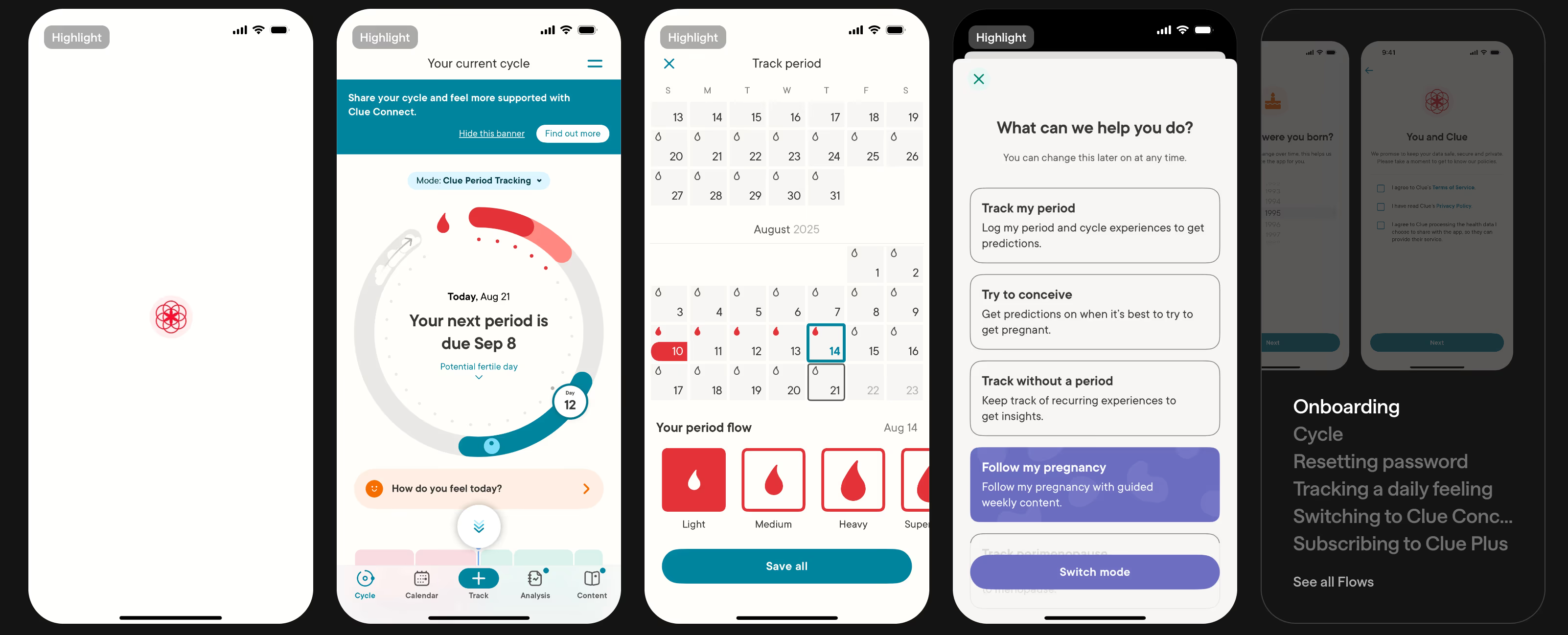
Clue, the Berlin app launched in 2012, made the opposite choice from Flo: stay clean, scientifically rigorous, and speak to women who want data without the content and community layer. Clue generates about $600,000 in monthly revenue, far behind Flo, but on a clearly different positioning: the data, without the noise.
Natural Cycles: the regulatory niche as a competitive advantage
Natural Cycles is the only contraception app FDA-certified in the United States and CE-marked in Europe. This positioning, a clinically validated natural contraception method, without hormones, let it raise $55 million in 2024 and speak to a precise and highly engaged user segment. Regulatory certification is a trust lever that 99% of competitors cannot reproduce quickly.
What these three apps show: in women's health, medical credibility and trust are not optional. They are prerequisites. The feature that differentiates CalAI (a photo to count calories) is a technical innovation. Here, the innovation is first an ethical and scientific commitment.
If you have already read our guide on building a fitness app, you saw how CalAI won on the radical simplicity of one use. In women's health, simplicity is not enough: you have to add trust.
Trust and health data
Here is a data point that should entirely reshape your product approach: among 23 women's health apps analyzed, only 52% explicitly asked for consent before collecting data, and 87% shared personal information with third parties (Persistence Market Research, 2025).
In other words: almost all existing apps treat cycle, fertility, and pregnancy data, the most intimate data a woman can share, as a resource to monetize. For a market supposed to defend women's health, that is a massive paradox.
What that means concretely for your app
Show clearly what you do with the data. Not in a 40-page privacy policy at the bottom of the page, in the onboarding itself. "Your cycle data never leaves your phone" or "We neither sell nor share your health data with any third party" is a sentence that belongs in the onboarding, not in the legal notices.
Offer local storage as an option. For the users most sensitive about their privacy (and there are many of them in this sector), the ability to store data locally on their device rather than on your servers is a selling point, not a technical detail.
Do not use their data for targeted advertising. That is the red line. An app that shows ads for diapers or fertility supplements by analyzing its users' cycle data is exactly what Flo did, and what it paid $56 million for.
Get a certification or a medical partnership. A medical review of your content, a partnership with a hospital or a recognized gynecologist, transparency on your prediction algorithm: everything that anchors your app in scientific credibility is a durable competitive advantage.
Warning: In Europe, health data is subject to the GDPR, with specific obligations for "sensitive" data (including reproductive health data). An app that collects cycle or pregnancy data without a named DPO, without an explicit legal basis, and without reinforced security measures faces penalties that can reach 4% of global revenue. This is not a technical detail. It is an existential risk for the project.
5. Onboarding and monetization: what works in this sector
Onboarding: start by listening
A women's health app's onboarding has a different function from a fitness app's. In fitness, onboarding is used to personalize the program. Here, it is first used to establish trust and to understand the life moment of the user.
A woman who downloads your app can be in radically different situations: she is trying to stop the pill and understand her natural cycle; she has been trying to conceive for 6 months; she is living her first pregnancy and looking for landmarks; she is entering perimenopause and does not know what to expect. Your onboarding has to identify this context before showing anything else.
The questions to ask first: the main goal (understand my cycle / conceive / track my pregnancy / manage menopause / general wellness), the contraceptive context if relevant, and the priority symptoms to track. Based on those answers, the app shows a personalized version of the dashboard, not a generic screen.
For the onboarding mechanics that convert, our article on optimizing mobile onboarding details the techniques that apply to this sector.
Monetization: the long trial and the annual plan
RevenueCat data (SOSA 2026) applies fully here: the Health & Fitness category generates 68% of its revenue through annual plans. In women's health, that is even more true. The menstrual cycle is a monthly, recurring phenomenon across a woman's entire reproductive life. An app that follows that reality naturally sells a long-term commitment.
The price structure that works:
- A trial of 7 to 14 days (short trials lose more than half of their users as early as Day 0, according to RevenueCat)
- Annual plan presented as "€X / month" to maximize perceived value
- Monthly plan at a high price as a price anchor
Flo Premium is typically positioned at €4–€6/month as an annual equivalent, versus €9–€12/month for a monthly plan. The gap creates a sense of urgency and naturally steers toward the annual plan.
To go further on monetization strategy, our guide on optimizing the mobile paywall covers the exact presentation mechanics.
The closed community as a retention lever
Flo made a counterintuitive bet: build an entirely closed and moderated community inside the app, where users ask intimate health questions in a protected space. This format, neither a public forum nor an open social network, is an extraordinary retention engine. Users come back not only to track their cycle, but to read the community's exchanges, ask their own questions, and receive answers from other women in the same situation.
For a V1, building such a community is out of scope. But putting it on the 12-month roadmap, once baseline engagement is established, is a strategic priority.
Open niches in women's health
The women's health market is not saturated. It is concentrated on a few very competitive segments (generic cycle tracking) and leaves entire high-potential niches untouched.
Menopause and perimenopause
This is the most open niche in the sector. Flo has identified it as its next major priority, which means the window for a specialized entrant is narrowing, but it still exists. Women in perimenopause (ages 40–55) have high purchasing power, a much higher price tolerance than women aged 20–30, and suffer from a glaring information void. An app dedicated to managing menopause symptoms - hot flashes, sleep quality, libido, vaginal dryness - with validated medical content and a protected community has every chance of finding its market.
PCOS and endometriosis
Polycystic ovary syndrome affects 10% of women of childbearing age. Endometriosis affects 1 in 10 women worldwide. Two chronic, underdiagnosed conditions, for which generalist apps offer little specific value. An app built around tracking PCOS or endometriosis symptoms, with adapted medical content, personalized alerts, and a community space, answers a precise need that Flo and Clue only address on the surface.
Postpartum health
Postpartum is the great forgotten of digital women's health. Pregnancy apps stop at birth. What comes next - the baby blues, postpartum depression, pelvic floor rehabilitation, the return of the cycle, sleep disorders - is barely covered. It is an extremely difficult life moment for many women, with a strong demand for support and a real willingness to pay for a tool that actually helps.
French-speaking women's health
The large majority of dominant apps (Flo, Clue, Natural Cycles) are designed for English-speaking markets. There is a real opportunity in the French-speaking market - France, Belgium, Switzerland, Quebec, French-speaking Africa - for an app that speaks to these users in their language, with content adapted to their realities (the French health system, reimbursements, local medical practices).
Budget for a women's health app
What it actually costs
A women's health app implies above-average requirements on data security, GDPR compliance, and the medical quality of the content. Those requirements have a direct impact on the budget.
Creation is scoped on request. Monetization offers are on the page Pricing.
This scope does not include medical content production (which can represent a significant budget if you have your content validated by experts), or the DPO if you have to appoint one.
For the detail of the variables that move these budgets, our article on the mistakes to avoid when building a mobile app covers the line items that drift most often.
The lesson that transfers to women's health: paywall timing and positioning clarity weigh more than the number of features. A women's health app that does one thing clearly, for a precise woman, at a precise moment of her life, converts better than a super-app that tries to cover the whole spectrum.
You have a mobile app project? Get an estimate of your project in a few minutes: Request a quote
8. What firstapp would do for your women's health app
Most agencies build an app and hand you the keys. You end up with a delivered product, no users, no acquisition strategy, and no idea what will generate retention in 3 months.
Our approach at firstapp is different. We think growth before we think features. Here is concretely what we would do on a women's health project.
What we have already built in health
firstapp has not worked on a menstrual cycle app. But we know digital health well.
Jinko.care is one of our projects in the medical sector, a connected health platform we built in React Native.
SUNAPP, the social network for people living with a chronic illness, founded by Clément Parot (founder of firstapp), reached 5,000 active users. This project taught something fundamental about health apps: users do not stay for the features. They stay because they feel understood and not alone. That is exactly the dynamic of a good women's health app.
That is exactly the dynamic of a good women's health app.
What we would design from the start: growth loops
A women's health app's growth is not built after launch with an ad budget. It is designed into the product itself, from the design phase. Here are the mechanics we would put on the V1 / V2 roadmap.
The monthly share card. At the end of each month, the app automatically generates a visual summary of your cycle: length, the date of your energy peak, the number of symptoms tracked, prediction accuracy. A beautiful, sober card, shareable in one tap on Instagram Stories or WhatsApp. "My March cycle: 27 days, energy at its peak on the 14th, prediction accurate within 2 days." This content generated by the app creates organic exposure every cycle - 12 occasions a year, per user, to trigger installs.
The partner loop. The invite to share your cycle (read-only) with your partner or a close friend. Each invite is an acquisition opportunity: the partner installs the app to see the shared data, discovers the product, and can in turn start using it for a related use. Simple to build, very low acquisition cost per user acquired.
The shareable moment of truth. When the app correctly predicts your next period within 1 day, it sends you a notification: "Your cycle arrives in 2 days. I said the 18th, it will probably be the 19th." This moment of unexpected precision is a natural sharing trigger. "This app knows my body better than I do." People post that. We design this moment in the app so it is shareable in two taps.
The 30-day challenge. An intensive tracking program over 30 days, with progressive insights that unlock as you go. At day 30, a complete recap, "what I learned about my body this month", visual, shareable, personal. This format is natively TikTokable: filming your phone displaying your health results is a format that performs very well on health and women's wellness TikTok.
What we would make TikTokable from the V1
TikTok is the most powerful acquisition channel for this type of app, but the content has to exist for it to work. We design the apps we ship so their founders can create organic content easily.
Concretely, that means:
Spectacular data visualizations. Your cycle over 6 months visualized as a heat map. Your predicted versus felt energy level over the last quarter. These visuals generated by the app can be filmed in 3 seconds and create curiosity ("how does she know that?").
A filmable onboarding. A well-designed women's health onboarding is content in itself: the symptom quiz, the cycle-profile reveal, the prediction generated in real time. Dozens of creators film their first use of an app and post it. If your onboarding is visually careful and reveals something surprising about the user's health, it will be filmed and shared.
An educational angle built into the product. Educational content on the phases of the cycle (follicular phase, ovulation, luteal phase, menstruation) and their effects on energy, libido, and focus is TikTok content that performs extremely well. If your app generates this kind of personalized insight, your users naturally want to share it: "my app taught me that my energy systematically drops 6 days before my period."
9. How to acquire your first users after launch
The women's health market has a strong particularity: word of mouth works better here than in any other sector. Women talk about health among themselves, between friends, in pregnancy Facebook groups, on fertility forums, in communities of women with PCOS. An app that truly serves them well will be recommended.
But word of mouth does not replace an acquisition strategy at launch. For a complete acquisition strategy, TikTok, Reddit, Instagram, growth loops, our guide on how to get your mobile app known is the direct complementary read.
TikTok: the formats that take off in the women's health niche
TikTok is the number-one acquisition channel for a women's health app in 2026, provided you do not make disguised ads. What works is content that teaches, that names a lived experience, or that reveals something the audience did not know about their own body.
"Day X of my luteal phase. Here is exactly what I feel." An ultra-short format (15–30 seconds), a personal voiceover, no production. The luteal phase (the week before the period) is an experience shared by hundreds of millions of women who never had the word to name it. This format creates immediate recognition. Comments explode, and so do shares. It is the ideal format for an account launching a cycle-tracking app.
"The 4 phases of your cycle and what they do to your body." Cycle syncing, adapting your food, your training, and your social level to your cycle phase, has been one of the most viral topics on wellness TikTok since 2023. Content in 4 parts (follicular phase, ovulation, luteal phase, menstruation) with the concrete effects on energy, libido, focus, and skin is content that gets saved massively and shared with friends. If your app is mentioned at the end as the tool that tracks these phases for you, the acquisition mechanic is clear.
"I tracked my cycle for 6 months. Here is what I discovered about my own body." A personal-reveal format. The creator (you, an ambassador, a real user) opens the app, shows her data, and points to the patterns she had not seen without tracking: "my energy systematically drops at D-6", "I sleep worse the 4 days before my period", "my cycle shortened by 3 days since I stopped the pill." These reveals trigger immediate curiosity. People want to see their own.
"What your cycle app actually does with your data." The figure of 87% of apps that share personal data without clear consent is a perfect hook. You mention it, you show what it means concretely (your fertility data resold to advertisers), then you explain your app's approach. This format generates shared outrage, and positions your product as the ethical alternative without you having to say it explicitly.
"PCOS: the 7 symptoms I did not know about." For an app positioned on PCOS, this format is an acquisition machine. Undiagnosed women who recognize themselves in the list download immediately. Women already diagnosed share it with friends who "look like what they were living." Two audiences, one piece of content.
"I compared Flo and [your app's name] for 30 days." The direct comparison format with the market leader is the most effective shortcut for capturing an established app's audience. You do not criticize Flo. You objectively show what your app does differently (privacy, a specific niche, the interface). Users looking for an alternative to Flo since the data scandal are an audience already won.
Instagram: the content that gets saved (and that converts)
On Instagram, saves are the metric that matters. Saved content is content the algorithm distributes massively. In the women's health niche, women save content about their health like nowhere else, because they come back to it, share it with their gynecologists, and send it to friends.
Carousel: "The 4 phases of your cycle, what really happens in your body."An infographic in 8 slides: follicular phase (days 1–13), ovulation (day 14), luteal phase (days 15–28), menstruation, with the effects on energy, skin, mood, libido, and sleep. This content is saved by tens of thousands of women every week on Instagram. It is educational, non-commercial, and positions your account as a reference. The final slide: "Your app tracks these phases for you automatically."
Carousel: "PCOS checklist. Do you recognize yourself?"A list of polycystic ovary syndrome symptoms, presented in a sober, non-alarmist way. This kind of content is shared en masse in the stories of the women concerned, relayed in private groups, sent to doctors. For an app positioned on PCOS, it is the best possible organic acquisition content.
Carousel: "What I wish I had known about my cycle at 20." Nostalgia plus education. Widely shared between women of different generations. The first slide hooks ("nobody ever explained this to me"), the following slides teach, the last one points to your app. A sober format, text on a light background, no production needed.
Reels: onboarding filmed in real time. A screen recording of your onboarding quiz with a voiceover commenting on each design choice live. "Why we ask this question. What it changes in your program. What the app generates next." This format attracts two audiences: potential users curious about the product, and other founders who learn from it. Both create traction.
Stories: the weekly question box. Every week, an open question on your niche: "Your biggest misunderstanding about your cycle?" / "What has surprised you since you started tracking your health?" / "Your worst luteal-phase symptom?" The answers feed your future content, create engagement, and give you a direct understanding of what your audience is living.
Reddit: the communities where your users look for answers
Reddit is the most direct ground for reaching women who are actively looking for a solution to a precise health problem. The subreddits to target according to your niche:
- r/PCOS (185,000+ members) - A very active community around polycystic ovary syndrome. Daily questions on symptoms, treatments, useful apps. If your app targets PCOS, this is the most qualified place in the world.
- r/TryingForABaby (290,000+ members) - Women on a conception journey. Exceptional engagement, and a very high willingness to pay for a reliable tool.
- r/BabyBumps (600,000+ members) - Pregnant women. Active, kind, and very hungry for practical tools.
- r/Menopause (65,000+ members) - A fast-growing community, few dedicated apps recommended, a direct opportunity for a well-positioned app.
- r/Endo (80,000+ members) - Endometriosis. A tight-knit community, a glaring lack of adapted tools.
The rule is the same as for any subreddit: contribute first, recommend later. Answer questions with real, sourced medical information, take part in discussions, build a credible history. When you mention your app, it has to be in direct response to an expressed need, not a promotional post.
From the idea to the women's health app
The market exists, the niches are open, and users are waiting for an app that truly respects them. The next step is to turn your idea into a product, with the right structure from the start.Talk about your project
FAQ
Do you need medical approval to build a women's health app?
It depends on what your app does. A cycle-tracking or general wellness app is not considered a medical device and does not require approval. By contrast, if your app claims a contraceptive, diagnostic, or treatment function for a condition, like Natural Cycles with its FDA approval, it falls into the medical-device category, subject to strict regulations (CE marking in Europe, FDA clearance in the United States). Defining precisely what your app does and does not do is the first legal step.
How do you differentiate against Flo, which dominates the market?
Flo is dominant on the generalist segment: cycle tracking, fertility, pregnancy. It is vulnerable on two axes: trust (its history of data sharing is known and documented) and specialization (it covers everything but does not excel on precise niches such as PCOS, endometriosis, or menopause). An entrant that positions itself on a precise niche with a strong commitment to data privacy attacks both flaws at once.
What is the best monetization model for a women's health app?
The annual subscription is the dominant model. The Health & Fitness category generates 68% of its revenue through annual plans (RevenueCat, SOSA 2026). In women's health, that figure is even more relevant: users commit to long-term issues (fertility, pregnancy, menopause) and have a strong propensity to pay annually for a tool they consider reliable. A trial of 7 to 14 days, followed by a well-presented annual plan, is the structure that maximizes conversions.
How long does it take to build a women's health app?
A serious iOS V1 (cycle tracking, personalized onboarding, paywall, basic GDPR compliance) takes 6 to 10 weeks with a specialized team. The schedule stretches if you integrate validated medical content (which requires an external review), a community feature, or a cycle-prediction AI. Plan at least two extra weeks for the Apple review phase, which can be more demanding on health apps.
Also read
How do you build a fitness app in 2026?
30% of fitness app downloads happen in January, and most of those users leave before the end of February. 68% of Health & Fitness revenue comes from annual plans.
Building a meditation and sleep app in 2026
The meditation and sleep app market is estimated at $1.2 billion in 2024 and $4.5 billion by 2033. Calm lost 24% of revenue and 500,000 subscribers between 2024 and 2025.
How do you protect yourself on GDPR for a women's health app?
Reproductive health data is sensitive data under the GDPR, subject to reinforced obligations. The minimum requirements: an explicit legal basis for each processing (explicit consent recommended), a named DPO if your processing is large-scale, privacy by design (collect only what is necessary), reinforced data security (encryption in transit and at rest), and a clear, accessible privacy policy in the app, not only on the website. Get support from a lawyer specialized in health data before launch.