How do you build a fitness app in 2026?
30% of fitness app downloads happen in January, and most of those users leave before the end of February. 68% of Health & Fitness revenue comes from annual plans.

Article summary
- 30% of fitness app downloads happen in January.
- 68% of Health & Fitness revenue comes from annual plans.
- 69% of subscription revenue in the sector is captured by apps launched before 2020.
- CalAI has passed 15 million downloads and $30 million in annual revenue.
- Building a fitness V1 is scoped on request.
Summarize this article with
30% of fitness app downloads happen in January. Most of those users are gone before the end of February.
The market for mobile fitness apps is one of the most dynamic in the sector, and one of the most selective. Thousands of apps launch every year. A handful capture most of the revenue. The others stall or disappear, not because the idea was bad, but because the founders built in the wrong order.
firstapp has worked with founders on this kind of project for several years. This guide does not explain how to code an app. It explains how to build a fitness app that holds up, from a product, monetization, and retention point of view.
1. The fitness app market in 2026: what the numbers actually say
The global mobile market generated $167 billion in revenue in 2025, up 10.6% year over year (Sensor Tower, 2026). The underlying trend: downloads are flat (+0.8%), but monetization is exploding. In other words, the era of growth by volume is over. What wins today is the ability to extract value per user.
The Health & Fitness category is one of those that benefits most from this dynamic. According to RevenueCat (SOSA 2026), the download-to-trial conversion rate in Health & Fitness reaches 5 to 6% at 30 days, above the global median across all categories. Users in this category are buyers. Provided you offer them the right product, at the right moment, in the right format.
Info: 68% of revenue generated by Health & Fitness apps comes from annual plans (RevenueCat, SOSA 2026). Not weekly plans. Not monthly plans. Annual plans. That single data point should steer your entire pricing strategy.
The bad news: 69% of subscription revenue in the sector is captured by apps launched before 2020. Recent apps (post-2022) structurally generate 25% less at the median than older apps (Adapty, 2026). You are not competing in a fair market. You have to differentiate from the first screen.
Newsletter
Once a week.
Last issue
We opened 10 apps to see how they sell a subscription.
+534 people read us each week
2. Choose your positioning before you code the first line
This is the step most founders skip, or rush through in two hours. It is nevertheless the most decisive decision of the project.
Coach, tracker, community: pick a side
There are four main families of fitness apps. Each answers a fundamentally different need:
The coach app prescribes. It tells you what to do today, how many reps, at what intensity. The user does not think, they execute. Freeletics, Nike Training Club, and Fitbod are examples. The value is in the program and the structured progression.
The tracker app records. It logs performance, visualizes data, and gives feedback on what was done. Strava, Strong, Hevy. The value is in the memory and the analysis of the effort.
The community app connects. It anchors the practice in a group, and creates competition or mutual support. Strava mixes tracker and community. Peloton is the most radical example.
The content app delivers. Videos, programs, online classes. Yoga, pilates, or meditation apps often fall in this category. Down Dog, Glo, Calm on the meditation side.
The trap of "we will do everything"
Most apps that fail tried to combine two or three of these families without mastering the first. The result: a product that is decent at everything, excellent at nothing. The user does not understand why they should pay for it rather than for Strava or Freeletics.
The real question is not "which features should we build" but "which precise problem do we solve better than anyone else". An app that helps beginners stop wondering what to do at the gym is a positioning. "A complete fitness app for every level" is not.
Before you write a line of code, answer this question: in five years, if your app is the best in the world at one single thing, what is that thing?
3. What the apps that take off have in common
The best way to validate a positioning is to watch what the apps that have already won do. Each of the apps below has one thing in common: it does one single thing better than anyone else. Not two. Not three. One.
CalAI: the most spectacular lesson in the market
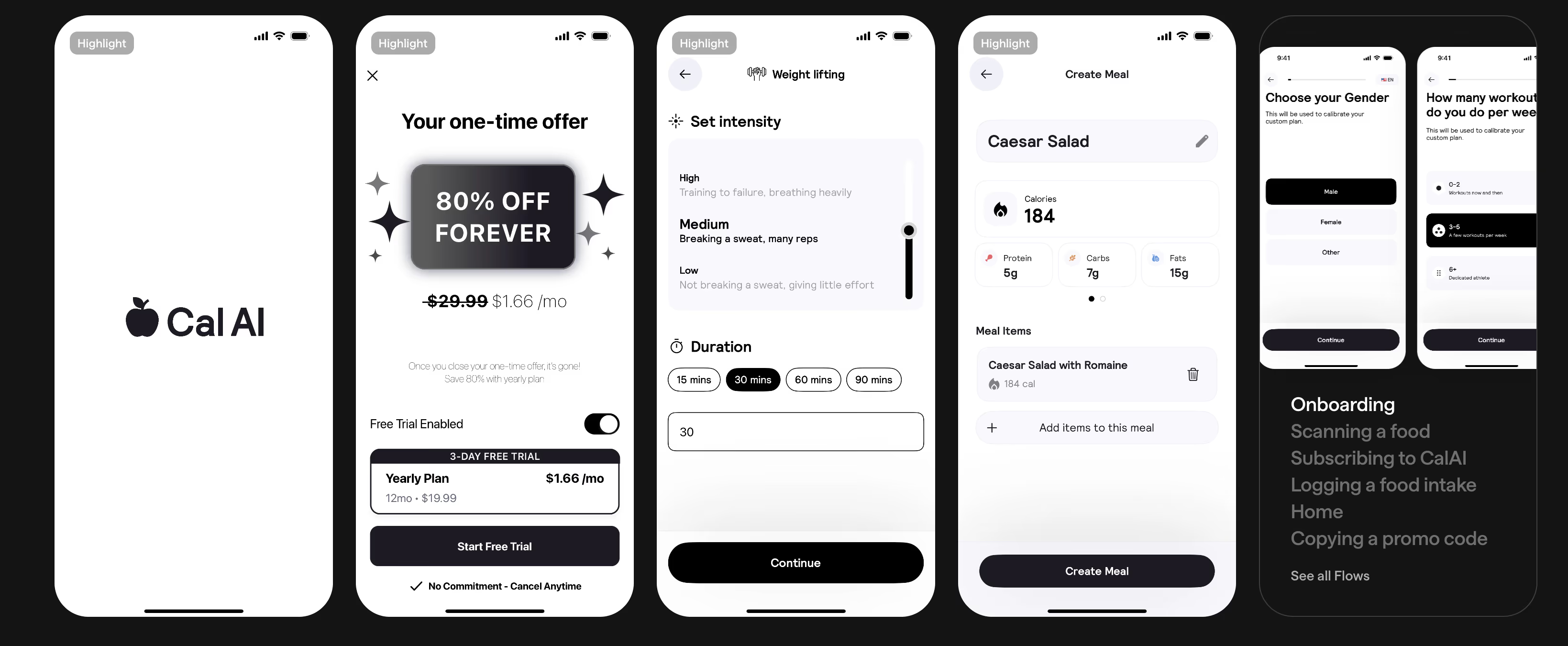
CalAI was launched by two 17-year-old high-schoolers with a simple idea: take a photo of your meal, and the AI counts the calories. No workout program. No coaching. No social. Just that.
The result: 15 million downloads and more than $30 million in annual revenue in under two years. In March 2026, MyFitnessPal acquired the app. The historical player in the sector paid to acquire a 7-person app that had taken market share by doing one thing more simply.
CalAI's first month generated $28,000 in revenue. The second: $115,000. The growth came from organic TikTok. The founders showed the app in action, simply, with no ad budget at the start.
What that teaches: the radical simplicity of a product, well executed on a single angle, systematically beats the "complete" app that does everything correctly but nothing exceptional.
MyFitnessPal: the king of the database, not of the UX
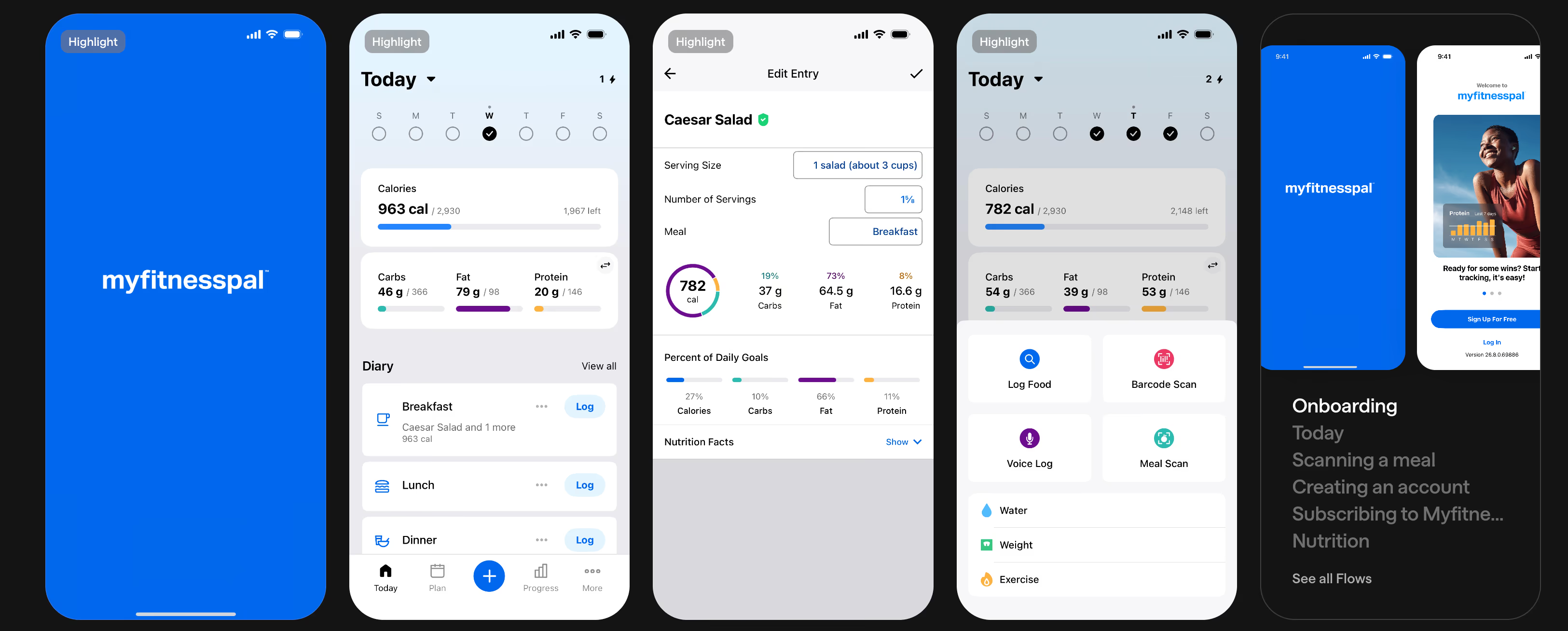
MyFitnessPal has more than 200 million users. Its competitive advantage is not the interface. It has been criticized for years. Its advantage is its database: 20 million foods, 68,500 brands, the menus of 380+ restaurant chains. Impossible to replicate for a new entrant.
The lesson: MyFitnessPal did not try to be a sports coach or a running app. It deepened its position on nutrition for 15 years until it became irreplaceable on that segment.
Strava: the tracker that created a religion
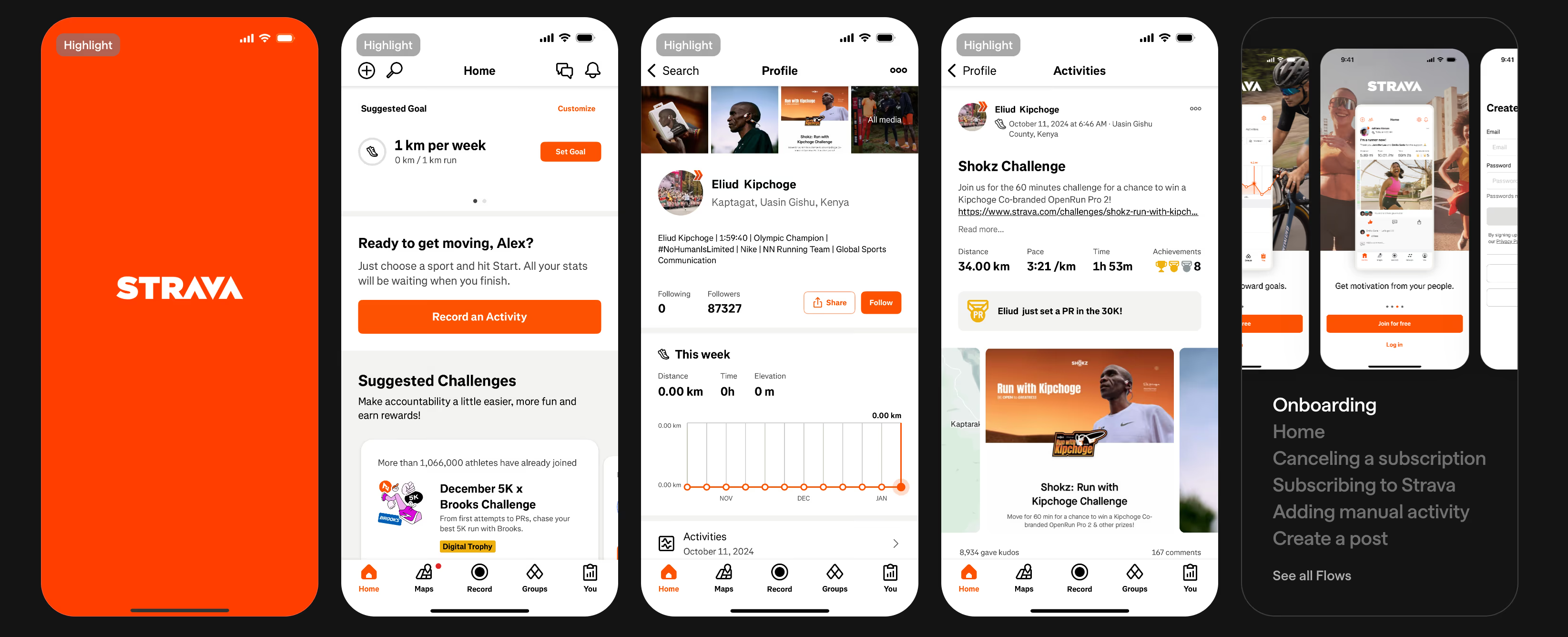
Strava does not tell you what to do. It records what you do and shares it with your network. No programs, no coaching, no nutrition. GPS + social. 125 million users, a community that creates the content, the challenges, and the retention itself.
Strava won because it understood that for serious runners and cyclists, social recognition of the effort is more powerful than any algorithmic coach.
Freeletics: the AI coach that does not compromise
Freeletics chose the opposite camp from Strava. No social in the foreground, no GPS tracking. An AI coach that generates your program according to your level and pushes you to progress. The app does not ask what you want to do today. It tells you what to do. For a certain category of users, that is exactly what they need.
Calyra (formerly Nutria): what we built, and what it produced
Calyra (formerly Nutria) is a nutrition-tracking app that firstapp worked with from A to Z: React Native development, onboarding strategy, monetization.
This is not a lucky break. It is the result of a clear positioning from the start, an onboarding built to convert, and an annual subscription strategy calibrated before the first line of code was even written.
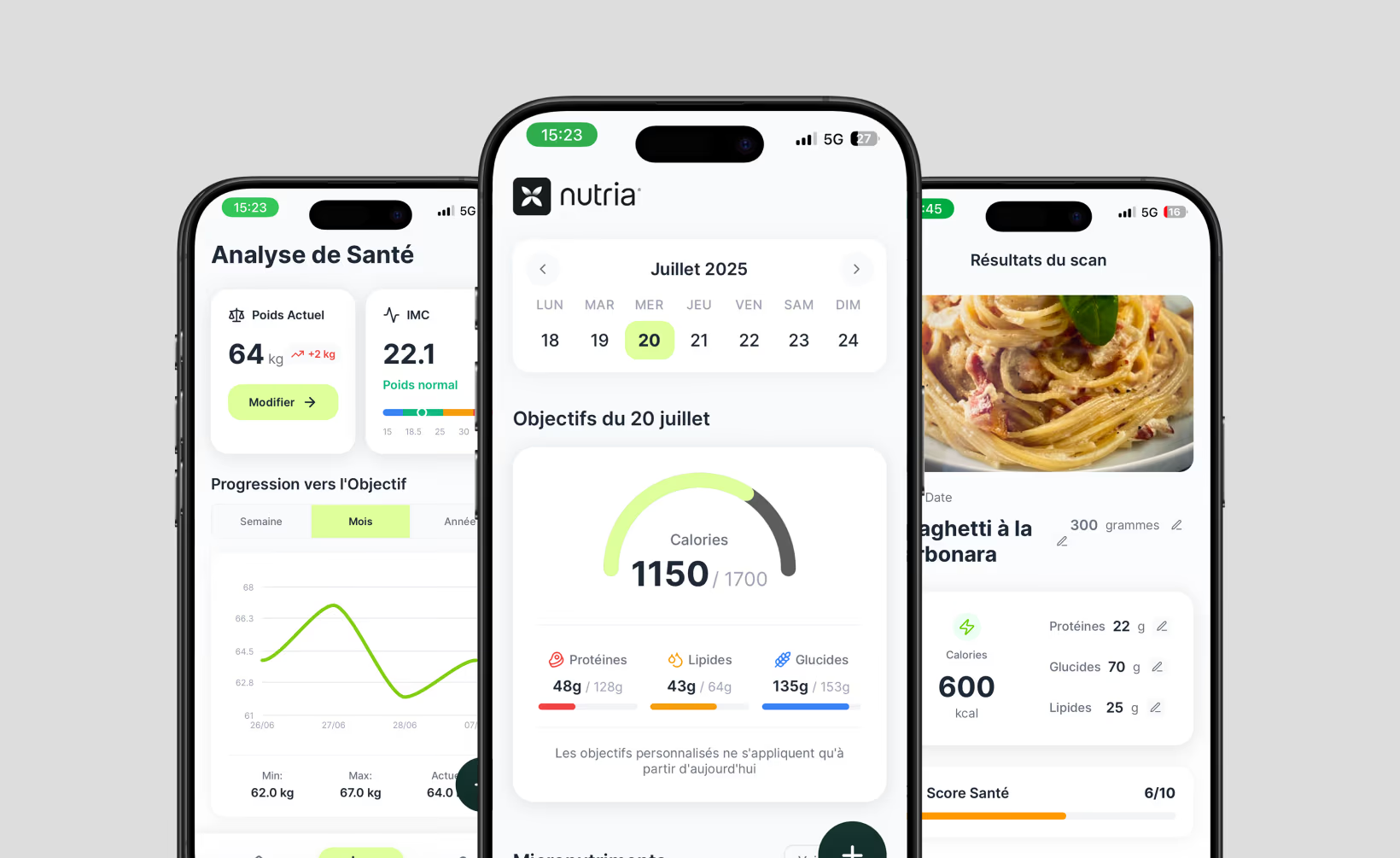
What these examples have in common: none of them tried to do everything. CalAI = photo → calories. Strava = GPS + social. Freeletics = an AI coach with no compromises. Calyra (formerly Nutria) = simple nutrition tracking, for a precise audience, with monetization thought through from the start.
Your fitness app has to fit in one of these boxes. If you cannot sum it up in a sentence of that kind, the product is not defined enough to launch yet.
Essential features of a fitness app
The viable minimum of a fitness app
A viable fitness app in 2026 has to solve the problem of "what do I do today?", not store data. Here are the non-negotiable features:
A personalized program from onboarding. Not a catalog of workouts to browse on your own. A program adapted to the user's level, goals, and availability, generated in the first minutes. In 2026, that goes either through a structured quiz or through a light AI layer. Both work. The absence of both does not.
HealthKit / Google Fit integration. Fitness users already use their watch, their iPhone, or their Android to track their activity. An app that does not connect to that existing ecosystem creates useless friction. It is a blocker at the moment of the subscription decision.
Visible progress. Users who do not see progress in the first weeks leave. Streak calendars, progress charts, badges - not to gamify, but to anchor the proof that the app works.
Contextual notifications. Not marketing notifications. Workout reminders scheduled by the user themselves, plus smart re-engagement messages at day 3 and day 7 of inactivity.
What you do not need to build in the V1
Full social (feed, follows, likes) is an expensive, useless machine at launch. Built-in messaging, real-time community challenges, HD streaming video - all of that can wait. In the V1, every feature you did not build is a week you saved to go to production and validate what matters.
The obsession with feature-complete kills more fitness projects than a lack of ideas.
You have a mobile app project? Get an estimate of your project in a few minutes: Request a quote
5. A fitness app's onboarding: where everything is decided
According to RevenueCat, 60% of conversions (trial or direct purchase) happen in the first week after download. And 55% of short-trial cancellations (3 days) happen on Day 0, before the user has even seen the product.
What that means concretely: if your onboarding does not convince in the first minutes, you have already lost the majority of your potential conversions.
To go further on this subject, our article on optimizing mobile onboarding to boost conversion details the exact mechanics.
The initial quiz is not optional
In a fitness app, the onboarding quiz is not a personalization gadget. It is the product. It is the moment you show the user that the app understands their situation, their level, their goal, their constraints (time, equipment, injuries). A fitness onboarding that does not collect this data is one more app on the list.
A good fitness quiz:
- 5 to 8 questions maximum (beyond that, drop-off rises)
- Questions on the main goal (weight loss, muscle, cardio, mobility)
- Questions on the current level (beginner / intermediate / advanced)
- Questions on availability (3x/week, 5x/week…)
- A personalized recap at the end of the quiz before showing the paywall
Put the paywall at the right moment
The paywall in a fitness app ideally sits after the quiz, when the user has already invested time and seen a version of their program. That is where the value is perceived. A paywall shown on screen 2, before any interaction, produces mediocre results.
RevenueCat data confirms that trials of 17 days or more convert 70% better than short trials (42.5% vs 25.5% trial-to-paid). For a fitness app, a trial of 7 to 14 days is the reasonable minimum. The user needs to see their first progress before they pay.
6. Monetization: why fitness apps bet on the annual plan
68% of Health & Fitness revenue comes from annual plans (RevenueCat, SOSA 2026). That figure is not an accident. Fitness apps that succeed understood that their product answers a long-term commitment: a resolution, a lifestyle, a physical transformation. It is not a service you consume for a month and abandon. Users who subscribe annually have a much stronger intention than those who pay month to month.
To understand monetization models in detail, our article on freemium, subscription, and one-time purchase lays the essential foundations.
The numbers that justify the annual choice
A monthly plan at €9.99 generates €119.88 over 12 months, if the user does not churn. The median monthly churn in subscription apps is about 8% (RevenueCat). Over 12 months, at that churn level, your real revenue per user is well below €120. An annual plan billed in one go at €59.99 collects more cash immediately and mechanically reduces churn: the user pays once and does not ask the question every month.
Median year-1 annual retention across all categories is 28% (down from 31%). That is not a good number. But a user who paid annually and comes back the following year is a much stronger signal than a monthly subscriber.
How to structure your pricing
The format that works in this category is systematically the same:
- Monthly plan shown first, at an uncomfortable price (€12 to €15/month)
- Annual plan positioned as the reasonable option, presented as "€X / month" (that is €4 to €6/month)
- Visual anchor strong: a crossed-out price, a "most popular" badge, savings calculated in euros
Presenting an annual plan as a monthly equivalent increases trial starts by 30% and the annual conversion rate by 10% (RevenueCat, SOSA 2026).
For a complete paywall strategy, read our guide: optimize your mobile paywall to convert more subscribers.
7. The mistakes that get expensive on a fitness app
Building without differentiation
The first mistake is building a "general fitness" app. In 2026, the user already has Freeletics, Nike Training Club, Strava, Garmin Connect, and MyFitnessPal on their phone. Why would they download yours? If you cannot answer that question in one sentence, go back to the positioning step.
The apps gaining ground today are hyperspecialized: strength programs for women aged 40, postpartum fitness, strength training for runners, mobility for office workers. A clear niche, a precise target user, a specific promise.
Ignoring seasonality
Demand for fitness downloads follows an extremely marked cycle: a massive peak in January (resolutions), a summer trough, a slight pickup in September. If you launch in March, you miss the easiest acquisition peak of the year. Planning your App Store launch for late December or early January means starting with a structural advantage on organic acquisition.
Conversely, building your growth on seasonality without working on post-January retention is filling a leaking barrel.
Underestimating the content problem
The most common mistake: building a beautiful fitness app while neglecting the content. A coach app without solid programs, without well-thought progressions, without clear instructions on the exercises, does not convert and does not retain.
The content (exercises, programs, demo videos) often represents as much work as the development itself. Plan for it in your budget and in your schedule. A perfect build with mediocre content produces a mediocre app.
To avoid the classic mistakes of building a mobile app, our article on the mistakes not to make when creating an app is a useful complementary read.
8. Realistic budget and timeline
Budget: what it actually costs
A React Native mobile fitness app, iOS first, with an onboarding quiz, a personalized program, a paywall, HealthKit integration, and progress tracking, is a serious project. Creation is scoped on request. Monetization offers are on the Pricingpage.
This scope does not include content production (programs, videos, coaching), or the acquisition budget.
To go further on budget, our article how much it costs to build a mobile app details the variables that move the price.
Timeline: be realistic
A serious iOS v1 takes 4 to 8 weeks with a dedicated team and a controlled scope. The projects that slip are the ones that add features along the way or that did not make their positioning decisions up front.
The App Store launch includes an Apple review phase (48h to 7 days depending on the period). Plan your submission at least two weeks before your target launch date.
9. What firstapp would do for your fitness app
The majority of agencies build what you ask for. The problem is that you do not always know what to ask for, and an app delivered without an integrated growth strategy is an app that will stay at 300 downloads.
At firstapp, we think acquisition and retention before we think features. Here is concretely what we would put in place on a fitness project.
What we have already proved
Calyra (formerly Nutria), a fitness app that we worked with from design to launch: €30,000 in revenue in the first month. In a sector where the median sits around 8% churn, that is the result of a product architecture designed to retain, not just to ship.
The lesson that transfers to fitness: churn on a health or sports app is not fixed with aggressive push notifications after launch. It is fixed in the onboarding, in the structure of the program, and in the micro-moments that anchor the habit in the first 7 days.
The growth loops we would design from the V1
A fitness app's growth is not bought. It is built into the product. Here are the mechanics we would put on the roadmap - not in V3 when it is not taking off, but from the start.
The shareable streak.Your streak of 7, 14, or 30 consecutive sessions becomes a visual card generated automatically, shareable in one tap. "30 sessions. 30 days. I did not miss a single workout." This format circulates massively on Instagram Stories and TikTok, and every share is a free organic ad with your app's name visible.
The friend challenge."Challenge a friend for the next 30 days." Every challenge sent is a direct acquisition invite. The friend gets a notification, downloads the app to accept, and lands in an onboarding funnel. The conversion rate of a user invited by a friend is structurally much higher than that of a user acquired through ads.
The filmable progress recap.At day 30 and day 90, the app generates a visual recap: weight lifted, sessions completed, progress on key exercises. A clean, animated, exportable chart. Users film their screen, add a voiceover, and post on TikTok. "My app told me I progressed 40% on the bench press in 3 months." That content exists naturally if you design the app to generate it.
Seasonality as an activation trigger.We would integrate an automatic "restart" system in January and in September, the two fitness-intention peaks of the year. Dormant users receive a personalized message with their last progress and a new program adapted to their return. Not a generic notification. A real context that says "we know where you are, pick up where you stopped."
What we would make TikTokable from the first screen
The best-performing TikTok content in the fitness niche in 2026 does not come from marketing teams. It comes from users filming their app. We design the interfaces so that happens naturally.
Onboarding as a revelation. A well-designed quiz that ends with "here is your athletic profile" - a strong visual, level, training style, recommended program - can be filmed in 30 seconds. Dozens of creators do this format: "I tried this fitness app for the first time." If your onboarding is visually careful and reveals something precise about the user, it will be filmed.
Today's workout shown as soon as you open the app. A home screen with the day's program - exercises, duration, estimated effort - clearly visualized is natively filmable. "Here is what my app has me do today" is a TikTok format that generates millions of views in the fitness niche.
Counterintuitive progress data. "My app told me I lift 40% heavier than 3 months ago, but my recovery has gotten worse." This kind of personalized insight, which the app generates automatically from tracked data, triggers curiosity and sharing. We design it into the product.
10. How to find your first users after launch
An App Store launch does not generate traffic by itself. The first 500 downloads do not fall from the sky because your app is listed. They come from an intentional content strategy, or they do not come. The one you will still be doing in six months. For a complete view of the acquisition channels available, our guide on how to get your mobile app known details the methods and formats that work in 2026.
Here is what works concretely in 2026, platform by platform.
TikTok: show the kitchen, not the finished dish
TikTok is the most powerful platform for launching a fitness app organically, provided you do not make disguised ads. What works is content that teaches or that provokes a reaction.
"I analyzed the 10 most-downloaded fitness apps. Here is what they all do wrong." Format: screen-in-screen with a voiceover. You spend 30 seconds on each app, you show the precise problem (onboarding too long, paywall too early, no personalization). In the conclusion, you say how you solved those problems in your app. This format builds trust and positions your app as a thought-through answer, not one more product.
"Build in public, week 1 of my fitness app launch." People love following someone who is building something in real time. Downloads that day, first reviews, first bug in production, first paying subscriber. This format creates an audience that invests emotionally in your success even before downloading the app. Do it over time, not as a single post.
"I test my app with someone who has never seen it." Film someone close to you doing their first onboarding. You see live where they hesitate, where they stop, what confuses them. It is authentic UX content that interests both potential users and other founders. Two audiences, two reaches.
"The problem nobody solves in fitness apps."Not a product pitch. A real point of view on a problem in the sector. Example: "Why 80% of fitness apps abandon you after 3 weeks." You state the problem with data, you develop it, and on the last slide you mention what you do differently. People click your profile, see the link, and download.
Instagram: the formats that get saved
On Instagram, the algorithm favors saves and shares much more than likes. A useful carousel generates 5x more reach than a quality photo. Concrete formats:
Carousel: "The 3 types of users who churn in February, and how to keep them." You talk about the user's problem (post-resolution dropout), you give concrete advice, and the last slide says: "We built [your app's name] to solve exactly that." Simple, honest, effective.
Reels: show your onboarding. A screen recording of your onboarding quiz with a voiceover explaining each design choice. "Why we ask this question. What it changes for the user. What we generate next." This kind of content attracts curious users and founders who want to learn from it. Both can become ambassadors.
Publish your numbers honestly. "Week 2 after launch: 847 downloads, 12 paying subscribers, conversion rate at 1.4%." Founders love this content. It creates a community around your project, it humanizes the work, and it positions your account as a reliable source, not a promo account.
Stories with UX polls. "Do you prefer to see your program for the week or for the day?" / "Do you use your app more before or after the workout?" Two advantages: you collect real product data and you create the engagement that boosts your organic reach.
Reddit: the most underestimated platform for a niche app
Reddit is the only platform where you can reach people who are actively looking for a solution - with no advertising algorithm. The absolute rule: never sell directly. Be useful first. The mention of the app comes naturally afterwards.
The subreddits to target according to your positioning:
- r/Fitness (12.4M members) - General questions, debates on programs, training logs. Answer questions with real expertise. When someone asks "I am looking for an app to structure my program", you answer honestly: your app if it is relevant, another one if it is not. Credibility comes from not always selling.
- r/loseit (~4M members) - A community focused on weight loss. If your app targets that goal, this is the most fertile ground.
- r/bodyweightfitness - For apps with no equipment, calisthenics, home programs.
- r/running - For everything related to running, cardio, and endurance programs.
- r/xxfitness (3.1M members) - A women's fitness community. Very relevant if your app targets women.
The format that generates traction:
Post an "I built this" or an honest postmortem. Example: "I launched a fitness app 3 months ago. Here is what I learned, the real data, the real mistakes." You share the real numbers (downloads, conversion, mistakes made), you ask the community questions, you reply to every comment. These posts generate hundreds of replies, natural backlinks, and early adopters who feel involved in the project.
The trap: posting only to promote. Reddit detects purely promotional behavior and users flag it quickly. Your account has to have a history of real contributions before you talk about your app.
From the concept to the fitness app
You have just laid the foundations. The next step is to go from the concept to a product that holds up, and that generates revenue from the first months.Talk about your project
FAQ: fitness app
Which technology should you choose to build a fitness app?
React Native is the best fit for a first fitness app targeting iOS and Android. According to RevenueCat (SOSA 2026), React Native apps show the best median download-to-paid conversion rate (2.5%), ahead of native apps (2.0%) and Flutter (1.8%). Cross-platform also lets you launch on both stores with a smaller budget than two separate native builds.
Should you start with iOS or Android for a fitness app?
Start with iOS. 77% of new subscription app launches in 2026 target iOS first (RevenueCat, SOSA 2026). The iOS user base has a systematically higher revenue per user than Google Play, and revenue unintentionally lost to billing errors is much lower (14% on the App Store vs 31% on Google Play).
How long does it take to build a fitness app?
An iOS V1 targeting the essential features (onboarding, personalized program, paywall, progress tracking, HealthKit integration) takes 4 to 8 weeks with a specialized team. The calendar stretches if the scope is not locked up front or if content production (programs, videos) is included in the same job.
How do you differentiate in such a competitive market?
By choosing a precise niche and becoming the best app for that segment, rather than a decent app for everyone. The fitness apps that are growing in 2026 are hyperspecialized: one sport, one type of user, one specific promise. Generality is the hardest positioning to hold against established players with millions of users and massive acquisition budgets.
Do you need a team of coaches to build a fitness app?
Not necessarily to launch, but the content is often underestimated. A coach app without solid, well-structured programs does not convert. If you do not have the expertise in-house, bringing in one or two specialized coaches to structure the V1 programs is an investment that radically changes the perceived quality of the product.
Also read

Calyra (ex-Nutria): €30,000 in the first month thanks to TikTok
Calyra (ex-Nutria) was delivered in one month on a market of more than 150 tracking apps, and generated €30,000 from the first month. The lever was TikTok, a long onboarding, and paywall tests.

Mobile app monetization: the 5 models that work in 2026
A hard paywall converts at 10.7% download-to-paid at D35, a freemium at 2.1%. Founders who set the model before they code convert on average 2 to 3 times better.
How do you monetize a fitness app?
The dominant model in the Health & Fitness category is the annual subscription: it represents 68% of sector revenue (RevenueCat, 2026). The optimal structure is a trial of 7 to 14 days (longer trials convert better), followed by an annual subscription presented as a monthly equivalent to maximize perceived value. A monthly plan at a high price serves as a price anchor to make the annual offer look better.