How do I optimize my mobile app?
65% of mobile apps are uninstalled within 24 hours, while in-app purchases passed $167 billion in 2025. The gains come from targeted fixes on the onboarding, the paywall, and ASO.


Article summary
- 65% of apps are uninstalled within 24 hours of download.
- A hard paywall converts at 10.7% at D35, against 2.1% for a freemium app.
- Trials of 17 days or more convert 70% better than short trials.
- Showing the annual price as a monthly equivalent brings 30% more trial starts and 10% more annual take rate.
- The firstapp audit is €1,500 and is delivered in 5 business days.
Summarize this article with
65% of mobile apps are uninstalled within 24 hours of download. Not because the idea is bad. Because the experience does not keep its promises.
Most founders react to that the same way: more ads, a full redesign, new features. The wrong direction. The problem is almost never in what the app does. It is in how it presents it, shows it, and sells it.
firstapp supports French-speaking founders at every step of this work, from the initial diagnosis to the iterations that move the metrics. What we see every time: the most significant gains come from targeted fixes, not from 18-month projects.
⚠️ Warning : This article gives you the 6 concrete levers to optimize your mobile app, the mistakes to avoid, and how to know where to start.
Why optimization has to start before you think you need it
The natural reflex after a disappointing launch is to blame the bad metrics on timing, the market, or the competition. Rarely on the product experience itself.
Yet the data is unambiguous. According to Sensor Tower (State of Mobile 2026), the global in-app purchase market passed $167 billion in 2025, up 10.6%. Downloads, meanwhile, are almost flat (+0.8%). What that means in practice: the market is growing, but not thanks to new users. It is growing because some apps know how to convert and retain better.
The optimization of a mobile app is not a coat of varnish you apply after launch. It is a structured process on the points of friction that stop your users from becoming paying customers, and your customers from staying.
Starting early also avoids a more insidious problem: bad reviews. An under-optimized app accumulates 2 and 3 stars. Yet according to AppTweak (ASO Benchmarks 2025), 90% of apps featured on the App Store have a rating of 4.0 or higher. Going from 3.6 to 4.2 stars is +60% conversion rate on the store listing. A bad reputation builds fast and repairs slowly.
Newsletter
Once a week.
Last issue
We opened 10 apps to see how they sell a subscription.
+534 people read us each week
The onboarding: your first fight
The onboarding is the screen between you and abandonment. It generally has less than 60 seconds to convince a user to stay, and that window is not negotiable.
An effective onboarding does three things: it states the problem the app solves, it shows concrete value before any friction (sign-up, payment, permissions), and it guides without overloading. Most apps do the reverse: they ask for an email, a password, and notification access before they have shown anything. That is not a design problem. It is a sequencing problem.
The figure to keep in mind: according to RevenueCat (State of Subscription Apps 2026), 55% of cancellations of a 3-day trial happen on Day 0. The user does not test, does not come back, they leave. It is not that they do not like the product. It is that they never understood why to stay.
Three questions to ask before touching the onboarding: how many steps before the user touches the main feature? Is there imposed friction before the value is shown? Does the user understand in under 10 seconds what the app is going to change for them?
Sticker Editor completely rebuilt its onboarding with firstapp. Result: +20% subscription conversion rate. No new features. Just an onboarding aligned with what the user expects, at the moment they expect it. If you want to understand what is at stake screen by screen, our guide on mobile onboarding optimization details the full method.
The paywall: do not leave money on the table
The paywall is one of the most under-optimized screens in 90% of apps. Too early, it drives people away. Too late, it is useless. Badly built, it generates conversions below the app's real potential.
The most striking figure comes from RevenueCat (SOSA 2026): a hard paywall converts at a median of 10.7% at D35, against 2.1% for a freemium app. That is 5 times more. It is not a statistical anomaly. It is what the data observed across 115,000 applications and $16 billion of revenue indicates every time.
Trial length matters as much as its existence. Trials of 17 days or more convert 70% better than short trials, 42.5% vs 25.5% trial-to-paid conversion according to RevenueCat. If you offer 3 days and it does not convert, the length is probably the cause, not the price.
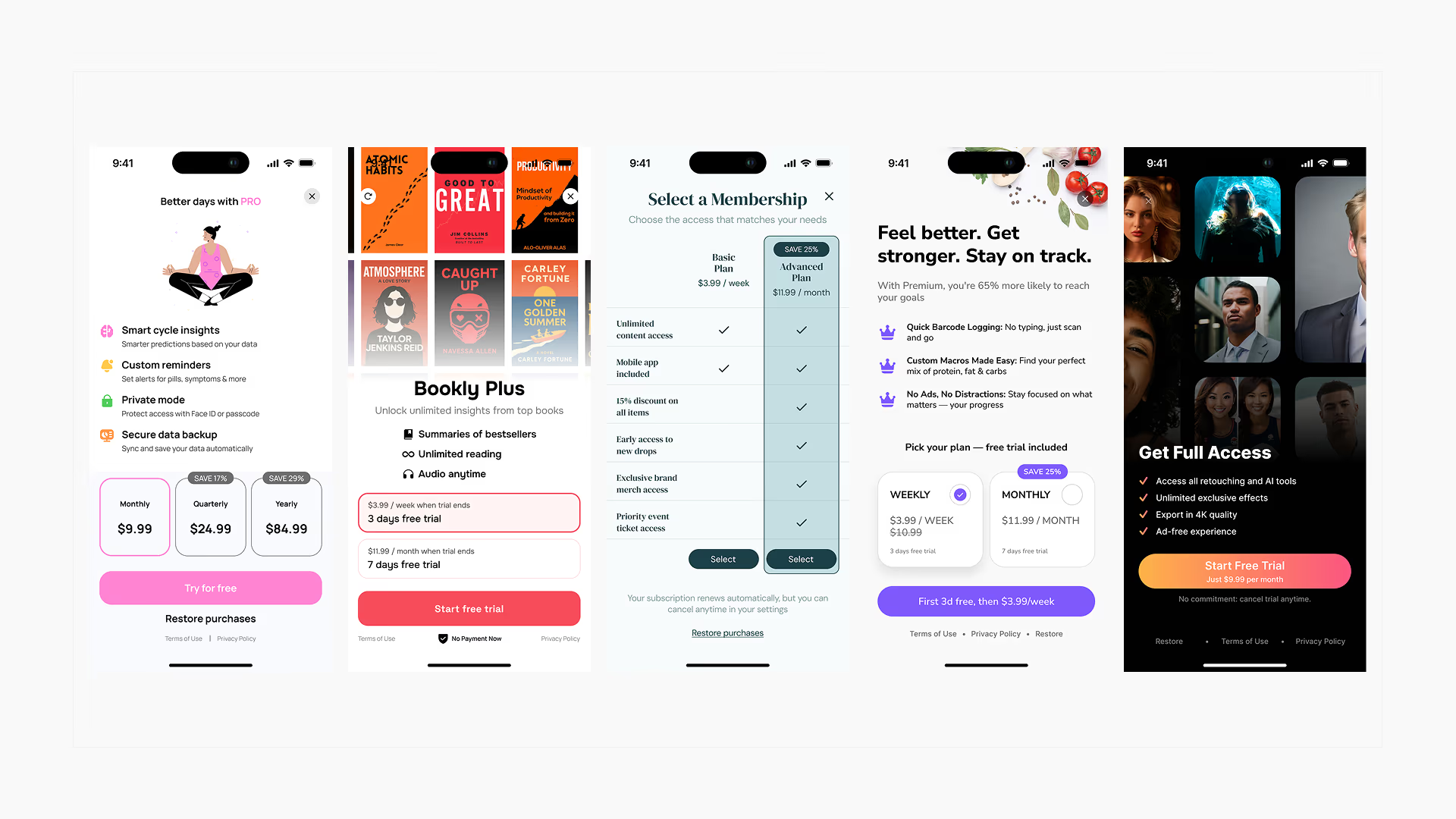
A high-performing paywall rests on a few simple principles: a value proposition that is clear in a few words, a recommended plan visually put forward, a trial or a guarantee that reduces perceived risk, and a visual hierarchy that guides the eye toward the action. The CTA label matters too. "Start for free" converts better than "Subscribe".
ASO: be found before you are judged
App Store Optimization is often treated as a formality. A title, a few keywords, generic screenshots. The result: an app invisible in search results, which depends 100% on its paid campaigns to exist.
💡 Key figure : According to AppTweak (2025), only 34% of non-gaming apps test their screenshots more than twice a year. Which means the majority of your competitors do not optimize their visuals regularly. That is a real window of opportunity.
Sticker Editor is the most direct example: by rebuilding only their store screenshots with firstapp, they gained +20% downloads. No new features, no extra ad budget, no product rebuild. Just visuals that communicate the app's value better in 2 seconds.
The ASO optimization is not limited to keywords. It covers the title, the subtitle, the short description, the screenshots, the icon, Custom Product Pages, and the ratings strategy. All of that acts on two distinct metrics: your visibility in search results, and your conversion rate once the user lands on your listing. The two are independent. A well-ranked app with mediocre screenshots loses downloads at the last step. Our complete App Store ASO guide covers all of these levers in detail.
The store rating is often underestimated in an ASO strategy. 90% of apps featured on the App Store have a rating ≥ 4.0 (AppTweak, 2025). Below that threshold, you do not get featuring. And without featuring, your organic acquisition is structurally capped. Sticker Editor worked on its review-collection strategy from launch: reaching the first 100 reviews quickly was a decisive lever for making the listing credible and triggering the first organic conversions.
Retention: keep what you have acquired
Acquiring a user costs on average 3 to 5 times more than retaining one. Yet retention is often the last priority of product teams, until the moment churn starts to offset acquisition and growth stalls.
Median annual retention on subscriptions is 28% according to RevenueCat (SOSA 2026), down from previous years. Out of 100 annual subscribers, 72 do not renew. If your acquisition does not offset that delta every month, you cap out.
An retention strategy that works runs through several levers: relevant, contextual push notifications (not generic broadcast), engagement loops in the product, well sequenced lifecycle emails, and cohort tracking to identify precisely where users drop off.
A specific point for apps on Google Play: 31% of Android churn is involuntary, caused by billing failures. That is double the rate observed on the App Store (14%), according to RevenueCat. If your user base is mostly Android, treat billing failure as a retention lever in its own right, not as a bug to fix someday.
Monetization: sell better, not more expensively
Increasing your LTV does not always go through a price increase. Often it goes through a better offer structure, proposing the right plan at the right moment, with the right billing period.
A concrete example from RevenueCat data (SOSA 2026): showing the annual price as a monthly equivalent generates +30% trial starts and +10% take rate on the annual plan. Not a new feature, not a price cut, just a change in how it is displayed.
The monetization structure is also worked at the level of contextual upsells, reactivation offers, and one-time purchases for users who refuse the subscription. According to RevenueCat, the monthly reactivation rate after churn sits between 18 and 24% depending on geography. It is a segment very few apps activate properly.
Jam Solidaire, supported by firstapp, reached €1M in annual revenue with 15,000+ active donors and an average basket of €13–€14. Not by raising prices. By working precisely on the structure of the donation path, the timing of follow-ups, and the value anchor before the ask. If the question freemium, subscription, or one-time purchase is not yet settled in your roadmap, that is often where everything starts.
Mobile app audit: where to start
Before touching anything, you have to know what to touch. That is exactly what a mobile app audit does when it is structured. Not a 40-slide report with generic recommendations, but an opinionated diagnosis that identifies the precise points of friction, quantifies them against sector benchmarks, and proposes fixes prioritized by business impact.
What a firstapp audit covers
At firstapp, the diagnosis is strategic and 360°. It adapts to the product: native mobile app, web app, or both. The axes analyzed vary with the context, ASO and store listing for mobile apps, organic acquisition and landing page for web apps, onboarding and monetization in every case. Each axis is scored /10, benchmarked on RevenueCat 2026 and AppTweak 2025 data, and paired with concrete recommendations ranked by estimated impact.
Another important point: the audit is not necessarily global. If you already know your problem is the onboarding, a disastrous D1 retention rate, users dropping off before they even reach the paywall, we can concentrate the entire diagnosis on that axis and go much deeper in the analysis. Same thing for the paywall: if your acquisition works but your conversion is flat, we focus everything on offer structure, timing, copywriting, and the psychological biases in play. An audit focused on a single axis is not a cut-down audit. It is often the most useful format when the problem is already identified.
"That's expensive for just recommendations." That is the most frequent objection, and it rests on a false picture of what an audit is. A firstapp audit is not a PDF sent by email. It is a 45-minute briefing call to understand your business, a full diagnosis benchmarked on data from 115,000 applications, a report with the 5 priorities ranked by impact, and a 1h30 to 2h debrief call during which we take each point apart together. The deliverable is an actionable roadmap the next morning.
"Why you rather than a CRO freelancer?" A generalist CRO freelancer optimizes web sales funnels. That is a different job. Mobile app optimization has its own mechanics: App Store scoring, D35 conversion benchmarks by monetization model, paywall trigger timing, billing failure handling on Android, ASO specifics by platform. These are levers most web CRO profiles do not master. At firstapp, that is all we do.
"Our dev is not available to implement." The great majority of recommendations from an audit do not require a developer: paywall copywriting, the order of onboarding screens, store visuals, offer structure, CTA labels. These are elements a product manager or a designer can change directly. Technical fixes are identified separately and planned according to your constraints. During the briefing call, we map together what can be implemented immediately.
The 3 firstapp audit packages
| What is included | Audit | Audit + fix | Monthly CRO |
|---|---|---|---|
| Async brief (questionnaire) | ✓ | ✓ | ✓ |
| Prior briefing call (45 min) | ✓ | ✓ | ✓ |
| 360° strategic diagnosis | ✓ | ✓ | ✓ |
| Scoring /10 + sector benchmarks | ✓ | ✓ | ✓ |
| PDF report + top 5 priorities | ✓ | ✓ | ✓ |
| Debrief call (1h30–2h) | ✓ | ✓ | - |
| Definition of 3 target KPIs | - | ✓ | ✓ |
| Metric tracking + micro-adjustments (30 days) | - | ✓ | ✓ |
| 2 check-ins during the fix (30 min) | - | ✓ | - |
| Final before/after report on the KPIs | - | ✓ | - |
| Continuous iterations (A/B, paywall, ASO…) | - | - | ✓ |
| 2 calls/month + Slack access | - | - | ✓ |
| Minimum commitment | - | - | 3 months |
The fix starts when you are ready to implement
An important detail on Audit + fix: the 30-day count starts on the date of your first implementation, not on signature. If you need two weeks to mobilize your technical team, those two weeks do not count. The work is timed on the real work, not on the calendar.
"30 days is too short to see results." The reverse is true on the priority levers. The first signals on the paywall and the onboarding arrive in 2 to 3 weeks, early enough to adjust during the 30 days. The final before/after report is there to document it, figures included. What 30 days cannot measure is the impact on retention at 60 or 90 days. That is precisely why monthly CRO exists.
"A 3-month commitment is too long." Below 3 months, we cannot iterate properly. The first month is for implementing and watching the first signals. The second is for adjusting and testing. The third is for measuring the real impact and identifying the next levers. Shortening that cycle means optimizing in a vacuum, without enough data to know what actually works.
Received ideas about optimizing an app
"We already tried to optimize, and nothing changed."
That is the most revealing objection. In 90% of cases, what founders have "tried" is: changing the design without looking at the data, changing several things at once without knowing what worked, or working on the wrong lever because the real problem had not been identified. Optimization without a method is tinkering. What changes with a structured diagnosis is that we know exactly what to touch, in what order, and how to measure the impact.
"Our app is running, we'll look at optimization later."
Every week without optimization is cohorts of users going through a suboptimal experience and not coming back. The problem with "later" is that bad reviews accumulate, churn sets in, and the reputation builds in the wrong direction. Climbing back from a 3.2-star rating takes much longer than never falling there.
"We optimize, but without solid data."
Rebuilding the onboarding because "it doesn't feel smooth" without having looked at the analytics is moving blind. Before any mobile optimization effort, tracking has to be in place. Without data, you do not know what you are optimizing, and you will not know if it worked. The first lever to activate is not the design. It is measurement.
"We're going to rework everything at the same time."
Changing the onboarding, the paywall, and ASO in the same week makes it impossible to know what worked. Disciplined iteration, one lever at a time, systematically beats the big project. It is not a question of caution. It is a question of data readability.
"A conversion problem is necessarily a design problem."
A low conversion rate is almost never a design problem. It is often a problem of message, timing, or offer structure. Changing the CTA colors when the paywall arrives too early in the journey will have no effect. Identifying the real cause before intervening is the only way not to solve the wrong problem.
FAQ
How much does optimizing a mobile app cost?
A mobile app audit from firstapp is €1,500, delivered in 5 business days. The other offers are on the Pricing page. In every case, the return on investment is measurable: fixing a paywall that converts at 1% when your sector is at 5% can represent several thousand euros of extra revenue per month.
What is the difference between ASO and app optimization?
ASO concerns only your store listing: title, keywords, screenshots, description. That is what determines whether you are found and whether people download. Mobile app optimization covers everything that happens after download: onboarding, retention, paywall, monetization. The two are complementary. Optimizing one without the other is filling a leaky bucket.
How long does it take to see results after an optimization?
Some changes are visible in a few days, notably on the paywall or the onboarding. Others, like ASO or retention, take 4 to 8 weeks to stabilize in the data. After a mobile app audit and the first implementations, the key metrics start to move within 2 to 6 weeks depending on the levers activated.
My app is recent. Is it useful to optimize this early?
Yes, and even necessary. Optimizing early avoids creating user habits on a suboptimal experience. The first cohorts are the most valuable for data. Better to track and fix from launch than to catch up 6 months later with a bad store rating, old negative reviews, or structural churn that is hard to reverse.
Do you need a developer to implement an audit's recommendations?
The majority of recommendations from a mobile audit concern copywriting, screen order, paywall structure, or store visuals, elements a product manager or a designer can implement without a developer. Technical fixes (trigger timing, native A/B testing, billing retry) require a dev resource. During the prior briefing call, we identify together what is in your immediate implementation scope.
Also read
Mobile experimentation: our method for optimizing a B2C app
Mobile experimentation runs through seven steps: data, problem, hypothesis, prioritization, experiment, measurement, and learning. The goal is to learn faster, not to multiply tests.

My mobile app isn't converting: the complete diagnosis
An app that isn't converting often has a decent product and a blocked funnel. The block is in onboarding, the paywall, the trial, pricing, the store listing, or Android billing.
How do I know if my mobile app needs to be optimized?
If your D1 retention rate is below 25%, your paywall conversion is under 2%, or your store reviews are stuck under 4.0 stars, your app has identifiable optimization levers. According to RevenueCat (SOSA 2026), the median D35 conversion is 2.1% in freemium and 10.7% on a hard paywall. Compare your figures with these references. The gap tells you where to intervene first.