How do you reduce churn in a mobile app?
Cutting churn from 2% to 1% can double LTV. About 31% of Google Play cancellations are payment failures, versus 14% on iOS.

Article summary
- Cutting churn from 2% to 1% can double a subscriber's LTV.
- About 31% of Google Play cancellations are payment failures, versus 14% on iOS.
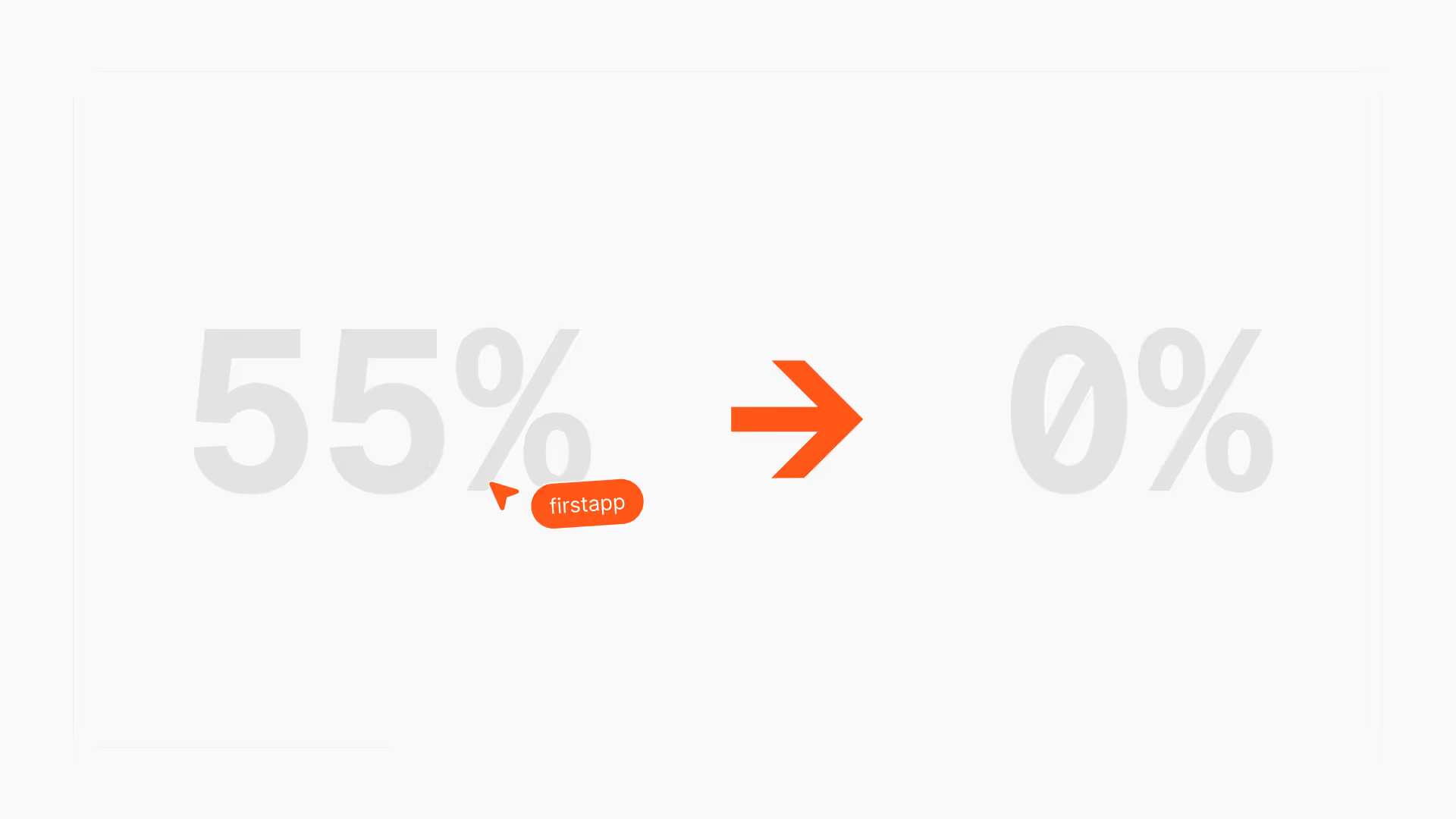
- 55% of trial cancellations happen on day 0, before the user has really used the app.
- Trials of 17 to 32 days convert at 45.7%, versus 26.8% for trials of 3 to 7 days.
- 18 to 24% of monthly subscribers who churned come back and subscribe again.
Summarize this article with
Cutting your churn from 2% to 1% can double your LTV. This figure is not an approximation: it is a mechanical consequence of how a subscriber's lifetime value is calculated. And yet most apps attack the wrong problem when they want to reduce their churn.
firstapp audits apps regularly. What we see: the majority of founders treat churn as a post-paywall retention problem, while for many of them the real problem is at J0 or in payment failures. Two causes. Two radically different treatments.
Voluntary churn vs involuntary churn
This is the distinction almost no French-language article makes. And it is the most important one.
The voluntary churn is a conscious decision by the user: they cancel because they no longer see the product's value, because they found an alternative, because they no longer use the app. This is the churn you try to reduce by improving onboarding, engagement, and the product experience.
The involuntary churn is not a decision. It is a technical failure: an expired card, a limit reached, a Google Play or App Store payment problem. The user did not mean to unsubscribe. They were simply pushed out of the system without knowing it.
The numbers are clear on the scale of the problem. According to RevenueCat (State of Subscription Apps 2026), about 31% of cancellations on Google Play are caused by payment failures, not by product dissatisfaction. On iOS, that figure drops to 14%. In other words, on Android, almost a third of your apparent churn is not real churn.
These two problems do not have the same solutions. Improving your onboarding does not recover a user whose card has expired. And implementing a payment retry does not retain a user who stopped using the app because they no longer see its value.
| Type | Share of total churn | Cause | Solution |
|---|---|---|---|
| Voluntary | ~86% iOS / ~69% Android | Dissatisfaction, disengagement | Onboarding, engagement, cancel flow |
| Involuntary | ~14% iOS / ~31% Android | Payment failure | Grace period, retry, winback |
Source: RevenueCat State of Subscription Apps 2026
Newsletter
Once a week.
Last issue
We opened 10 apps to see how they sell a subscription.
+534 people read us each week
J0 churn: your first enemy
This is the most important figure in this article.
According to Adapty (State of In-App Subscriptions 2026), 89.4% of trial starts happen on day 0, meaning the day of install. And according to RevenueCat (SOSA 2025), 55% of trial cancellations also happen on day 0, before the user has even had time to use the app.
What that means: your largest trial churn is not caused by a bad product experience. It is caused by a decision made in the first minutes, often at the very moment of seeing the paywall for the first time.
A user who cancels their trial at J0 has typically lived through one of these scenarios:
- They started a trial to access a specific feature, used it, then canceled immediately so they would not be charged
- They saw the paywall before understanding the app's value and refused to start the trial
- They started the trial out of curiosity with no real intention to subscribe
J0 churn is not a retention problem. It is a problem of onboarding and paywall placement. If your paywall appears before the user has had their click of understanding about your app's value, you mechanically manufacture J0 churn.
The solution is not to lengthen the trial period. It is to make sure the user has experienced the app's core value before reaching the paywall. To go further on this, our article on J0 trial cancellations covers the levers specific to this critical moment.
Churn benchmarks by category
Before you optimize your churn, you need to know whether your current churn is good or bad. What is acceptable in one category can be catastrophic in another.
| Category | Median annual retention | Estimated monthly churn |
|---|---|---|
| Productivity | 85.6% | < 1.5% |
| Health & Fitness | ~68% | ~2.7% |
| Education | ~60% | ~4% |
| Entertainment | ~45% | ~6% |
| Global median | ~28% (Y1 renewal) | ~3% |
Sources: RevenueCat SOSA 2026 - Adapty State of In-App Subscriptions 2026
A monthly churn under 3% is generally considered acceptable for a subscription app, but this global benchmark hides very different realities by vertical. A productivity app at 3% monthly churn is underperforming. An entertainment app at 3% is performing very well.
💡 Key figure : The most useful figure for placing yourself: compare your Y1 renewal rate (the first renewal of an annual subscription) with the benchmarks for your category. The global median renewal is 28% according to RevenueCat, with considerable gaps between categories.
How to reduce voluntary churn
Fix onboarding before anything else
Early voluntary churn (J0 to J30) is almost always an onboarding problem. The user did not understand why your app was worth its price, because the app did not give them the means to understand it.
The rule: the user must have reached their aha moment before arriving at the paywall, and they must have had time to build a first habit before the end of their trial. A 3-day trial is not enough to create a habit. For an app whose value shows up over time (fitness, wellbeing, learning), a 14 to 30 day trial structurally generates less end-of-trial churn than a 3 or 7 day trial.
The correlation is documented: apps with trials of 17 to 32 days convert at 45.7% trial-to-paid versus 26.8% for trials of 3 to 7 days (Adapty 2026). A longer trial is not a gift handed to the user. It is extra time for your app to do its job.
Building habits during the trial
A user who has built your app into their daily routine does not unsubscribe. Churn comes from users who do not have that routine.
The documented levers for creating the habit during the trial: streaks and visible progress (each completed session generates a progress signal), contextual and non-intrusive notifications (a reminder at the right moment, not in bulk), and continuous personalization based on usage (the app that adapts to the user creates more attachment than the generic app).
Calyra (ex-Nutria), one of our clients at firstapp, reached 2% monthly churn from launch by building in, from the design stage, engagement mechanics that create a routine around using the app.
Implement a cancel flow
This is the most underused lever in French apps.
A cancel flow is a sequence triggered when the user taps "Cancel my subscription." Instead of letting them leave directly, the app offers an alternative: a one-month pause, a downgrade to a cheaper plan, or a loyalty discount.
On iOS, Apple has allowed "win-back offers" directly in the cancel flow since iOS 15. On Android, Google Play offers "Save" offers. These mechanisms are available natively and documented. Most French apps do not implement them.
Industry data shows that well-implemented cancel flows recover between 15% and 30% of users who intended to cancel. This is not a dark pattern. It is giving the user an option they may not have considered.
Push toward the annual plan
This is the structural change with the most impact on long-term retention.
12-month retention by plan type according to RevenueCat SOSA 2026: 44.1% for annual plans, 17.5% for monthly plans, 3.4% for weekly plans. A user on an annual plan is 13 times more likely to still be active in 12 months than a user on a weekly plan.
Converting your monthly users to an annual plan is not just a question of immediate revenue. It is a structural reduction of your churn. To understand how to feature the annual plan on your paywall without losing conversion, the setup with the annual pre-selected and shown as a monthly cost increases trial starts by 30% according to RevenueCat.
How to reduce involuntary churn
Involuntary churn is recoverable at 80-90% if you have the right mechanisms in place. Most apps have none.
Turn on grace periods
Grace periods are windows of time during which the user keeps access to the app even if their payment has failed. The App Store and Google Play both offer native grace periods (configurable in App Store Connect and Google Play Console).
On iOS, Apple offers a default grace period of 6 days on annual subscriptions, 16 days on monthly subscriptions. On Google Play, the default grace period is 3 days but can be extended up to 30 days.
During this window, the user keeps using the app and the platform automatically tries to renew the payment. If you have not turned on grace periods, your app cuts access immediately on payment failure. That is often the main source of involuntary churn.
Implement proactive communication
The platform handles the technical retry. You handle communication with the user.
An email or a push notification sent within 24 hours of a payment failure, with a clear message ("Your payment failed, update your card to keep access") recovers a significant share of users who did not know their card had expired.
This message should be factual, not guilt-inducing. And it should arrive before access is cut, not after.
Spot expiring-card signals
Some payment SDKs (RevenueCat, Adapty) can detect ahead of time that a user's card expires within the next 30 days. That information can be used to send a preventive message before the payment fails.
This is the most effective form of involuntary-churn recovery: intercept the problem before it becomes a payment failure.
Winback: your lost subscribers are not lost
This is the most ignored lever in French apps' churn strategies.
According to RevenueCat (SOSA 2026), 18 to 24% of subscribers who churned come back and subscribe again on monthly plans. A former subscriber is your most qualified prospect. They know your product. They have already paid once. The psychological barrier is lower than with a new user.
iOS "Win-Back Offers" (available since iOS 17.2) and "Resubscribe" promotions on Google Play let you target these former subscribers with a specific offer: a first period at a reduced price, a free month, a trial extension. These offers are visible only to users who were subscribed and no longer are.
The winback sequence that works according to industry data:
- J+3 after cancellation: cancellation confirmation email, a reminder of what they lose
- J+7: an educational email about a feature they used (not a promo)
- J+14: a comeback offer with a time-limited discount
- J+30: a last attempt, a different offer or a downgrade option
This sequence is not aggressive. It is based on the value the user has already experienced, not on commercial pressure.
FAQ
What is a good churn rate for a mobile app?
A monthly churn under 3% is generally considered acceptable for a subscription app according to industry benchmarks. But this figure varies sharply by category: productivity apps reach 85.6% annual retention (meaning under 1.5% monthly churn), while entertainment apps can have churn of 5 to 7% per month without that being abnormal. Always compare your churn with the benchmarks for your specific category, not with the global average.
Why do users unsubscribe from a mobile app?
Reasons for unsubscribing fall into two categories. Voluntary churn covers product dissatisfaction, lack of use, discovering an alternative, or a price judged too high. Involuntary churn covers payment failures: an expired card, a limit reached, a technical problem. According to RevenueCat 2026, 31% of cancellations on Google Play and 14% on iOS are involuntary. These two types of churn have different solutions and must be treated separately.
How do you reduce involuntary churn on Android?
Three main levers. First, turn on grace periods in Google Play Console (up to 30 configurable days) to give the platform time to renew the payment before cutting access. Second, send a proactive message within 24 hours of a payment failure, before access is cut. Third, use the expiring-card alerts available via RevenueCat or Adapty to anticipate failures before they happen.
Does a cancel flow really reduce churn?
Yes. Well-implemented cancel flows recover between 15% and 30% of users who intended to cancel, by offering them an alternative (pause, downgrade, discount). On iOS, Apple lets you offer native "Win-Back Offers" in the cancel flow since iOS 15. On Android, Google Play offers "Save" offers. These mechanisms are available without complex development via SDKs such as RevenueCat or Adapty, and they are barely used by French apps.
How do you reactivate subscribers who churned?
Former subscribers are your most qualified prospects: they know your product and have already paid once. According to RevenueCat 2026, 18 to 24% of churned subscribers come back on monthly plans. Use iOS Win-Back Offers (iOS 17.2+) and Google Play resubscribe promotions to target them with a dedicated offer. Complete that with an email sequence in 3 to 4 steps over 30 days, based on perceived value and not on commercial pressure.
Also read
Why users cancel their trial within 24 hours
55% of trial cancellations happen on day 0, before the app is really used. A longer trial does not fix that. Value has to come before the paywall.

Mobile app retention rate: the 2026 benchmarks
The median annual retention of a subscription app is 28% in 2026, according to RevenueCat across 115,000 apps. It was 31% the year before.
How to keep your users on a mobile app
25% of mobile apps are opened only once. The first session, those first 3 minutes, decides whether the user comes back at J+1.
How do you calculate a mobile app's churn rate?
The monthly churn rate is calculated by dividing the number of subscribers lost during the month by the number of subscribers at the start of the month, multiplied by 100. Example: if you have 1,000 subscribers on January 1 and 50 cancellations in January, your monthly churn is 5%. Be careful to separate volume churn (number of subscribers lost) from revenue churn (revenue lost): if your highest-paying users churned, the impact on your MRR can be greater than the volume rate suggests.