How do you build a dating app in 2026?
For the first time since 2012, the dating app market shrank in 2025. Tinder lost 5.2% of revenue and Bumble 9.5%, while PURE and Hinge grew.

Article summary
- In 2025, Tinder lost 5.2% of revenue and Bumble 9.5%, the first market decline since 2012.
- PURE reached $100 million in annual revenue, with 46% growth.
- Hinge grew 25% in 2025 and generates $691 million in annual revenue.
- 70% of dating market revenue comes from subscriptions.
- The uninstall rate reaches 62.4% among non-organic users.
Summarize this article with
For the first time since Tinder was created in 2012, the dating app market shrank in 2025. Tinder lost 5.2% of its revenue. Bumble dropped 9.5%. The two biggest dating apps in the world are losing paying users at the same time.
And yet, over the same period, PURE, a dating app for Gen Z, reached $100 million in annual revenue with 46% growth. Grindr, Feeld, and niche apps keep growing. Hinge grew 25% in 2025.
That paradox says everything about the state of the market in 2026: generalist apps are running out of steam, and apps that serve a precise community with a distinct experience are growing. Building a dating app that succeeds in 2026 is not building "the next Tinder". It is identifying the segment the giants serve badly, and serving it better than they do.
firstapp works with founders on complex B2C projects. This guide gives you a complete, factual view of the market, the mechanics that work, and what you really have to build to exist in this sector.
1. The state of the market: the first decline in its history
The global dating app market generated a little more than $6 billion in 2025, slightly down for the first time since the industry was created (Business of Apps, 2026). More than 350 million people use dating apps worldwide, of whom only 23 million pay for premium features.
The figures by app give a more precise picture of what is happening:
- Tinder : 75 million MAU, 9.8 million subscribers, revenue down 5.2% in 2025, the app's first decline in its history
- Bumble : 50 million MAU, 3.6 million paying users, revenue down 9.5% in 2025
- Hinge : 32 million users, 1.7 million paying subscribers, revenue up 25% in 2025
- Grindr : 13.7 million MAU, $260 million in revenue in 2024, and growing
- PURE : $100 million in annual revenue, 46% growth in 2025
Info: iOS represents 80% of mobile revenue in the dating app sector (Business of Apps, 2026). 70% of total revenue comes from paid subscriptions. Microtransactions (boosts, roses, superlikes) make up most of the rest and are growing fast.
The conclusion that follows: the generalist market is saturated and in decline. Niche apps, and those that offer a radically different experience (Hinge, PURE), keep growing. That is the clearest opening for a new founder.
To understand the global mobile market this sector sits in, our guide on building a mobile app for a startup lays the useful foundations.
Newsletter
Once a week.
Last issue
We opened 10 apps to see how they sell a subscription.
+534 people read us each week
2. Rule No. 1: do not build the next Tinder
This is the most important conversation to have before you write a line of code. Building a generalist dating app in 2026 - profile, photos, swipe, match - means competing directly with Tinder (75 million users), Bumble (50 million), Hinge (32 million), and about ten other players established for years. You will not win.
The reason niche apps win is mechanical: in a generalist app, every user is competing with millions of others. In a niche app, the community is tighter, the profiles are more coherent, and the rate of real matches is much higher. Users stay because it works better, not because the app has more features.
The underlying trend: verticalization of the dating market
The real trend of 2025–2026 is verticalization. The big generalist apps are losing ground while a new generation of hyper-specific apps finds its audience. This shift is not anecdotal. It is the direction the whole market is taking.
Here are concrete examples of vertical apps that exist and work:
For athletes and fitness people. Fitafy brings together 600,000 users around a simple principle: find someone who shares the same sports habits, the same diet (vegan, keto, vegetarian), the same health goals. The app integrates Apple Health and Google Fit to show recent activity directly on the profile. Surveying their community, the founders found that 100% of active athletes judged it essential that their partner share their lifestyle, and 100% found it impossible to find that profile on Tinder or Bumble.
For Muslims. Salams (formerly Minder) is the reference app for Muslim singles looking for a partner while respecting Islamic values. It lets you filter by level of religious practice, family background, and life plans. Swipe anonymity, the option to blur photos for women wearing the hijab, and strict community moderation make it a product radically different from generalist apps, and extremely well received by its target community.
For vegans. Veggly is a dating app reserved exclusively for vegans and vegetarians. The principle: filter out from the start the dietary and ethical incompatibilities that often create friction in mixed relationships. The niche is small overall, but engagement is extremely strong because users know exactly why they are there.
For people who love travel. Fairytrail connects people whose lifestyle is nomadic, or who want to travel with a partner. Profiles show destinations visited, travel plans, and the types of experiences they are looking for.
For alternative relationships. Feeld is for people in open relationships, polyamorous people, or people exploring non-conventional forms of relationship. A niche the generalist apps treat as too marginal, which nevertheless generated growing revenue in 2025.
For professionals and the elite. The League selects its members based on their LinkedIn profile. The app positions itself as a dating space for ambitious, career-driven people looking for profiles at their level, with a waitlist that creates scarcity and desire.
For people who want to slow down. Thursday only works one day a week: Thursday. The idea: fight swipe fatigue by creating urgency and intention. If you match on Thursday, you arrange to meet that same week. The app took off quickly in London before expanding to other cities.
What these apps have in common: they solve a problem generalist apps cannot solve by definition - the lack of real compatibility on what matters most to their users. The niche is not a limitation. It is the product.
The niches still open in France
The French-speaking market is still poorly served by local vertical apps. Concrete opportunities exist around: active seniors (50+), people with disabilities, French-speaking religious communities (practicing Catholics, Jews, evangelicals), single parents, and French expats in major cities worldwide. These segments are actively looking for an app that understands them, and the competition there is almost nonexistent compared with the generalist market.
3. What Hinge, PURE, and Grindr do differently
As in the fitness or women's healthsectors, the apps that are growing in 2026 all have one thing in common: they made a radical choice and stuck to it.
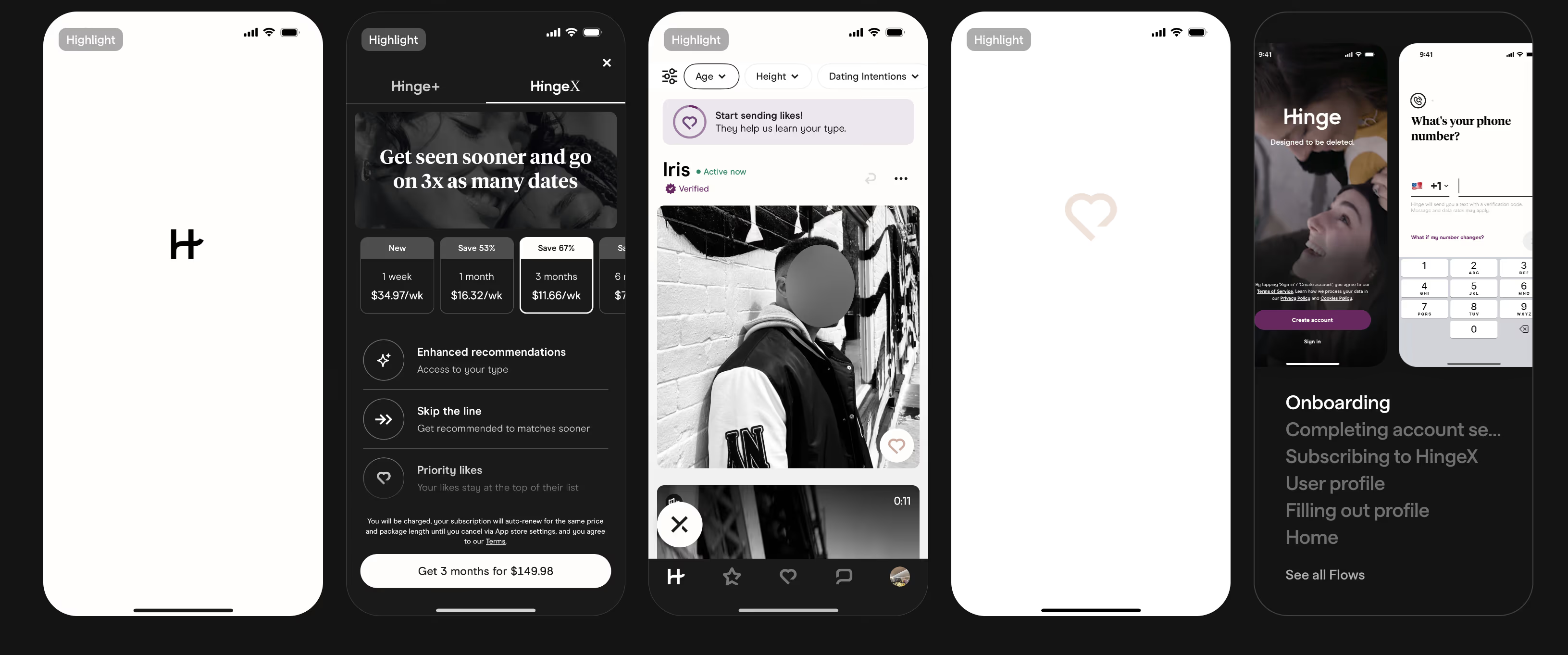
Hinge: "Designed to be deleted"
Hinge is the most instructive story in the dating market in 2026. Acquired by Match Group for a handful of millions in 2018, it now generates $691 million in annual revenue, and grew 25% in 2025 while Tinder and Bumble declined.
The difference: Hinge took the opposite of Tinder on every product decision. No swipe, prompts. Not a simple photo profile, answers to personality questions. Not optimization for match volume, optimization for real dates. The tagline "designed to be deleted" is not marketing: it is a real product constraint. Hinge wants its users to find someone and leave. That counterintuitive positioning creates a trust Tinder cannot reproduce.
The result: 27% of couples formed through a dating app in 2024 used Hinge, ahead of Tinder (25%) and Bumble (20%) (The Knot Real Weddings Study, 2024).
PURE: the feed format against the swipe
PURE is proof that the dating market is not closed to new entrants, provided you offer something truly different. The app does not work like Tinder: no swipe, a feed design based on explicit desires and intentions, ephemeral profiles that disappear to create urgency, and a strong culture of consent and transparency.
By targeting Gen Z, which suffers from swipe fatigue and looks for more intentional connections, PURE reached $100 million in annual revenue with 95% growth in sign-ups in 2025, while Tinder was losing subscribers. All of it without a massive acquisition budget: product-market fit and word of mouth did the work.
Grindr: community as the absolute competitive advantage
Grindr has served the gay, bi, and queer community since 2009. 13.7 million MAU, $260 million in revenue, and one of the highest ARPUs (average revenue per user) in the entire dating industry, thanks to Grindr Unlimited subscriptions billed at $25 to $50 a month.
The lesson: when an app truly understands its community - its codes, its needs, its specifics - users pay more and stay longer. Grindr does not need features Tinder does not have. It needs to be the place where its community finds itself. That is an advantage generalist apps cannot buy.
4. The essential features of a dating app
The viable minimum of a dating app
A viable dating app V1 needs four fundamental blocks:
The user profile. Photos, a description, basic information (age, location, orientation). The level of detail depends on your positioning: a generalist app asks for little, a niche app can ask for more (values, lifestyle, relationship intentions). In every case, the profile has to be filled in fast enough not to discourage people at sign-up, and rich enough to allow relevant matching.
The discovery mechanism. The swipe (Tinder, Bumble), the feed (PURE), the profile grid (Grindr), algorithmic suggestions (Hinge): each format creates a different experience and attracts a different type of user. This choice has to align with your positioning. An app for intentional connections cannot work with mass swipe.
Messaging. Simple, native, real time. The quality of the conversation experience is often what separates apps that retain from apps that do not. Opening prompts (like Hinge), stickers, reactions, voice messages: each added layer can increase engagement if it reduces the friction of the first conversation.
The match system. The logic that decides who sees whom, in what order, with what priority. It is the algorithmic heart of the app and the hardest part to get right.
You have a mobile app project? Get an estimate of your project in a few minutes: Request a quote
What you do not need to build in the V1
In-person events built into the app, live video, voice calls, compatibility games, full personality tests - all of that can wait. In the V1, you have to validate that your core value proposition works: the right profiles find each other, conversations start, meetings happen. Once that cycle is validated, you add layers.
5. Onboarding and the matching algorithm
Onboarding: the first impression that decides everything
A dating app's onboarding is particularly delicate for a precise reason: users have to share personal information (photos, age, orientation, intentions) before they have seen anything of the product. The friction is real, and every extra step drops the completion rate.
What works: a progressive onboarding that starts with the minimum (email, date of birth, gender, orientation), immediately shows a few matching profiles, then asks for photos and the rest once the user has seen that the app exists and works. Curiosity is the best driver of completion.
What kills conversions: asking for a photo before showing anything, forcing a Facebook or Instagram connection on the first screen, an identity-verification process that is too long before the first match.
Verification. In 2026, safety is a selling point in dating apps. Tinder's Face Check reduces exposure to bad actors by more than 60% (Match Group, 2025). Bumble says verified profiles are 56% more likely to receive matches. Integrating a simple photo verification (selfie + a specific pose) from the V1 improves both trust and engagement.
For the onboarding mechanics that maximize conversion, our article on mobile onboarding optimization covers the techniques that apply directly.
The matching algorithm: the real added value
The algorithm is what brings a user back - or what disappoints them and leads them to uninstall the app. The uninstall rate in dating apps is one of the highest in the entire industry: 62.4% for non-organic users, 57.8% for organic users (AppsFlyer, 2025). The main reason: users do not find what they are looking for, or the flow of suggested profiles does not match their expectations.
A reasonable V1 matching algorithm takes into account: geographic location, age, orientation, explicit criteria (height, children, lifestyle), and an activity score that prioritizes recently active profiles over abandoned ones.
As you collect behavioral data (who liked whom, who matched with whom, which profiles trigger conversations), the algorithm can learn and improve. That is the data flywheel established apps have and new entrants do not, which is why it matters to start in a niche where the audience is qualified and the data becomes usable faster.
6. Monetization: what works in 2026
70% of dating market revenue comes from subscriptions (GetStream, 2026). The rest comes mainly from microtransactions. Advertising and one-time purchases represent a marginal share.
The subscription: the dominant model
The premium subscription unlocks features that increase the chances of a match: seeing who liked your profile, visibility boosts, advanced filters, unlimited superlikes. Subscription prices have risen sharply over these past two years:
- Tinder Gold: €14.99 to €29.99/month (Apple App Store, 2026)
- Hinge+: €34.99/month
- Bumble Premium: €19.99 to €39.99/month
These prices are deliberately high. They have also contributed to the decline of Tinder and Bumble: users judge that the benefit does not justify the price. For a new entrant, that is an opening: a cheaper subscription with a clearer value proposition on the target niche.
For paywall and pricing mechanics, our article on mobile paywall optimization details the structures that maximize conversions.
Microtransactions: a powerful complement
Visibility boosts (your profile pushed to the top for 30 minutes), superlikes, Hinge "roses": these one-off purchases generate significant revenue without asking for a monthly commitment. Hinge made roses a central mechanic of its experience: sending a rose is a strong signal that stands apart from a simple like. The result: a microtransaction that actually improves the experience and generates revenue.
A well-calibrated freemium
The free version has to be useful enough for the user to stay and see the product's value, but limited enough that they want to move to premium. Hinge's limit of 8 free likes a day is a well-calibrated example: it forces selectivity (which improves match quality), while creating a gentle frustration that pushes toward premium.
7. What firstapp would do on your dating project
Dating apps have a specificity few agencies really understand: the product is the community. An app with no users is useless. And an app with poorly balanced users (too many men, not enough women, or an audience that does not match the promise) retains no one.
At firstapp, we think distribution and community before we think features. Here is what we would do concretely on a dating project.
What we would handle before coding
The chicken-and-egg problem first. It is challenge No. 1 of every dating app: you need users to attract users. An empty app retains no one. The strategy for the first 1,000 profiles is a product decision, not a marketing one. It decides whether you geolocate first on a single city, whether you manually invite a precise community, whether you do a waitlist launch to create scarcity.
Gender or community balance from the start. On a heterosexual app, a strong men/women imbalance kills the experience on both sides. On Tinder, the ratio is 75% men / 25% women, which creates structural frustration. Bumble partly corrects that imbalance with the "women message first" mechanic. On your app, the acquisition strategy for each side of the community has to be thought through separately and at the same time.
Niche positioning as a competitive advantage. As with all our verticals, we ask the question before we code: which underserved segment are you addressing? Which community will give you the first 500 users who will talk about it to their friends?
The growth loops we would design
The social invite. "Invite a friend to join the app" with a shareable profile that makes people want to. The sophisticated version: suggest the user invite specific friends from their contacts who match their search, with a personalized message generated automatically.
The verification badge as a trust and conversion signal. Verified profiles receive more matches. That is proven (Bumble: +56%). We design verification as a desirable feature, not a constraint: a visible badge, priority in suggestions, a "verified profiles only" filter for premium users. Verification becomes a reason to subscribe.
Content generated by the app. "Here is your dating profile according to your swipes": a visual card generated automatically from the user's behavioral data. Shareable, surprising, TikTokable. "My app says I am looking for someone creative, adventurous, and independent. It is right."
Shareable success. When two users match and organize a date through the app, offer to share "we matched", with no details, anonymously and optionally. The rate of couples formed through dating apps (27% in 2024) is a strong argument. If your app can show its success stories, it builds social proof that cannot be bought.
What we would make TikTokable
Dating content is some of the most consumed on TikTok. Dating-app founders who show the backstage of their product - matching data, the first couples formed, the process of designing the algorithm - capture an engaged, qualified audience.
"I analyzed the most-matched profiles on my app. Here is what they have in common."Real data from your app, anonymized. This content is fascinating for anyone who uses dating apps - that is, hundreds of millions of people.
"Why I built a dating app for [your niche], and what I discovered while building it."The build-in-public version of dating. Design decisions, mistakes, the first users - this format creates attachment and credibility even before launch.
"What the data really says about how people use dating apps."Swipe fatigue, match rate, conversation-to-date conversion rate: numbers nobody sees and everybody wants to know.
What we would make TikTokable and viral on Instagram
Dating content is among the most consumed on TikTok and Instagram. Founders who show the backstage of their app - real data, first couples, design decisions - capture a qualified, engaged audience. Here are the concrete formats we would design from launch.
TikTok, the formats that generate installs:
"Build in public: I am building a dating app for [your niche]."A weekly journal format. You show the real product decisions: how you chose the algorithm, why you dropped the swipe, which profiles you rejected at sign-up to keep community quality. This format creates an emotional attachment to the project even before launch - people download because they followed the build.
"I looked at the first 100 profiles created on my app; here is what I learned."Anonymized, your first users' data is fascinating. Which sports do they play? What levels of religious practice? What relationship intentions? This content is both transparent about your community and useful for future users who want to know if the app fits them.
"The first couple formed through our app."The testimony of the first match that led to a real relationship is one of the most powerful pieces of content a dating app can have. Authentic, emotional, shareable. If you can film a couple telling how they met on your app, that content gets shared widely.
"Here is why I did not build the next Tinder."A point-of-view format. You explain your niche choice, why the generalist market is saturated, and what convinced you there was room for something different. This content attracts both potential users and founders interested in your approach.
"POV: you create your profile on our app for the first time."A screen recording of the onboarding in real time, with a voiceover commenting on the questions and what they reveal about the niche. If your onboarding is careful and specific to your community, it is filmable and interesting.
Instagram, the formats that get saved:
Carousel: "Why generalist dating apps exhaust you - and what we built instead."Slide 1: the problem (swipe fatigue, an unbalanced men/women ratio, matches that go nowhere). Slides 2 to 7: why it happens, what is structurally missing in generalist apps. Slide 8: your app as the answer. This carousel gets saved by people who recognize themselves in the problem, and shared with friends living the same thing.
Carousel: "The online dating stats nobody shows."27% of couples formed through an app in 2024. A 62% uninstall rate. A 0.6% average match rate for a man on Tinder. These figures are staggering and create immediate engagement. You close with your app as a better-calibrated alternative.
Reels: "What a good profile looks like on [your app's name]."You show two or three anonymized (or fictional) profiles - one too generic, one well filled in - and you explain what makes the difference on your app specifically. Educational, useful, directly tied to the product.
Stories: polls on the dating habits of your niche."Have you ever struggled to find someone who shares your level of sports practice?" / "Does your partner's diet matter to you?" Simple questions that publicly validate the problem you solve, and that show your audience exists and recognizes itself.
In a dating app, user safety is a legal and ethical responsibility. We would integrate from the V1: photo verification at sign-up, one-tap reporting, instant blocking, and a clear policy on profile moderation. These features are not optional. They decide whether your app can be published and kept on the App Store over the long term.
FAQ: dating app
Is it still possible to launch a dating app in 2026?
Yes, provided you are not trying to compete with Tinder head-on. The generalist market is saturated and in decline. Niches are growing: PURE (Gen Z), Grindr, Feeld, and BLK all grew in 2025 while the giants declined. The opportunity is precisely in the segments the big apps serve badly - out of disinterest, misunderstanding, or because they are too small for their economic model.
Which monetization model should you choose for a niche app?
The premium subscription remains the dominant model (70% of sector revenue). For a niche app, a subscription cheaper than Tinder or Bumble, with a clear value proposition on the community, is the natural entry point. Microtransactions (boosts, highlights, special messages) can complement it, but they are not a primary model on a niche with limited volume.
How do you handle user safety on a dating app?
Profile verification (selfie + a specific pose, like Bumble), one-tap reporting, instant blocking, and a clear moderation policy are the four minimum pillars. Tinder's Face Check reduced exposure to bad actors by more than 60% (Match Group, 2025). In Europe, the Digital Services Act imposes extra obligations on platforms that allow interactions between users. Consult a specialized lawyer before launch.
How long does it take to develop a dating app?
A serious iOS V1 (profile, matching, messaging, photo verification, subscription) takes 8 to 12 weeks with a dedicated team and a scope locked up front. Profile moderation, report handling, and security testing systematically add 2 to 3 weeks if they are not anticipated in the initial plan.
What is the main reason dating apps fail?
A lack of user density at launch. A dating app with few profiles does not offer relevant matches, which makes the first users leave, which makes the app even less useful for the next ones. It is a negative spiral that is hard to reverse. The solution is to choose a niche or a geographic area narrow enough to reach critical density quickly, rather than launching globally with a user profile that is too broad.
Also read
How do you build a social network in 2026?
Niche social networks grow by more than 50% a year in active users. Strava, Letterboxd, and Discord show that a specific community beats a generalist network.
How do you find your first 100 app users?
More than 14,700 subscription apps launch every week. The ones that last recruit their first 100 users one by one, and only open acquisition once retention is proven.
How do you solve the chicken-and-egg problem at launch?
Several approaches have proved themselves: launch in a single city with an intense local acquisition campaign (a university, a neighborhood, a precise community), build a waitlist before launch to create scarcity and desire, manually invite the first profiles through partnerships with existing communities (associations, Facebook groups, forums). The goal of the first months is not global growth. It is reaching enough density in a narrow perimeter for the app to be useful.