How do you build an app in education in 2026?
Duolingo has 135 million monthly active users and 50 million daily active users. An educational app is won by getting the user to come back, not only by teaching.

Article summary
- Duolingo has 135 million monthly active users and 50 million daily active users.
- The mobile educational apps market is valued at $7.5 billion in 2024.
- Conversion rates for educational apps were 16% on iOS and 30% on Google Play in 2024.
- The streak is described as Duolingo's most important feature, ahead of the lessons.
- 81% of Duolingo's revenue comes from subscriptions.
Summarize this article with
Duolingo was acquired by Google for $1.1 billion in 2025. The app has 135 million monthly active users, 50 million daily active users, and generated $748 million in revenue in 2024, up 41% year over year.
Its secret is not having invented language learning. It is having understood that the real problem of an educational app is not teaching, it is getting people to come back. Streaks, hearts, leagues, the green owl: everything is designed to create a daily habit, not to maximize the speed of learning.
The market for mobile educational apps is one of the most dynamic in the digital economy in 2026: $7.5 billion in revenue in 2024, with expected annual growth of 27.3% through 2034. But it is also one of the markets where conversion rates are the lowest, and where retention is challenge number one.
firstapp works with founders on B2C projects where engagement is at stake. This guide explains what you really have to build to launch an educational app that works.
1. The EdTech market in 2026: the data that matters
The global EdTech market was estimated at $187 billion in 2025, with projected annual growth of 10.8% through 2033 (Grand View Research, 2025). Focusing specifically on educational mobile apps, the market is valued at $7.5 billion in 2024 and is expected to reach $83.8 billion by 2034, annual growth of 27.3% (Market.us, 2025). It is one of the highest growth rates in the entire mobile sector.
The big platforms give the scale of the market:
- Duolingo : 135.3 million MAU in Q3 2025, 50 million DAU in Q3 2025, $748 million in revenue in 2024 (+40.8% year over year), 9.5 million paying subscribers, 960 million total downloads. Acquired by Google for $1.1 billion in 2025.
- Coursera : 197 million registered learners, $757 million in revenue in 2025 (+9% year over year)
- Khan Academy : 189.6 million registered users, 66.8 billion minutes of learning in 2024-2025
- Khanmigo (Khan Academy's AI tutor): 2 million users, up 731% in one year
Info: The K-12 segment (kindergarten through the end of high school) represents 38.9 to 45.9% of the mobile EdTech market depending on the source (Grand View Research, Market.us, 2025). Professional training and corporate learning are the most profitable segment: they represent 67% of revenue per end user (Grand View Research, 2025).
An important figure to anticipate: conversion rates for educational apps are among the lowest on the entire App Store, 16% on iOS and 30% on Google Play in 2024 (Business of Apps, 2025). By comparison, fitness or health apps convert 2 to 3 times more. The reason: learning takes an effort that watching a series or buying something does not. This constraint has to steer every design and monetization decision.
For the general context of the mobile market, our guide on building a mobile app for a startup is a useful complementary read.
Newsletter
Once a week.
Last issue
We opened 10 apps to see how they sell a subscription.
+534 people read us each week
2. Choosing your segment: the 5 main families of educational apps
As in the fitness sector or fintech, the first decision is the segment. "Building an educational app" without choosing a precise audience and subject means competing with Coursera, Duolingo, and Khan Academy at the same time, a battle lost in advance.
K-12: children and teenagers
This is the widest segment (45% of the mobile EdTech market). It covers school learning from kindergarten through the end of high school: math, reading, languages, science. The customers are the parents - they pay, they decide the download, and they judge the value on their child's progress.
This segment is demanding on data security (GDPR for children, COPPA in the United States), on pedagogical quality, and on the child's engagement. Gamification is particularly effective there - and expected. Parents pay well for apps that have a measurable impact and that they can show their child without guilt.
Language learning
Duolingo defined this segment. Babbel, Busuu, Rosetta Stone, Pimsleur: competition is strong on the generalist side. But niches exist: learning Korean for K-pop fans, Japanese for anime fans, dialectal Arabic, business French for African professionals. Segments Duolingo serves imperfectly because they are too small for its model.
Professional training and upskilling
This is the most profitable segment of EdTech. Professionals pay for skills that have a direct return on investment: web development, data science, design, digital marketing, business languages, management soft skills. The CAC is higher than in B2C, but retention is much better - someone taking a course to move forward professionally has a strong intention and low price sensitivity.
LinkedIn Learning, Udemy, and Coursera dominate here. But the market for mobile micro-learning apps (5-10 minutes a day on a precise subject) is much less saturated.
Exam and certification prep
Middle-school exams, the baccalauréat, entrance exams to grandes écoles, professional certifications (GMAT, TOEIC, AWS, accounting): a very results-oriented segment, where the user has a deadline and strong extrinsic motivation. Churn risk is low because the exam date creates a natural obligation. Monetization is often a one-time purchase or a short-term subscription.
Creative learning and hobbies
Learning to play guitar, to draw, to cook, to code for fun, to take photos: a segment where motivation is intrinsic and where the short-video format (like Yousician for music) or an interactive format works very well. Users are adults, they have discretionary time, and they willingly pay for a pleasant experience.
3. What Duolingo understood that nobody manages to reproduce
Duolingo is the absolute case study of mobile EdTech. Not because its pedagogy is revolutionary - linguists debate its real effectiveness - but because its retention mechanics are among the best designed in the entire mobile industry.
The streak: the most powerful mechanic in EdTech
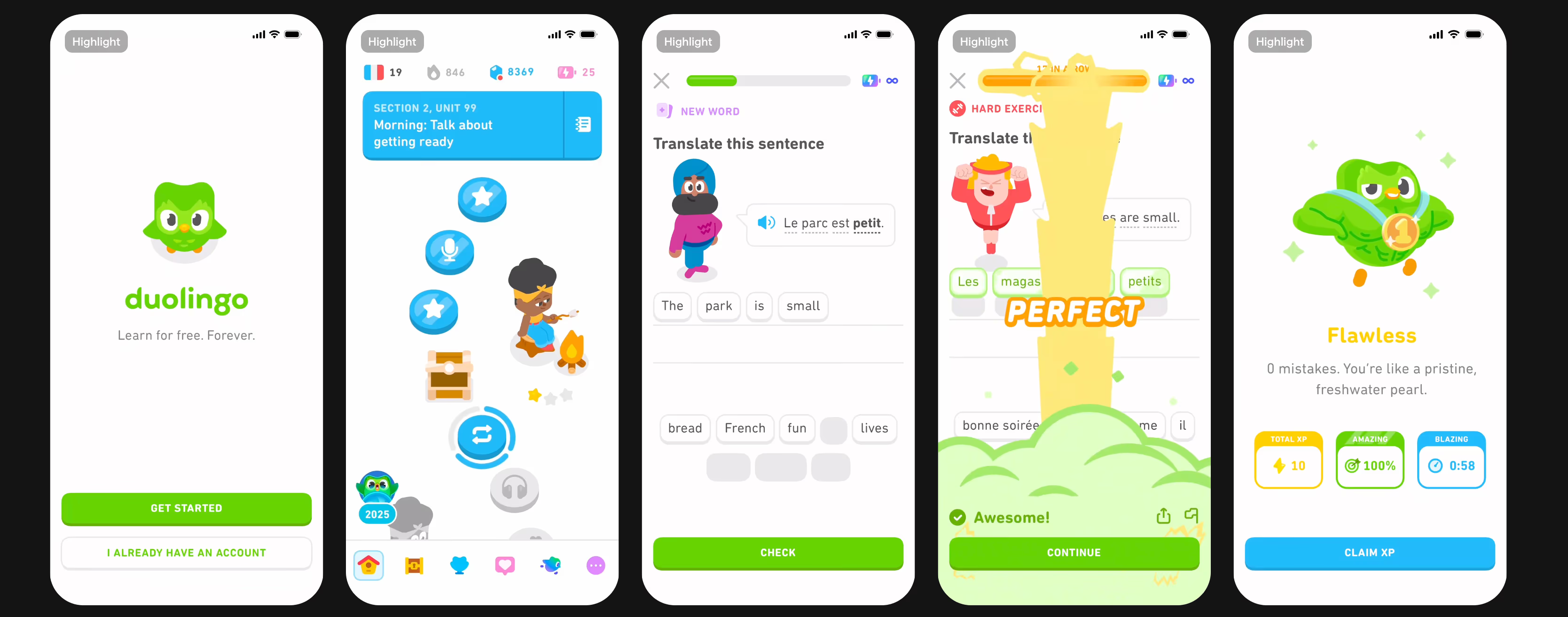
The Duolingo streak - your number of consecutive days of learning - is the most important feature of the app. Not the exercise-selection algorithm. Not the quality of the lessons. The streak.
Why? Because it exploits two powerful cognitive biases at once: loss aversion (losing a 200-day streak is more painful than never having had one) and identity consistency (someone with a 30-day streak starts to define themselves as "someone who learns a language every day"). When you lose your streak, Duolingo sends you a notification with the owl Duo who "cries". The guilt is designed into the product.
In Q3 2025, Duolingo crossed 50 million daily active users, with DAU growth of 36% year over year. This figure - the DAU/MAU ratio - is the real measure of an educational app's health. Duolingo has a ratio of 37%, among the highest in the entire mobile industry.
Hearts: the pressure of making a mistake
Duolingo's hearts (lives) system is a loss-aversion mechanic: each mistake costs a heart, and when you have none left, you have to wait or pay. This mechanism forces attention and creates a slight anxiety that increases engagement - while also creating pressure toward premium (Duolingo Plus removes the heart limit).
Leagues: social competition
Every week, users are grouped into leagues according to their activity level. The top 10 move up a league, the last ones move down. This competition creates extra engagement, especially at the end of the week, when users check their ranking and do extra sessions so they do not drop.
TikTok marketing as a growth loop
80% of Duolingo users come from organic channels: word of mouth, viral content, brand campaigns. The "Duo is dead" campaign in early 2025 - where Duolingo announced the "death" of its owl mascot, with videos of the bird hit by a Tesla Cybertruck - went viral on TikTok and Instagram before the media even picked it up. This level of cultural presence is the result of a social-media strategy built over years around the mascot as a pop character - not a massive advertising budget.
4. The engagement mechanics that actually make the difference
Duolingo did not invent these mechanics. But it systematized them better than any educational app before it. Here is what you have to build into your app from the V1.
Spaced repetition
Spaced repetition is the pedagogical technique most scientifically proven for long-term memorization. The principle: review a concept just before you would have forgotten it, at intervals that widen over time. If you learn a vocabulary word today, the app shows it to you again tomorrow, then in 3 days, then in a week, then in a month.
This mechanic naturally creates regular sessions - since the app always has something for you to review today. It is a retention engine built into the pedagogical structure.
Microlearning
The ideal learning session on mobile lasts between 5 and 15 minutes. Beyond that, the drop-off rate climbs. Educational apps that have understood this cut their content into short lessons, with a clear start and end, visible progress, and a sense of accomplishment at the end of each session.
This micro format is the opposite of 2-hour courses copied from the classroom. It is not the same thing. A 2-hour video course on a mobile app is Coursera - and it takes a very strong intention to learn. A 10-minute module a day is Duolingo - and it can become a daily habit even for someone who "does not have the time".
Visible progress and celebrations
Every level passed, every lesson completed, every badge earned - the app has to celebrate. Not excessively, but consistently. Visible progress is the fuel of intrinsic motivation. A user who clearly sees that they are moving forward continues. A user who does not know where they stand leaves.
Personalized AI: the 2026 lever
Khan Academy's Khanmigo AI tutor reached 2 million users in 2024-2025, a 731% increase in one year. AI in education is no longer a promise. It is a reality. An educational app that adapts its content to the user's real level, identifies their specific gaps, and offers targeted exercises, delivers an experience no static textbook can reproduce.
In 2026, integrating a light AI layer into a mobile educational app has become a minimum standard, not a differentiating feature. What differentiates is the quality of that personalization - the precision with which the app adapts the difficulty, the pace, and the format of the exercises to each user.
The smart notification, not the intrusive one
Educational apps that work use notifications as a kind reminder, not as spam. The right format: a daily notification at the time the user chose themselves during onboarding, with a message that mentions their streak or their personal goal. Generic notifications ("Time to learn!") have very high opt-out rates. Personalized notifications ("You have 3 days left before you lose your 14-day streak") work because they speak to something the user built themselves.
5. Onboarding and monetization: the EdTech specifics
Onboarding: set a goal before you start
The onboarding of an educational app has a precise role: turn a vague curiosity into a concrete commitment. "I would like to learn something" is not enough to create a habit. "I want to learn digital marketing to change jobs in 6 months, and I am available 15 minutes a day in the morning" - that is a commitment that can generate retention.
The best educational apps ask these questions from onboarding: what is your precise goal? By when? How much time can you give it per day? Based on the answers, they generate a personalized plan and show an estimated arrival date. This initial commitment is the first anchor of retention.
For the onboarding mechanics that maximize conversion, our guide on mobile onboarding optimization applies directly to EdTech.
Monetization: freemium with the right limits
The dominant model in mobile EdTech is freemium. Duolingo is the canonical example: all the content is free, but premium removes the annoying limits (hearts, ads) and adds personalization features. 81% of Duolingo's revenue comes from subscriptions.
The key to educational freemium: the free version has to be good enough for the user to understand the product's value and actually progress - but limited enough that premium is a real jump in comfort. The limit that works best is not access to content (frustrating, perceived as an abusive paywall) but the removal of friction: ads, session limits, offline access.
For paywall structures that convert, our article on mobile paywall optimization covers the mechanics that apply to EdTech.
The annual subscription as a retention lever
A user who pays annually is much more likely to keep using the app - because they made an investment and want their money's worth. In EdTech, this effect is even stronger: learning is a long-term project, and the annual subscription creates alignment between the financial commitment and the pedagogical commitment.
Educational apps that offer an annual plan shown as a monthly equivalent (€4/month rather than €49/year) and a monthly plan at a deterrent price (€12/month) naturally steer toward the annual - and in return generate better retention and more predictable revenue.
6. What firstapp would do on your educational project
An educational app is perhaps the hardest mobile project to do well. Not because the technology is complex - but because the product has to succeed where traditional education often fails: make learning desirable, regular, and measurable for users who have a thousand other demands on them.
At firstapp, we think retention before we think features. In EdTech, retention is not one metric among others. It is the product.
What we would design first
The streak from the V1. The streak mechanic is not an optional feature to add in V2. It is the heart of the retention engine. We would build it into the first version, with the daily notification logic, streak protection (streak shield), and a visual celebration at the end of each completed session.
The personal goal in onboarding. Before showing a single lesson, we have the user define their precise goal (what they want to learn), their deadline (why now), and their daily availability. Based on those answers, we generate a personalized progression plan with an estimated arrival date. This initial contractual commitment is the first anchor of retention.
Visible progress at every session. A progress bar in the lesson, a score at the end, a badge unlocked, a celebration animation - every session has to end with a sense of accomplishment. That is what brings them back tomorrow.
Light AI personalization. You do not need a complex AI model in the V1. Adaptive difficulty logic - which goes up when the user succeeds, and comes down when they fail - is enough to create an experience perceived as personalized. We integrate it from the V1 because it is a 2026 expectation, not a premium feature.
The growth loops we would design
The shareable streak. "I have been learning [subject] for 30 days in a row" - a visual card generated automatically, shareable on Instagram Stories or WhatsApp. This content creates organic exposure at every milestone, with the app name visible.
The challenge between friends. "Challenge a friend to learn [subject] with you for 7 days." Every challenge sent is a direct acquisition invitation. Competition creates extra engagement for both participants. Duolingo built a significant part of its retention on this mechanic.
The shareable completion certificate. At the end of a module or a course, the app generates a certificate with the user's name, the subject mastered, and the total time invested. This certificate is shareable on LinkedIn - a natural acquisition channel for professional-training apps.
The weekly summary. Every Monday, the app sends a recap of the previous week: time learned, progress, streak maintained, comparison with the week before. This format creates a habit of checking in and provides shareable content for social networks.
You have a mobile app project? Get an estimate of your project in a few minutes: Request a quote
7. How to acquire your first users
TikTok: education performs better than entertainment
Educational content is among the most consumed on TikTok. The hashtag #LearnOnTikTok has passed 600 billion views. The EdTech niche has a particularity: quality pedagogical content is naturally shareable, because people like to share what they have learned.
"The 80/20 rule nobody teaches on [your subject]."Pure educational format. You teach the most useful thing in your field in 60 seconds. No product pitch - just value. People share because it is useful, discover your app through your bio, download. Duolingo built a massive TikTok community with this format on surprising linguistic anecdotes.
"I learned [skill] in 30 days with this app, here is my progress."Logbook format. You show the reality of learning: the difficulties at the start, the breakthroughs, the measures of progress. This format is authentic, makes people want to try the experience, and creates an emotional link with your app.
"The thing people do wrong when they learn [subject]."Common-mistake format. Short, engaging, very shareable. You show the mistake, explain why it is a problem, and show how your app avoids it structurally.
Put the mascot or the visual identity at the center.Duolingo proved it: a strong mascot creates a cultural presence advertising cannot buy. If your app has a character, a distinctive visual world, build content around that. People react to characters, not to features.
Instagram: the formats that build a qualified audience
Carousel: "Learn [subject] in 10 slides."The educational carousel format is the one that generates the most saves on Instagram - and saves are the strongest signal for the algorithm. A carousel that teaches something useful in 10 slides on your field gets saved, shared, and builds a qualified audience around your niche.
Reels: progress in fast-forward.30 seconds that show the beginner level versus the user's level after 4 weeks of learning with your app. This before/after format is natively engaging and gives concrete proof of the product's effectiveness.
Stories: interactive quizzes on your niche."Could you answer this question on [your subject]?" A story quiz with the answer on the next slide. This format creates engagement, positions your account as a learning source, and sends people who want to go further toward the app.
Reddit: active learning communities
Reddit hosts very active learner communities. A few subreddits to target depending on your niche:
- r/languagelearning (3.2 million members) - the largest language-learning community on Reddit. Daily questions on methods, apps, resources. If you are building a language app, this is your priority ground.
- r/learnprogramming (4.2 million members) - learners in web and mobile development. Active, welcoming, very hungry for tools and resources.
- r/GetStudying - learning methods, school productivity, exam prep.
- r/GetMotivated - motivation and personal development, overlaps with upskilling apps.
- r/france - for French-speaking apps, education discussions there are regular.
The format that works: answer existing questions with real expertise, then mention your app when it is directly relevant. "I built an app that solves exactly this problem - if you want to test the beta, I will send you a link" generates invested early adopters.
For a complete acquisition strategy, our guide on how to get your mobile app known covers every method in detail.
FAQ: educational app
What is the difference between an educational app and an e-learning app?
The two terms often overlap, but there is a nuance: e-learning generally means long structured content (courses, training) consumed actively and intentionally. A mobile educational app can be lighter - daily microlearning, spaced repetition, gamification - and aims to create a regular learning habit rather than consumption of long content. Duolingo is a mobile educational app. Coursera is an e-learning platform. Both models work, but they do not address the same learning intention or the same moment of use.
Can you build an educational app without being a teacher or a pedagogue?
Yes - but the pedagogical content is the heart of the matter. An app with perfect design and mediocre pedagogical content does not retain. Two options: partner with a pedagogy expert who brings the content, or start from a niche where you yourself have solid expertise. Your app's content is as important as the development. Plan for it in the budget and the schedule.
How do you monetize an educational app in 2026?
The dominant model is freemium with a subscription: free content accessible to everyone, premium that removes friction (ads, session limits) and adds personalization features. The annual subscription shown as a monthly equivalent is the structure that maximizes both conversion and retention. 81% of Duolingo's revenue comes from subscriptions (Duolingo FY2024). Professional-training apps can also work on one-off course purchases or enterprise licenses.
How long does it take to build an educational app?
An iOS V1 with educational content, a streak, personalized onboarding, and a paywall takes 6 to 10 weeks with a dedicated team and a fixed scope. The bottleneck is often the pedagogical content - if you have to produce dozens of lessons, exercises, and levels, that production can take as long as the development itself. Plan it up front, not in parallel with the build.
Can an educational app target both children and adults?
Technically yes - but it is a frequent positioning mistake. Children and adults have radically different motivations, ways of learning, and purchase-decision paths. An app for children speaks to parents (who pay, evaluate pedagogical quality, and care about data security). An app for adults speaks to autonomous learners (who pay for themselves and look for a return on their time). Choosing a precise segment makes the product, the onboarding, and the communication far more effective.
Also read
Mobile app onboarding: Duolingo, Calm, and Headspace, decoded
60% of a mobile app's conversions happen in the first week, and 55% of cancellations of a 3-day trial happen on Day 0. Duolingo anchors motivation, Calm makes you feel the product, Headspace personalizes the path.
How to keep your users on a mobile app
25% of mobile apps are opened only once. The first session, those first 3 minutes, decides whether the user comes back at J+1.
How do you retain users on an educational app?
Retention is the central challenge of EdTech. The mechanics that work: the daily streak (like Duolingo), the personal goal set in onboarding, personalized notifications at the time the user chose themselves, progress celebrations at every session, and challenges between friends that create a social obligation. Retention is designed into the product from the V1. It is not bought with re-engagement campaigns.