How do you build a fintech app in 2026?
Revolut has 55 million customers worldwide, including 5 million in France. A fintech app launches with a license or a regulated partner, then a KYC onboarding.

Article summary
- Revolut has 55 million customers worldwide and 5 million in France.
- The global fintech market is valued at $395 billion in 2025.
- An electronic-money institution license takes 12 to 18 months with the ACPR.
- Banking-as-a-Service lets you offer an account, a card, and transfers without waiting for your own license.
- Below 4.0 stars, the article describes a fintech app as invisible in App Store search.
Summarize this article with
Revolut has 55 million customers worldwide. In France, it is now its largest user base in Europe, 5 million people in France, with a stated goal of 10 million by the end of 2026. The British neobank is investing $1.1 billion in France and setting up its European headquarters in Paris.
That figure says two things at once: the French fintech market is massive. And the competition there is brutal.
Building a fintech app in 2026 is not coding a banking interface and publishing it on the App Store. It is navigating a hyper-regulated sector, building a trust the user does not grant easily, and finding the precise segment where you can create more value than the players already in place.
firstapp works with founders on projects with strong product constraints. This guide gives you a complete, factual view of what launching a fintech app actually involves, from regulation to monetization.
1. The fintech market in 2026: the data that matters
The global fintech market is valued at $395 billion in 2025, with projected annual growth of 16.3%, a market expected to reach $1,533 billion by 2034. It is one of the fastest-growing sectors in the entire digital economy.
Revenue from fintech apps specifically (excluding infrastructure) reaches $2.99 billion in 2024 and should pass $12 billion by 2034. The mobile payments industry generated more than $20 billion in revenue in 2024, up 8.5% year over year (Business of Apps, 2025).
Info: 69% of publicly listed fintech companies became profitable in 2024, versus less than half the previous year. The sector is moving from a growth-at-all-costs logic to a logic of real profitability. That is good news for new entrants that build solid business models from the start.
Two structural dynamics to keep in mind for 2026:
Mobile payments are accelerating. By 2030, 53% of in-person purchase value will be transacted via mobile, about $25,000 billion. Every service or product that sits in this payment chain has a real opportunity.
AI is the next fault line. The AI market in fintech is estimated at $30 billion in 2025 and should reach $83 billion in 2030. Offer personalization, fraud detection, credit scoring, automated financial advice: the apps that integrate AI into the core of their product now will have a durable competitive advantage.
To understand the global mobile market fintech sits in, our guide on building a mobile app for a startup lays the useful foundations.
Newsletter
Once a week.
Last issue
We opened 10 apps to see how they sell a subscription.
+534 people read us each week
2. The 6 segments of a fintech app: find your angle
Fintech is an umbrella term. It covers product realities, audiences, and levels of regulatory complexity that are radically different. Before you write a line of code, you have to know which segment you are playing in.
The neobank and the current account
Revolut, N26, Sumeria: this is the most visible and most competitive segment. Offering a mobile bank account with a card, transfers, currency exchange, and built-in budgeting. The barrier to entry is high: a banking license or a partnership with an authorized payment institution, significant investment in regulatory compliance, and user trust that is very hard to build against players that are already massively established.
Who it suits: projects with a very defined niche (an account for minors, an account for self-employed workers in a precise niche, an account for a specific community) and a budget sufficient for compliance.
Budget management and personal finance
Bankin', Linxo: apps that aggregate existing bank accounts and give a consolidated view of finances. Fewer regulatory barriers than a neobank (no banking license needed to aggregate read-only via DSP2), and a market that is still immature in France. Finary started on this positioning before evolving into a full investment platform - proof that aggregation can be an entry point toward much larger revenue.
Who it suits: founders who want to create value on the interface and on data intelligence without managing the complexity of a payment institution.
BNPL and installment payments
Klarna, Alma, Pledg: installment payments built into e-commerce journeys. Strong growth: 350 million users worldwide used BNPL apps in 2024 (Business of Apps). The business model rests on merchant commissions and interest on payment facilities.
Who it suits: B2B projects that distribute to merchants, not directly to the general public.
Savings and investing
Trade Republic, Yomoni, Bourse Direct: apps for stock-market investing, ETFs, crypto, and interest-bearing savings. This segment requires an investment-services provider license (PSI) in France, issued by the AMF. The regulation is heavier than for a simple payment institution.
Who it suits: teams with solid financial expertise and a long-term project.
Accounting and finance for professionals
Qonto, Shine, Pennylane: financial management tools for small businesses and the self-employed. Invoicing, accounting, tax filings, cash flow. The B2B market is less competitive than B2C, and users have a strong willingness to pay for tools that save them time on constraining tasks.
Who it suits: founders with knowledge of the professional world or of accounting, who want to address a precise professional niche (tradespeople, freelancers, restaurant owners…).
Crypto and digital assets
Bitstack, Coinbase, Binance: crypto wallets, exchange, staking, DeFi. A segment that is highly regulated in France since the PSAN regime (Prestataire de Services sur Actifs Numériques), progressively replaced by the CASP regime (Crypto-Asset Service Provider) with the implementation of MiCA in 2025.
Who it suits: technical teams with a deep knowledge of the blockchain sector and an appetite for regulatory compliance.
3. What Revolut, Sumeria, and Finary do
As in the fitness sector or women's health, the apps that dominate fintech each won by choosing a precise angle, and by executing it much better than everyone else.
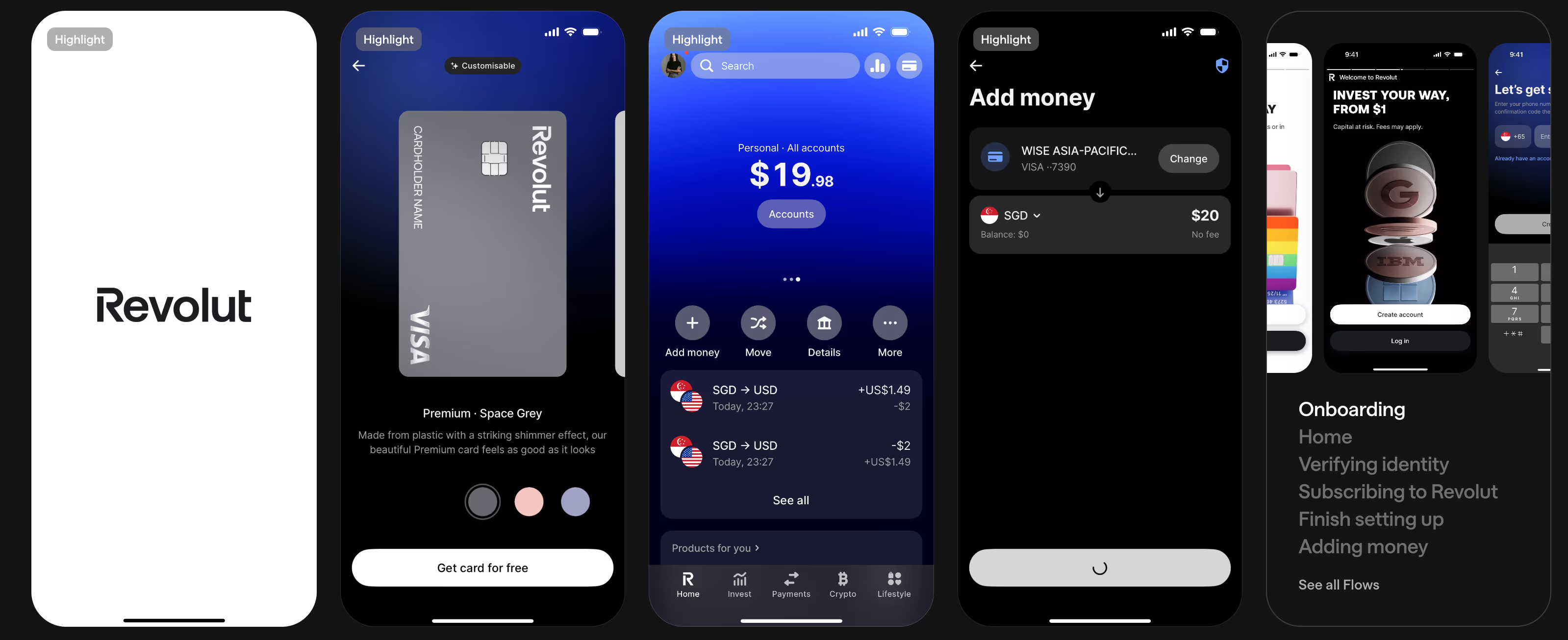
Revolut: the financial super-app
Revolut started in 2015 with a single idea: fee-free currency exchange for travelers. One obsession, one precise problem. Today, it is an app with 55 million customers, $4.1 billion in annual revenue, and a valuation of $45 billion.
Its trajectory is the perfect demonstration of progressive expansion: first master exchange, then add transfers, then the current account, then investing, then crypto, then insurance. Each feature added after the previous one was solidified, never everything at the same time.
In France, Revolut is the most-used fintech player with 5 million users, and it is aiming for 10 million by the end of 2026. The initial acquisition strategy rested on an extremely generous referral program: each user could unlock a metal card by inviting friends. A classic growth loop, executed at a time when nobody else was doing it in banking.
Sumeria (formerly Lydia): the bet on the French market
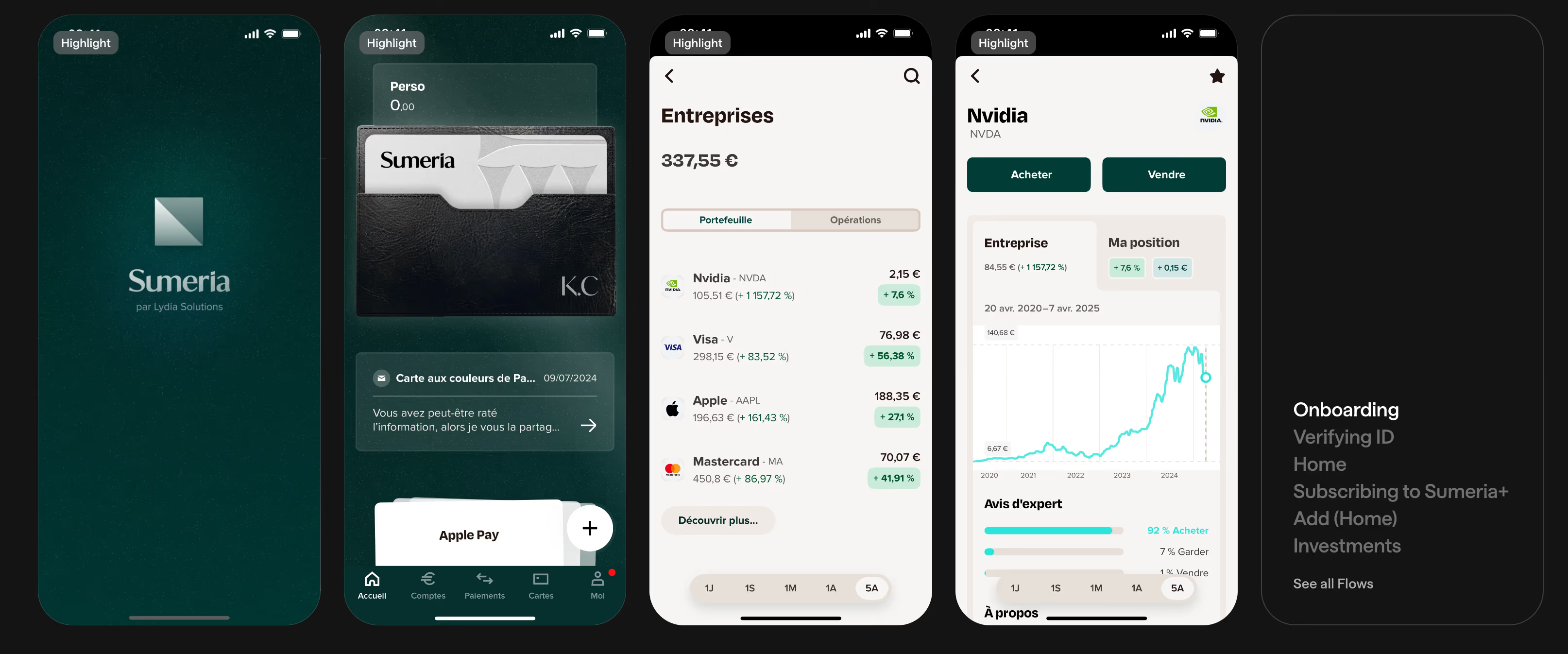
Lydia was launched in 2013 as a payment app between friends, simplified P2P transfer. It reached 7 million users in France by focusing exclusively on that market. In 2023, it obtained its own banking license from the ACPR. In 2024, it rebranded as Sumeria with the ambition of becoming the leading European bank for young people by 2030.
The lesson: start on an ultra-simple use case (sending money to a friend), master it in a precise geographic market, then look up toward something bigger. Depth in one market is worth more than width across several.
Finary: growth through content
Finary is the most instructive lesson in the French fintech market for a new founder. Launched in 2020 by Mounir Laggoune and Julien Blancher, the app starts as a wealth aggregator: bank accounts, real estate, crypto, stocks, everything in a single dashboard. It progressively turned into a full investment platform, with a life-insurance product in partnership with BlackRock and Generali, a private-wealth offer (Finary One, available from €500,000 in assets), and soon a PEA, a PER, and a securities account.
The concrete numbers: 600,000 users and profitability reached in the fourth quarter of 2024. In September 2025, Finary raised €25 million in a Series B from PayPal Ventures, LocalGlobe, Hedosophia, and its historical investors Y Combinator and Speedinvest. The total raised since launch reaches €38 million. The stated goal: €5 billion in assets under management within three years.
What differentiates Finary from all its competitors: its growth was initiated in large part thanks to its YouTube channel, hosted by Mounir Laggoune. A financial-education channel that built a community of several hundred thousand subscribers even before the app was mature, creating a qualified, convertible audience from the launch of each new feature. It is a content → trust → install growth loop that very few fintechs have managed to reproduce.
The lesson for a founder: distribution can be built before the product. An educational audience in your niche is a durable competitive advantage, especially in a sector where trust is the first barrier to adoption.
You have a mobile app project? Get an estimate of your project in a few minutes: Request a quote
4. Regulation: the subject that costs the most to ignore
Fintech is the only sector in this guide where regulation can stop your project even before it is launched. Ignored, it exposes your company to criminal penalties, fines from the ACPR, and a forced removal from the App Store.
The licenses to know in France
The electronic money institution (EME) lets you issue electronic money - in other words, hold user funds and issue cards. This is the license Lydia/Sumeria obtained and that Revolut uses via its French branch. Issued by the ACPR, a timeline of 12 to 18 months, minimum capital and governance requirements.
The payment institution (EP) lets you execute payments and transfers without issuing electronic money. Less constraining than the EME, but still subject to ACPR authorization.
The investment services provider (PSI) is required to offer investment services (stocks, ETFs, financial advice). AMF authorization, training and capital requirements.
The digital-asset service provider (PSAN / CASP) is required for everything related to crypto. France was a pioneer in Europe with its PSAN regime, which is evolving toward the European CASP regime with MiCA in 2025–2026.
The alternative: Banking-as-a-Service
Getting a license takes between 12 and 24 months and costs hundreds of thousands of euros in compliance, lawyers, and capital. Most fintech startups cannot afford that delay at launch.
The alternative: Banking-as-a-Service (BaaS). Players such as Treezor, Swan, Lemonway, or Stripe Treasury offer their regulated infrastructure white-label. You build the user experience, they handle compliance and hold the license. It is the regulatory shortcut that let dozens of European fintechs launch without waiting two years.
The cost: a commission on transactions, integration fees, and a dependency on a third party for critical functions. Plan for it in your business model from the start.
Warning: The DSP2 (Payment Services Directive 2) requires strong authentication (SCA) on all transactions. Concretely, your app must integrate a compliant two-factor mechanism, biometrics plus a code, or a notification plus a PIN. This is not a UX option. It is a legal obligation, and failing to comply exposes you to penalties. MiCA, in force since 2025 for digital assets, adds a specific regulatory layer for any app that touches crypto.
Why regulation is also a competitive advantage
Compliance is constraining. It is also a moat. Once you have your ACPR authorization, or you work with a solid BaaS partner, competitors who arrive after you have to go through the same process. Regulation creates a barrier to entry. Use it to your advantage.
5. Fintech onboarding: converting despite KYC friction
A fintech app's onboarding is the hardest to optimize of all app sectors. The reason: KYC (Know Your Customer) is mandatory for any app that handles funds. Identity verification, a supporting document, sometimes a video selfie: friction the user does not expect to go through to download an app.
Most fintech apps lose a significant share of their users during KYC onboarding. It is the statistic nobody displays, and the main reason fintech app conversion rates are structurally lower than those of fitness or health apps.
For the general mechanics of mobile onboarding, our article on optimizing mobile onboarding to boost conversion gives the full framework. What follows is specific to fintech.
Show the value before you ask for documents
The classic mistake: asking for identity verification as early as screen 2, before the user has seen anything of your app. The result: they abandon before understanding why they should go to that trouble.
The right approach: let the user explore the interface, see their potential dashboard, understand what the app can do for them, then ask for KYC when they are convinced. Revolut and N26 use this principle: you can see the app working in demo mode or with limited access before completing verification.
Split KYC into progressive steps
A complete KYC form presented all at once generates maximum friction. The solution: progressive KYC. You start with the minimum (email, name, date of birth), you activate the basic features, then you ask for supporting documents only when the user wants to access a feature that requires them (for example, transferring more than €150 or opening a savings account).
Explain why you ask for each piece of information
"Why do you need my ID card?" is the mental question every user asks at each KYC step. If your app does not answer it explicitly, with a short, honest sentence that recalls the legal constraint, you lose trust. A line such as "French regulation requires us to verify your identity to protect your funds" does more for the KYC completion rate than any loading animation.
Ask for reviews at the right moment: a trust lever unique to fintech
In most app categories, App Store reviews influence the conversion rate. In fintech, they decide whether someone downloads or not. Before entrusting their banking data or their savings to an unknown app, users systematically check two things: the overall rating and recent reviews. An app at 3.8 stars with comments mentioning transfer problems will not be installed, no matter how good its screenshots are.
That is why the review-collection strategy in a fintech app is not a secondary optimization. It is a pillar of acquisition.
The moment you ask for a review changes everything. The general rule applies here with even more force: never ask for a review during friction (KYC in progress, an apparent bug, waiting for validation). Ask for a review after an emotionally positive moment:
- After the first transfer received or sent successfully
- After the first budget insight that reveals a possible saving
- After reaching a savings goal
- After a prediction or a monthly recap that impresses
These moments create a favorable disposition. The user has just experienced something concrete with your app. Asking for a review at that precise instant generates positive responses, not indifferent ones.
The minimum rating to exist in fintech. Below 4.0 stars, your app is invisible in App Store search and its rating badge creates friction at install. Above 4.4 stars, the rating becomes a sales argument. The goal is not to manipulate reviews. It is to systematically ask satisfied users who, without an explicit request, would leave no comment.
Our article on how to get more reviews on your mobile app details the exact collection and timing mechanics.
Fintech offers more monetization models than any other app sector. The challenge: choose the right model for your segment, because the wrong model can destroy the trust you spent months building.
Freemium with a premium subscription
This is the model of Revolut, N26, and Sumeria. A free basic account with limited features (number of transfers, fee-free exchange cap, savings features), and paid plans (Standard, Premium, Metal) that unlock the advanced features.
The advantages: acquisition is smooth (no friction at the door), the free user base creates word of mouth, and premium users generate recurring revenue. The drawback: the large majority of users stay on the free version. That is the structural reality of fintech freemium, and the reason acquisition volumes have to be high for the model to be profitable.
To go further on the subscription mechanic, our guide on optimizing the mobile paywall applies directly.
Commissions on transactions
This is the model of P2P payment apps and BNPL. You do not charge the end user. You take a commission on each transaction processed (merchants, currency exchange, international transfer fees). Lydia/Sumeria long operated on this model on the merchant side.
The advantage: zero friction for the user. The drawback: margins are thin and you need significant volume to be profitable.
The B2B subscription
This is the model of Qonto, Shine, and Pennylane. Professionals and companies pay a fixed monthly subscription to access the tool. Tickets are much higher than in B2C (€30 to €200/month), retention is better (switching accounting tools is painful), and the CAC is justifiable.
This is the most solid model for a new fintech app, especially if you address a precise professional niche where existing tools are a poor fit.
White-label financial products
Once you have a user base, you can distribute third-party financial products (insurance, credit, interest-bearing savings) and earn a distribution commission. This is what Revolut does (travel insurance, crypto, trading) and Finary, whose model rests on the premium subscription in addition to commissions on investments made through the platform (assurance-vie, crypto). This model first requires an existing user base. It is a complementary revenue source, not a starting model.
7. What firstapp would do on your fintech project
Fintech is the sector where the distance between "a good idea" and "a product that holds up" is the greatest. Regulation, user trust, KYC onboarding, data security: every decision has a direct impact on your ability to launch and to scale.
The majority of agencies build what you ask for and stop there. At firstapp, development is one part of the work. Before writing the first line of code, we think acquisition, trust, conversion, and retention. In fintech, these questions are not asked after launch. They are resolved in the product architecture.
What we have already done in high-constraint contexts
firstapp has not worked on a neobank. But we know the products that require managing trust and friction at every step.
Jinko.care is a connected health platform we built in React Native. Sensitive medical data, onboarding that collects personal information, a user journey that has to reassure before it informs. The constraints of a health app and a fintech app are cousins: sensitive data, a user who hesitates, regulation that imposes steps, trust that is built or broken in the first screens.
Sticker Editor : after an audit and an onboarding rebuild, +20% conversion. The onboarding was the problem, not the product. In fintech, KYC is the equivalent of that bottleneck. We know how to work on it.
What we would do from the design phase
Regulation first. Before the first mockup, we clarify your legal position: do you need an ACPR authorization or a BaaS partner? Which KYC partner (Onfido, Sumsub, Veriff) matches your budget and your target UX? Which DSP2 constraints apply to your use case? These answers change the technical architecture, the budget, and the schedule. Discovering them along the way systematically costs several months and several tens of thousands of euros extra.
Onboarding designed to convert despite KYC. KYC is the biggest source of churn in fintech. We apply a precise approach: show the value before asking for documents, split verification into progressive steps, explain each request in one honest sentence. The wording, the order of the steps, and the exact moment each friction is introduced are what make the difference between a 20% and a 60% KYC completion rate.
Trust designed into the product. In fintech, trust is not won with marketing content. It is built in every micro design decision: transparency on fees, no fake urgency, clarity on what the app does with the data. We integrate these principles into the UX specs before anyone opens Figma.
The growth loops we would design from the V1
Referral with a concrete benefit. The Revolut model - invite a friend, unlock a premium feature or receive a bonus - is the most proven growth loop in fintech. Well executed, the cost per user acquired through referral is structurally lower than any paid channel. Poorly executed (a bonus that is too small, friction on the invite), it generates zero. We design it so it is shared at the right moment - after a first success in the app, not on the home screen.
The shareable "financial health score". Your personalized financial health score - monthly savings, spending by category, progress toward your goals - presented as an exportable visual card. "My app told me I spend €340 more than the median for my age on restaurants." This content is filmable, shareable on stories, and generates curiosity toward the app. We design the visual in the product from the V1, not as a V3 roadmap feature.
The shared-pot or group-expense loop. For P2P payment apps, every invite to split a restaurant bill or a shared pot is a direct acquisition toward contacts who do not have the app yet. Lydia/Sumeria built its initial base on exactly this mechanism. We integrate the invite mechanic into the architecture from the start, not as a feature you add when growth stalls.
What we would make TikTokable from the first screen
Finary proved a fintech can build a massive audience through educational content. Their YouTube channel preceded and fed their product growth. On TikTok, the same logic applies in short form. We design the apps we ship so their founders can create this content easily.
Concretely: spectacular data visualizations the user wants to share ("here is what my finances look like after 3 months of use"), an onboarding whose result is filmable ("my app told me I am in the top 20% of savers my age"), and unexpected financial insights that create curiosity in the people who see the content.
8. How to acquire your first users in fintech
Fintech is the sector where trust precedes action. Nobody downloads an unknown banking app because they saw an ad. The decision comes from a recommendation, from educational content that built credibility, or from an App Store review that removed the doubt. The acquisition strategy has to be thought through accordingly.
TikTok: the lever traditional fintechs ignore
The #FinTok hashtag has existed since 2020 and generates billions of views. It is the most dynamic category of educational content on TikTok, and the most qualified in terms of intent. Users who watch videos on budget management, savings, or bank fees are precisely your audience. Finary built its initial growth via YouTube on exactly this model: educational content first, the product second. On TikTok, the mechanic is identical but in short form.
"What your bank actually costs you per year, and you do not know it."Format: a live calculation of the average annual fees of a traditional bank (card fees, account-maintenance fees, international transfer fees, overdraft). The final figure is systematically higher than what people imagine. You finish by showing how your app makes these fees visible, or removes them. This is content that generates shared outrage, one of the most viral emotions on TikTok.
"I tracked all my spending for 30 days with this app."A logbook format, one video a week or a recap at the end of the month. You show the insights the app generated: a surprising spending line, a saving identified, a goal reached. This format is authentic, filmable without production, and creates direct curiosity for the app. If your data visualizations are careful, they get filmed and shared.
"Why I left [traditional bank name] for this app."The breakup format is one of the most shared on finance TikTok. You list the concrete irritants of your old bank (wait time, hidden fees, a dated interface), then you show the difference with your app. Not a pitch. A factual, personal comparison.
Pure educational content, with no mention of the product."How an ETF actually works", "The difference between a PEA and assurance-vie in 60 seconds", "Why saving in a Livret A makes you lose money against inflation". These videos have no direct link to your app. They build your credibility. When you mention your product in a later video, you already have an audience that trusts you.
Reddit: where your users look for serious financial answers
Reddit is the only place where millions of people ask sincere financial questions and wait for answers from experts. The rule is the same as in every other sector: contribute first, recommend later.
The subreddits to target:
- r/personalfinance (21.4 million members) - The largest finance subreddit in the world. Daily questions on budget, savings, debt, investing. If your app solves one of these problems, the discussions are there permanently. Contribute with sourced, expert answers, without mentioning your app in the first exchanges.
- r/financialindependence (2.2 million members) - The FIRE community (Financial Independence, Retire Early). Highly engaged, with a strong propensity to use wealth-tracking and tax-optimization tools.
- r/eupersonalfinance - Specific to Europe, it covers questions of tax, foreign-currency accounts, the PEA, and assurance-vie. Relevant if your app targets the French-speaking European market.
- r/france - A generalist subreddit, but finance discussions are frequent there and often without satisfying answers. A founder who brings a clear answer on a complex subject (bank fees, crypto taxation, the best budget app) quickly becomes a reference.
The "I built this" format applied to fintech."I built an app to make bank fees visible. Here is what I learned about banks' real practices." This kind of post mixes transparency about the product, concrete data on the sector, and an invitation to try it. Reddit users are very receptive to honest founders who share their real data (downloads, conversions, bugs they hit).
Answer existing questions.Every week, dozens of posts ask "what is the best budget app?" or "how do I track my wealth easily?". An expert answer that details the choice criteria and mentions your app as one of the options honestly is the most effective and most durable form of Reddit acquisition.
The realistic budget
A fintech app has extra costs compared with other sectors: integration of a KYC partner (Onfido, Sumsub, Veriff), integration of a BaaS partner if needed, reinforced GDPR compliance, in-depth security testing.
Creation is scoped on request. Monetization offers are on the Pricingpage. Legal and regulatory-compliance fees are to be planned on top.
For the classic mistakes that blow up budgets, our article on the mistakes to avoid when building a mobile app is a directly useful read.
8. How to acquire your first users in fintech
Fintech is the sector where trust precedes action. Nobody downloads an unknown banking app because they saw an ad. The decision comes from a recommendation, from educational content that built credibility, or from an App Store review that removed the doubt. The acquisition strategy has to be thought through accordingly.
TikTok: the lever traditional fintechs ignore
The #FinTok hashtag has existed since 2020 and generates billions of views. It is the most dynamic category of educational content on TikTok and the most qualified in terms of intent. Users who watch videos on budget management, savings, or bank fees are precisely your audience. Finary built its initial growth via YouTube on exactly this model: educational content first, the product second. On TikTok, the mechanic is identical but in short form.
"What your bank actually costs you per year, and you do not know it."Format: a live calculation of the average annual fees of a traditional bank (card fees, account-maintenance fees, international transfer fees, overdraft). The final figure is systematically higher than what people imagine. You finish by showing how your app makes these fees visible or removes them. This is content that generates shared outrage, one of the most viral emotions on TikTok.
"I tracked all my spending for 30 days with this app."A logbook format, one video a week or a recap at the end of the month. You show the insights the app generated: a surprising spending line, a saving identified, a goal reached. This format is authentic, filmable without production, and creates direct curiosity for the app. If your data visualizations are careful, they get filmed and shared.
"Why I left [traditional bank name] for this app."The breakup format is one of the most shared on finance TikTok. You list the concrete irritants of your old bank (wait time, hidden fees, a dated interface), then you show the difference with your app. Not a pitch. A factual, personal comparison.
Pure educational content, with no mention of the product."How an ETF actually works", "The difference between a PEA and assurance-vie in 60 seconds", "Why saving in a Livret A makes you lose money against inflation". These videos have no direct link to your app. They build your credibility. When you mention your product in a later video, you already have an audience that trusts you.
Reddit: where your users look for serious financial answers
Reddit is the only place where millions of people ask sincere financial questions and wait for answers from experts. The rule is the same as in every other sector: contribute first, recommend later.
The subreddits to target:
- r/personalfinance (21.4 million members) - The largest finance subreddit in the world. Daily questions on budget, savings, debt, investing. If your app solves one of these problems, the discussions are there permanently. Contribute with sourced, expert answers, without mentioning your app in the first exchanges.
- r/financialindependence (2.2 million members) - The FIRE community (Financial Independence, Retire Early). Highly engaged, with a strong propensity to use wealth-tracking and tax-optimization tools.
- r/eupersonalfinance - Specific to Europe, it covers questions of tax, foreign-currency accounts, the PEA, and assurance-vie. Relevant if your app targets the French-speaking European market.
- r/france - A generalist subreddit, but finance discussions are frequent there and often without satisfying answers. A founder who brings a clear answer on a complex subject (bank fees, crypto taxation, the best budget app) quickly becomes a reference.
The "I built this" format applied to fintech."I built an app to make bank fees visible. Here is what I learned about banks' real practices." This kind of post mixes transparency about the product, concrete data on the sector, and an invitation to try it. Reddit users are very receptive to honest founders who share their real data (downloads, conversions, bugs they hit).
Answer existing questions.Every week, dozens of posts ask "what is the best budget app?" or "how do I track my wealth easily?". An expert answer that details the choice criteria and mentions your app as one of the options honestly is the most effective and most durable form of Reddit acquisition.
FAQ: fintech app
Do you absolutely need a license to launch a fintech app?
It depends on what your app does. If you aggregate banking data read-only via the DSP2 API, you do not need a license, but you must register as an AISP (Account Information Service Provider). If you hold funds, issue a card, or execute payments, you need an ACPR authorization or a partnership with an already authorized institution (Banking-as-a-Service). If you touch crypto, the PSAN / CASP regime applies. The first step is to define precisely what your app does and to consult a lawyer specialized in financial law before any architecture decision.
What is Banking-as-a-Service and why does it matter?
Banking-as-a-Service (BaaS) lets a startup offer regulated financial services (account, card, transfer) by using the license and infrastructure of an authorized partner, without obtaining its own license. In France and in Europe, players such as Treezor, Swan, Lemonway, or Stripe Treasury offer this kind of service. BaaS reduces time-to-market from 18–24 months (the time to obtain a license) to 3–6 months, in exchange for a commission on transactions.
How long does it take to build a fintech app?
An iOS V1 with expense management, integrated KYC onboarding, and basic compliance takes 8 to 14 weeks with a specialized team and a KYC partner already chosen. The schedule stretches if you integrate a BaaS partner (3 to 6 extra weeks of integration depending on the partner), if you build on iOS and Android at the same time, or if regulatory decisions are made along the way rather than up front.
How do you get a fintech app known at launch?
Word of mouth remains the most powerful channel in fintech. People trust recommendations from people close to them for an app that manages their money, not ads. A well-designed referral program (like Revolut's in its early days) is the most effective organic acquisition lever. In addition, educational content on TikTok and Reddit (personal finance, savings, budget management) attracts qualified users with strong intent. Our complete guide on how to get your mobile app known covers all of these methods in detail.
What is the difference between a neobank and a budget app?
A neobank actually holds your funds, issues a bank card, and executes transfers. It requires a banking license or a BaaS partnership. A budget app (such as Bankin' or Finary) aggregates your existing bank accounts read-only via the DSP2 APIs. It does not touch your money. The difference is fundamental: regulatorily, technically, and in the trust the user has to grant.
Also read
Mobile app quote: estimate your budget in 7 steps
A quote at €3,000 and a quote at €80,000 can describe the same feature. The gap comes from what is included, what is missing, and what will be billed later.
Passwordless sign-in for a mobile app: how do you do it?
70% of users abandon an app after the first try, often at sign-up. Without a password, identity goes through a code, a link, biometrics, or an Apple or Google account.
How do you trust an unknown fintech app? How do you build one?
Trust in a fintech app is built on four pillars: regulatory transparency (clearly display your authorization or your BaaS partner), visible security (strong authentication, encryption explicitly mentioned), honest design (no hidden fees, no fake urgency), and user reviews (an App Store rating of 4.2 stars or higher is a decisive trust signal for new downloads). Trust is designed into the product. It is not bought with marketing content.