Calyra (ex-Nutria): €30,000 in the first month thanks to TikTok
Calyra (ex-Nutria) was delivered in one month on a market of more than 150 tracking apps, and generated €30,000 from the first month. The lever was TikTok, a long onboarding, and paywall tests.

Article summary
- The app was delivered in React Native on iOS in one month, against more than 150 tracking apps.
- Two TikTok accounts published 6 to 8 videos a day, the scan of a dish showing the value immediately.
- The test of an annual-only paywall did not work: the brand was still unknown.
- Apple Sign In and Google Sign In replaced the email form and improved conversion at signup and at the paywall.
- The first month made €30,000 in revenue, with 5% monthly churn.
Summarize this article with
There are more than 150 calorie-tracking applications on the App Store. MyFitnessPal weighs tens of millions of users. Cal AI was just acquired by MyFitnessPal. In that context, launching a new nutrition app in 2024 looks like a beginner's mistake.
The founder did not ask himself that question. A student at HEC, he had a clear conviction: the calorie-tracking market was not saturated in the sense that nobody was looking for a solution anymore. It was saturated in the sense that nobody knew how to choose anymore. And in that confusion, an app that knows how to convert from the first seconds can take its share very fast.
firstapp worked with him from the idea to launch, in 1 month. What happened next is worth telling in detail.
An HEC student in the most saturated market on the App Store
The founder is not a developer. He had no network in tech, no pre-existing community, no significant marketing budget. What he had was an obsession with detail and a capacity for work.
His reading of the market was right: on a query as searched as "calorie tracker," the big apps capture the volume but they all suffer from the same problem. They are heavy, complex, built for nutrition experts. The average user who just wants to watch what they eat gets lost after three days and deletes the app.
The opportunity was not to invent something new. It was to do better on the first 3 minutes of the user experience. And to have the courage to distribute it at scale.
If you are considering this market, our guide on building a fitness application in 2026 details the technical and business specifics of the sector.
Newsletter
Once a week.
Last issue
We opened 10 apps to see how they sell a subscription.
+534 people read us each week
Building the app in 1 month
The decision to ship fast was obvious. On a market this competitive, every week spent developing is a week of revenue lost. The goal was not to build the most complete app. It was to ship an app that was clean, fast, and immediately monetizable.
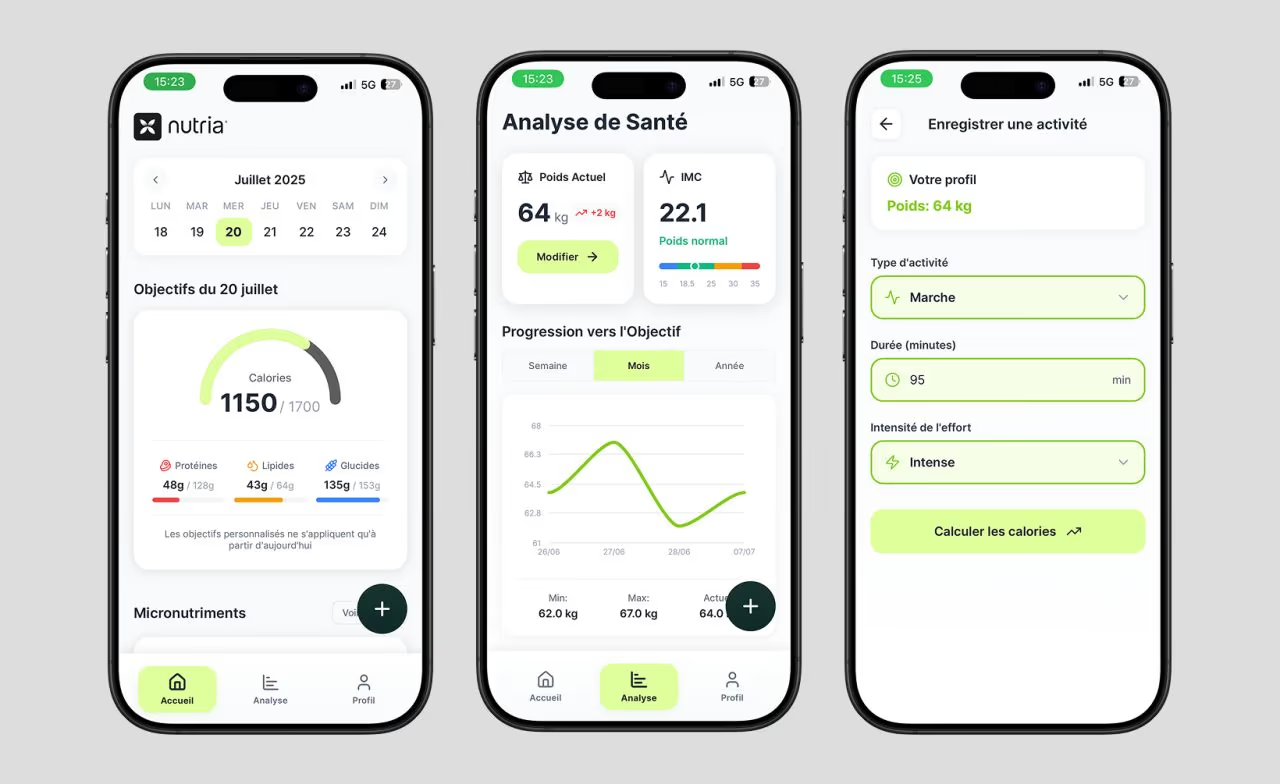
The app was delivered in React Native on iOS in 1 month. Core features: food scan by barcode and visual recognition, macro tracking, personalized goals, history. Nothing superfluous.
That choice of speed is not a constraint. It is a strategy. Most of the features founders think are indispensable at launch are not. What is indispensable is putting the product in users' hands to learn fast. If you are wondering what a project of this type actually represents in budget, our mobile app quote guide lets you estimate your envelope in 7 steps.
The long onboarding: the counterintuitive bet in fitness
The first structuring product decision was to make a long onboarding. On purpose. Against the intuition of many founders who want to "get straight to the point."
In the fitness and nutrition sector, the more questions you ask the user, the more they commit. It is not friction. It is a signal of attention. It is one of the fundamental principles we detail in our guide on mobile app onboarding.
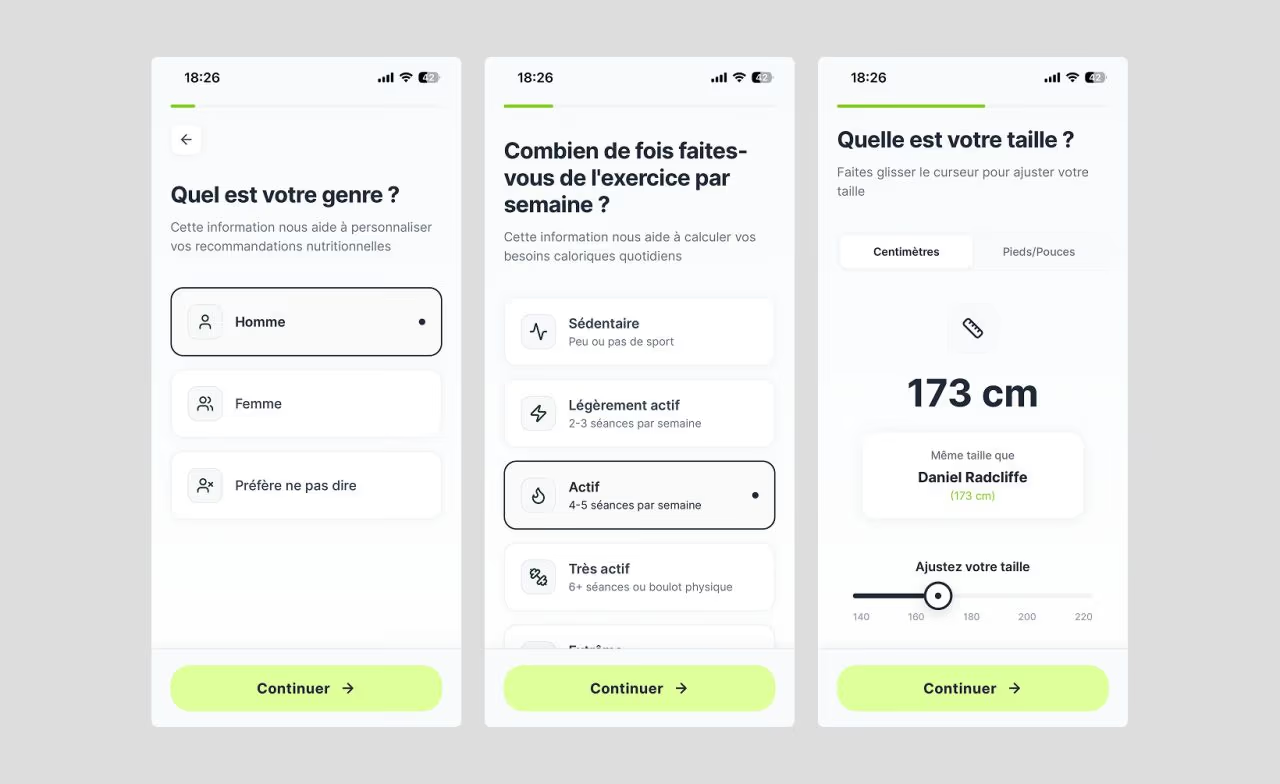
Calyra (ex-Nutria) asks from the start: your goal (lose weight, maintain, gain mass), your physical activity level, your dietary constraints, your current weight and your target weight. At the end of the onboarding, the user does not discover a generic app. They discover an app that seems to have been made for them.
This mechanism plays on two powerful psychological levers.
The first is perceived personalization. The user feels that the product understands them. They are therefore much more inclined to trust it, and therefore to pay.
The second is active commitment. Every question the user answers is a micro-investment in the product. They have spent time. They have shared personal information. Abandoning after that represents a psychological cost. The data confirms this intuition: in the Health & Fitness category, 68% of revenue comes from annual subscriptions (RevenueCat SOSA 2026), which indicates a strong and lasting commitment from the users who convert.
When the paywall appears at the end of the onboarding, the decision is already made in the mind of the majority of users. The paywall no longer convinces. It confirms.
The TikTok strategy: 2 accounts, 6 to 8 videos a day
The product was ready. The real question was: how do you acquire users without a significant advertising budget? It is a question every founder asks at launch. We answer it in detail in our guide on how to make a mobile app known.
He chose TikTok. Not timidly, a few videos here and there. Systematically and obsessively.
He created two distinct accounts: one account with a masculine persona, one account with a feminine persona. The goal was to cover two different audiences with content adapted to their codes, their language, and their specific issues around nutrition.
On each account: 3 to 4 videos a day. That is between 6 and 8 videos produced and published daily.
That pace is exhausting for someone who does only that full time. For a student managing classes in parallel, it is something else. That is where his determination made the difference. He held that pace for several weeks without letting up.
The content format was simple and repeatable: a demonstration of the app in real conditions. A dish, a photo, a scan. The nutritional breakdown appears in a few seconds. A reaction to the camera. End.
Each video was a sales argument disguised as content. And it worked because the app lent itself perfectly to that format.
Why Calyra (ex-Nutria) is a "tiktokable" app
Not every app is distributable the same way on TikTok. Calyra (ex-Nutria) had something most apps do not: the demonstration of value is instant and visual.
You film a dish. You scan it. In two seconds, the screen shows the calories, the protein, the fat, the carbs. It is concrete, it is spectacular, it is understandable in under 5 seconds without audio.
On TikTok, you have about 2 seconds to keep someone on your video. An app whose value is visible immediately is an app that distributes itself naturally in this format.
Compare that with a budget app or a project-tracking app. The value is real, but it shows itself over weeks or months of use. Impossible to show convincingly in 30 seconds.
The lesson is direct for any founder: before deciding how to distribute your app, ask whether your value is showable in under 10 seconds. If yes, TikTok and Reels become extremely powerful organic acquisition channels. If not, you have to go find other formats.
Calyra (ex-Nutria) checked every box. And he had understood it intuitively.
Paywall tests: what worked, what did not
The post-launch product strategy was marked by several iterations on the paywall. All of them instructive. If you want to go further on the subject, our complete mobile app paywall guide covers architectures, copy, and A/B tests.
The initial paywall: annual + monthly
At launch, Calyra (ex-Nutria) offered two options: an annual subscription and a monthly subscription. A classic structure in the fitness market, and a logical one: the annual plan generates more revenue over 12 months and mechanically reduces churn.
The "annual only" test: a mistake that makes sense
A few weeks after launch, we wanted to push the experiment further. The hypothesis was attractive: remove the monthly plan to force users toward the annual, increase the average basket, and simplify the choice.
Result: it did not work.
The reason is simple in retrospect. Calyra (ex-Nutria) was a new brand. Users did not know it. Asking them to commit for a year from the start is asking for a level of trust they had not yet given. The monthly plan is not just a lower-price option: it is an entry door for those who want to test before they commit.
We went back to the annual + monthly offer. The lesson is counterintuitive but documented: on apps whose awareness is still low, the monthly plan serves as a psychological safety net for the user. Taking that option away closes the door on part of the base.
What works structurally in fitness
Market data confirms what we see on Calyra (ex-Nutria). In the Health & Fitness category, the annual plan dominates (68% of revenue according to RevenueCat), but it converts better when the user has a choice. Presenting the annual price brought back to the month, with the monthly as the high reference, is the configuration that maximizes both take rate and average basket.
Apple Sign In + Google: the detail that tips conversion
One of the decisions with the most impact on conversion was integrating Apple Sign In and Google Sign In.
Before they were in place, signup went through a classic email form. Email, password, validation. Three steps that seem trivial but generate invisible friction: the user hesitates over which email to use, invents a password they will forget, and sometimes has to validate through a link sent by email. On mobile, every extra tap turns into drop-offs.
With Apple and Google, signup comes down to one tap. Identity is verified, the email is pre-filled, no password is needed. And because almost all iOS users already had an active Apple or Google account on their phone, adoption of these options was immediate.
The result was measurable from the first weeks: better conversion at signup, better conversion on the paywall. Not because the product had changed, but because we had removed a friction that was costing subscriptions without us seeing it.
It is a point founders systematically underestimate at development time. Apple Sign In and Google Sign In are not comfort options. They are direct conversion levers.
Calyra (ex-Nutria) results
€30,000 in revenue from the first month of launch. 5% monthly churn, a figure to put in perspective: our analysis of mobile app churn shows the median sits around 8 to 10% for this type of app. Calyra (ex-Nutria) was therefore clearly below that. An app delivered in 1 month, without over-engineering, on a market where competitors have years of head start. To place the €30,000 in the market context, our analysis of how much a mobile app makes shows the median sits around $72/month. Calyra (ex-Nutria) was therefore very far above that from the start.
What the Calyra (ex-Nutria) story demonstrates is not that you have to go on TikTok. It demonstrates something more structural: distribution is a product in its own right.
The founder did not win because his app was better than MyFitnessPal. He won because he made product decisions that made distribution easier (a value demonstrable in 10 seconds, an onboarding that convinces before the paywall) and because he had the discipline to execute his content strategy without letting up.
On a saturated market, the question is not "is my product better?" The question is "is my product designed to be found and to convince fast?"
Calyra (ex-Nutria) answered yes on both.
FAQ
Can you really launch an app on a market as competitive as fitness?
The fitness market is among the most contested on the App Store, but competition does not mean the absence of opportunity. What the big apps lose in agility, a well positioned app can regain in precision: a more personalized onboarding, a more immediate value, a more targeted distribution. Calyra (ex-Nutria) is the direct proof. The size of the market is also a signal of demand: the users exist. The question is to convince them better than what already exists.
Is TikTok really an acquisition channel for a mobile app?
TikTok works for apps whose value is visible in under 10 seconds. If your app allows a spectacular action or an immediate transformation (scan, result, comparison, before/after), TikTok is an organic acquisition channel underexploited by the majority of founders. The condition is content volume: a few videos are not enough. You have to commit to a sustained pace for several weeks before the algorithm starts distributing at scale.
Why does a long onboarding convert better in fitness?
In the health and fitness category, a long onboarding creates a feeling of personalization that psychologically prepares the user to buy. Every question asked is perceived as proof that the app understands their specific profile. At the end of an onboarding of 8 to 12 steps, the user has invested time and attention: abandoning represents a psychological cost. The paywall that arrives next confirms a decision already made rather than causing it.
Should you offer a monthly subscription in addition to the annual?
Yes, especially in the launch phase. On an app whose awareness is still low, the monthly plan serves as an entry door for users who do not yet know the brand. Removing that option to force the annual can seem logical to maximize the average basket, but it closes the door on those who need an intermediate step to trust. The right configuration is to present the annual plan first, showing its monthly equivalent, with the monthly visible as an alternative.
Are Apple Sign In and Google Sign In really worth integrating from launch?
Yes, systematically. Signup friction is one of the most costly silent losses on a mobile app. Apple Sign In and Google Sign In reduce signup to a single tap, with no password and no email to validate. On iOS in particular, adoption is near-universal. The impact on conversion at signup and at the paywall is measurable from the first weeks. It is not an optional feature. It is a conversion lever to integrate from the initial development.
Also read
How do you build a fitness app in 2026?
30% of fitness app downloads happen in January, and most of those users leave before the end of February. 68% of Health & Fitness revenue comes from annual plans.
How do you get your mobile app known?
More than 14,700 apps launch every month, downloads are flat at +0.8%, and revenue is up 10.6%. TikTok, Reddit, Instagram, ASO, and growth loops are the channels that last.