Build a mobile app without coding: myth or reality?
Lovable reached €20M in ARR in two months, and Base44 was acquired for $80M by Wix. These tools validate an idea: they do not build the onboarding or the paywall that make the revenue.

Article summary
- Lovable reached €20M in ARR in two months.
- Base44 was acquired for $80M by Wix, and its backend cannot be exported.
- 77% of users abandon an app in the first 72 hours, rarely because of the code.
- According to RevenueCat 2026, cutting churn from 2% to 1% can double LTV.
- Creation is scoped on request. Monetization offers are on the Pricing page.
Summarize this article with
firstapp gives you its honest, straight opinion on no-code tools. Lovable, Bolt, Base44: these tools are real, powerful, and useful. But they do not do what you think. Here is what they can do, what they cannot do, and above all what actually makes the difference between an app that generates revenue and an app that runs in a vacuum.
No-code in 2026: it is serious
Let us start by not being condescending. No-code in 2026 is no longer Wix or Webflow for brochure sites. It is Lovable, which reached €20M in ARR in 2 months, the fastest growth in the history of European startups. It is Base44, acquired for $80M by Wix, with 250,000 users and 2 million in 2026. It is Bolt.new, which can generate a fullstack app in a few minutes from a natural-language prompt.
These tools are real. They work. And for some use cases, they are genuinely impressive.
The low-code / no-code platform market is projected at $94 billion by 2028. This is not a fad. It is a structural shift in how apps are built. Denying that would be stupid.
But "these tools work" and "these tools are enough to build an app that generates revenue" are two very different claims. And that is where a lot of founders get caught.
Newsletter
Once a week.
Last issue
We opened 10 apps to see how they sell a subscription.
+534 people read us each week
The 3 no-code tools that actually matter
Lovable - Best for prototyping fast
The most impressive tool on the market for generating a fullstack app from a prompt. You describe what you want in natural language, Lovable generates clean React/TypeScript code, integrates it with Supabase for the backend, and gives you a GitHub repo you own. €20M in ARR in 2 months: the growth speaks for itself. Ideal for founders who want a working prototype in a few hours to validate an idea or pitch investors.
⚠ Limit: code quality degrades on complex projects (20+ components). Credit-based pricing can become unpredictable. And above all, Lovable gives you an app that runs, not an app that converts.
Bolt.new - Best for devs who want to move fast
Bolt generates clean, exportable fullstack code from a prompt. The advantage over Lovable: no vendor lock-in. You export your code and deploy it wherever you want. Ideal for founders with a minimum of technical knowledge who want a solid starting point without starting from zero.
⚠ Limit: token consumption can explode on ambitious projects. Some users report costs of €1,000+ for complex projects. And like Lovable, what Bolt generates is an app that exists, not an app optimized to monetize.
Base44 - Best for validating an idea in 48h
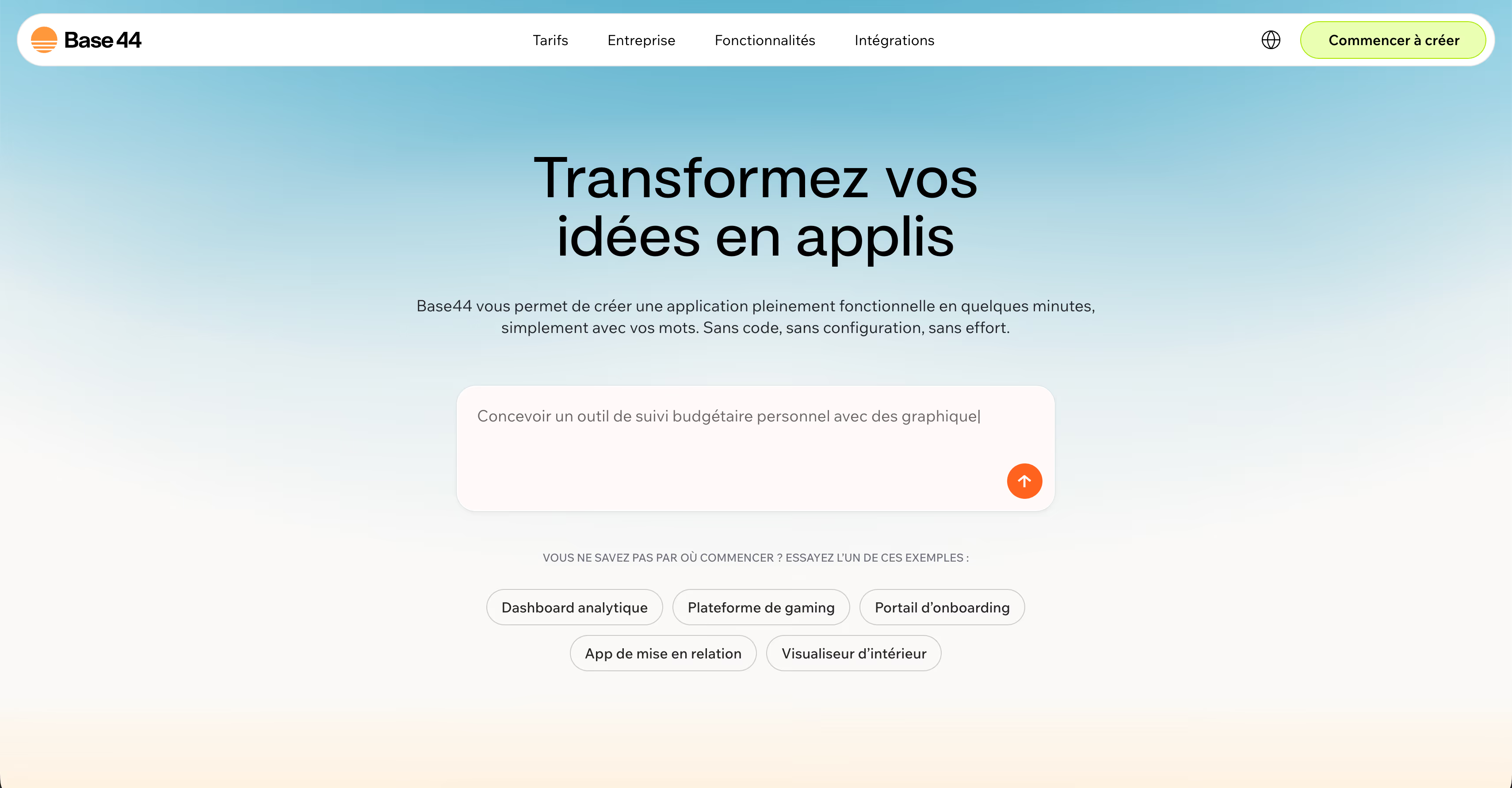
Base44 pushes the all-in-one approach to the extreme: backend, frontend, auth, hosting, everything on a single managed platform. You describe your app, it exists. Ideal for non-technical founders who want a working prototype for first user tests, without fighting the infrastructure.
⚠ Critical limit: you cannot export the backend. Your app lives on Base44's infrastructure, owned by Wix since June 2025. If you want to migrate to real development later, you will have to rebuild the backend logic from scratch. It is perfect for validating. It is a trap for scaling.
What no-code does well
Let us be honest and give these tools the credit they deserve.
No-code excels at
- Validating an idea before investing in development
- Generating a prototype to pitch investors
- Testing a concept with real users quickly
- Building an MVP in a few days on a minimal budget
- Iterating on product-market fit without waiting for a developer
- Showing a product mechanic to a team or to partners
What no-code does not do
- An onboarding that converts at 20%+
- A paywall optimized for a hard paywall
- A retention strategy for D0 / D7 / D30
- Well-segmented push notifications
- A clean, scalable RevenueCat integration
- A/B tests on the paywall and the onboarding
- An app that performs at 100K users
No-code solves the problem of the founder who cannot code and wants to see their idea come to life quickly. It does not solve the problem of the founder who wants an app that generates durable revenue.
What no-code does not do, and that is where everything is decided
Here is the point that is rarely said clearly: coding an app has never been the hard part. What is hard, what decides whether your app generates revenue or stays a nice project, is everything around the code.
Onboarding, the sequence nobody builds well
A no-code onboarding is a sequence of screens generated by a prompt. A good onboarding is a sequence designed to bring the user to their aha moment in the first 3 minutes, with the right questions, in the right order, with the right visuals, at the right pace. It is a discipline of its own. No-code tools generate screens. They do not think through the retention strategy that goes with them.
77% of users abandon an app in the first 72 hours. It is almost never a code problem. It is always an onboarding problem. And a no-code onboarding that was not thought through strategically joins those 77% in 99% of cases.
The paywall, the most important screen nobody tests
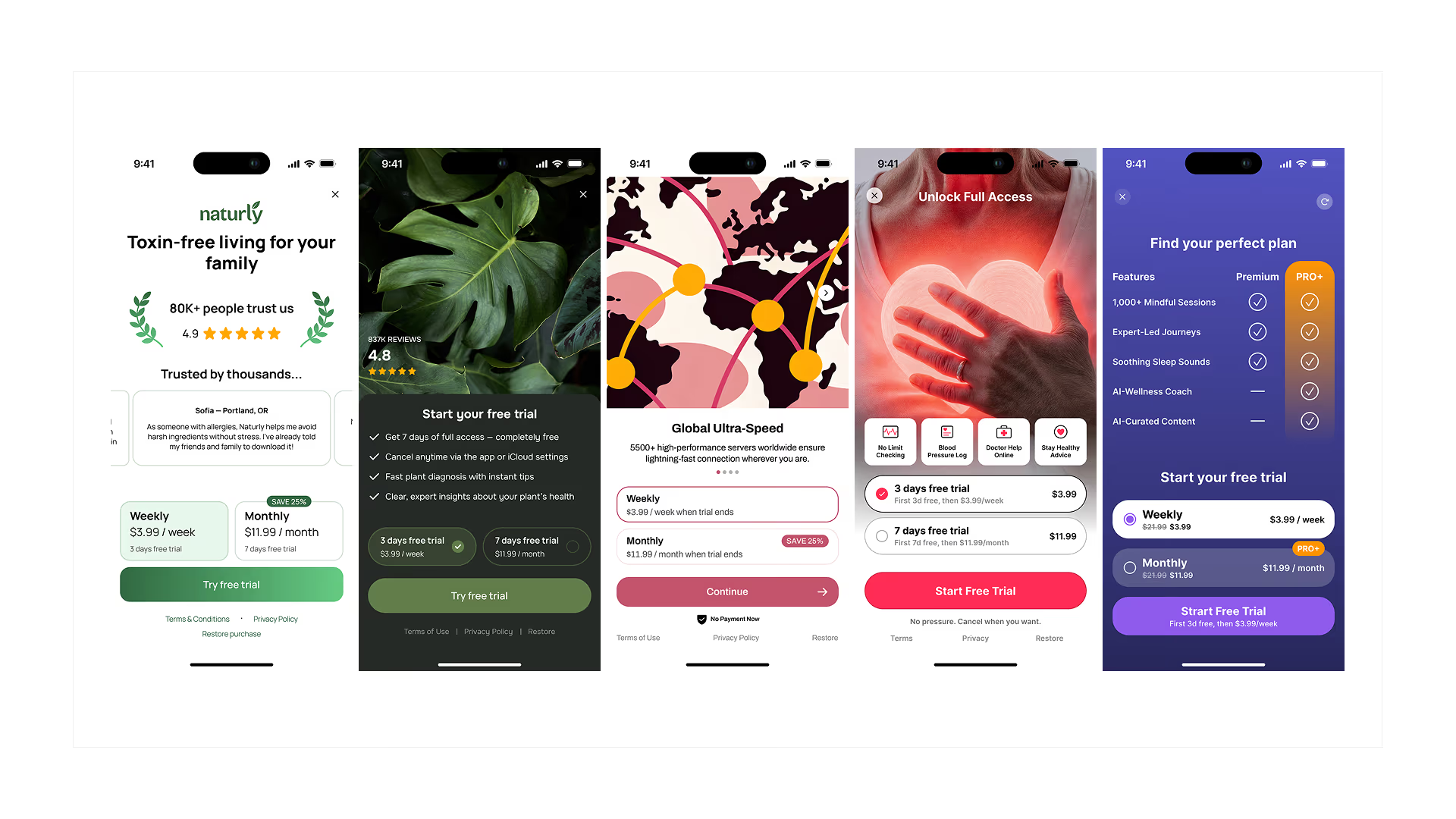
A no-code paywall is a screen with a price and a button. A good paywall is a thought-through architecture: timing after the aha moment, a second paywall on refusal, result-oriented copy, an annual / monthly offer ladder, trust signals placed well, an animated CTA. It is months of A/B tests to find what converts.
No-code tools give you the ability to display a paywall. They do not give you the strategy for it to convert at 10%+ rather than at 2%.
Push notifications, the most underestimated retention lever
Sending a push notification: any tool can do that. Sending the right notification, to the right user, at the right moment, with the right message, depending on where they are in their journey, is another matter. A user who receives a relevant notification comes back. A user who receives spam uninstalls. Notification segmentation and timing take real product thinking and a clean technical integration.
Retention, where the money is actually made
The RevenueCat 2026 data is clear: cutting churn from 2% to 1% can double your LTV. Retention is decided in the features - visible progress, streaks, milestones, social proof - and in the instrumentation: knowing exactly where users stop, what they do not use, what brings them back. No no-code tool gives you that. It is a product-management discipline that takes expertise and data.
Scalability, the wall everyone hits
Base44 does not let you take the backend out. Lovable generates code that degrades after 20 components. Bolt can cost you €1,000 for an ambitious project. These tools are built to go fast, not to hold 100,000 active users with complex queries, solid infrastructure, and predictable costs.
The real problem: coding was never the hard part
This is the most important thing to understand in this article.
The no-code myth rests on a false premise: that the main difficulty in creating an app is the code. It is not. It never has been. The difficulty is building a product people want to use, getting them to pay for it, and keeping them long enough for your business to be profitable.
A founder who uses Lovable to generate their app in 2 days and publishes it without having thought about onboarding, the paywall, and retention has exactly the same problems as a founder who spent 3 months having it coded. The technology is not the problem. Product and growth expertise is the problem.
Onboarding, paywall, and habit
At firstapp, we see apps arrive built with no-code, vibe coding, or classic development. What decides whether they succeed has nothing to do with the technology used to build them. It has everything to do with these 5 elements:
1. An onboarding that delivers the value in under 3 minutes. The aha moment has to be lived before the user has time to wonder "is this really for me?" If your onboarding does not do that, the technology that built it does not matter.
2. A paywall that converts, with the right timing, the right price, and the right message. A well-placed hard paywall converts 5x better than a poorly thought-through freemium. It takes tests, expertise, and data. Not a prompt.
3. Smart push notifications. Not spam: contextual messages that bring the user back at the right moment with the right trigger. It gets configured, segmented, and tested.
4. A well-triggered review system. 90% of apps featured on the App Store have a rating ≥ 4.0 stars. That rating does not fall from the sky. It is built with review requests at the right moment, fast replies, and a reputation-management strategy.
5. Features designed to create a habit. Visible progress, streaks, milestones, social proof: retention mechanics are not improvised. They are designed up front and tested with real user data.
Which no-code tool for which project
→ You have an idea and zero budget: use Lovable or Base44 to generate a prototype in 48h. Test with real users. Validate the market. Do not publish yet.
→ You have validated the idea and want to pitch investors: a no-code prototype is perfect for that. Lovable with a good mockup will convince any counterpart.
→ You want to publish a real app and generate revenue: there, no-code alone is not enough. You need a real stack (React Native, Supabase, RevenueCat), and above all product expertise on onboarding, the paywall, and retention.
→ You already have a no-code app running and you want to move it into serious production: this is the moment to start again on solid foundations. Migration from Base44 in particular is painful - better to anticipate it.
Our advice at firstapp: use no-code to validate, not to scale. As soon as you have proof that people want to pay for your app, invest in a real stack, a real onboarding, a real paywall. That is where growth is decided.
You have a no-code prototype and you want to move to a real app that generates revenue? That is exactly what we do at firstapp: we take your validated concept, we build it cleanly in React Native, and we work the onboarding, the paywall, and retention so it converts from launch.
FAQ: build an app without coding
Can you really build a mobile app with no-code?
Yes, for a web app or a prototype. For a real native mobile app on the App Store, with onboarding, a paywall, push notifications, and a clean RevenueCat integration, current no-code tools hit their limits quickly. Lovable and Bolt generate web apps, not React Native apps optimized for mobile conversion. The distinction matters.
Lovable, Bolt, Base44: which one should you start with?
To validate an idea quickly: Base44 if you are non-technical and want a working app in 48h. Lovable if you want clean code you can then hand to a developer. Bolt if you have some technical knowledge and want an exportable starting point. In every case, these tools are validation tools, not production tools.
Can a no-code app be published on the App Store?
Technically yes, via a wrapped web app (Capacitor or similar). But Apple is increasingly strict about the quality of submitted apps. An app generated from a prompt with no work on the user experience has a strong chance of being rejected or of getting a mediocre rating. And even once published, an app without strategically designed onboarding and paywall will not generate revenue.
How much does it cost to move from no-code to classic development?
It depends on the state of the no-code. If you have a Lovable prototype with clean, exportable code, a developer can use it as a base, and that reduces development time. If you have a Base44 app with the backend locked inside their infrastructure, you start almost from zero on the server side. Anticipate that migration from the start if you know you will want to scale. Creation is scoped on request. Monetization offers are on the Pricingpage.
Will no-code replace development agencies?
No, and for a simple reason: no-code solves the problem of code generation. It does not solve the problem of product strategy, conversion optimization, and retention. What creates value in an app is the expertise around the code: onboarding, the paywall, retention mechanics, ASO. That work takes experience and data. A prompt does not replace it.
Also read
Lovable, Bolt, Base44, Claude, Cursor: which one should you choose for your app?
Lovable, Bolt, and Base44 output web apps. Claude and Cursor output code. None of them decides the onboarding, the paywall, or publication on the App Store.
Vibe coding vs agency: cost and result over 6 months
Over 6 months, a subscription app in vibe coding alone is estimated at €12,000 to €35,000, an agency at €12,000 to €27,000. Only 4.6% of apps reach €10,000 of MRR in two years.