How do you monetize a mobile AI application?
AI apps convert to trial about twice as little as classic apps, and generate 41% more revenue per paying user. Copying the paywall of a fitness or productivity app is a structural mistake.

Article summary
- AI apps convert to trial at about 5.3%, versus 10.9% for the average subscription app.
- They generate 41% more revenue per paying user, and 14% more direct purchases.
- An annual plan with a trial reaches €66.70 of LTV at one year, versus €49.92 for a classic app.
- Displaying that plan as a monthly cost increases trial starts by 30% and annual adoption by 10%.
- At launch, a hard paywall with a trial filters the curious; freemium with no clear usage limit is not recommended.
Summarize this article with
AI apps convert twice as poorly to trial as classic apps. And yet they generate 41% more revenue per paying user.
This paradox is not a bug. It is the signal that the rules of the game have changed, and that copying the paywall strategy of a fitness or productivity app onto an AI app is a structural mistake.
firstapp works with founders on the monetization of their apps, and AI apps raise pricing questions that classic frameworks do not yet cover well. Here is our reading of the 2025-2026 data.
The AI app market: figures that make your head spin
2025 was the year AI apps consolidated in the stores. It is no longer an emerging trend. It is a segment in its own right, with its own monetization mechanics.
The figures are eloquent. According to Sensor Tower (State of Mobile 2026), ChatGPT alone generated $3.4 billion in IAP revenue in 2025, with growth of 254% year over year. Time spent on generative AI apps reached 48 billion hours, 3.6 times more than in 2024.
But what is more interesting for a founder is the growth data by segment. According to RevenueCat (SOSA 2026):
- Lifestyle AI apps grew 691% in revenue in one year
- Graphics and Design AI apps: +202%
- Utilities AI apps: +174%
These growth rates have no equivalent in traditional categories. Non-gaming apps now generate more than $85 billion in global IAP revenue, surpassing gaming for the first time in 2025. AI apps are the main engine.
Newsletter
Once a week.
Last issue
We opened 10 apps to see how they sell a subscription.
+534 people read us each week
The central paradox: fewer trials, more revenue
This is where it becomes counterintuitive.
According to RevenueCat data across 115,000+ apps, AI applications convert to trial at about 5.3%, versus 10.9% for the average subscription app. Roughly twice as little.
And yet the same data shows that AI apps generate 41% more revenue per paying user than non-AI apps. They also get 14% more direct purchases, without a trial.
How do you explain this apparent contradiction?
First, users who download an AI app often have a different intent. They arrive with a precise task in mind: generate a text, edit an image, analyze a document. The free trial does not speak to them as much as an immediate solution to the problem they have now. This user profile is more likely to pay directly than to "test."
Second, the perceived value of AI apps is structurally higher. You do not pay for content or features. You pay for a result. And users who have experienced that result are ready to pay more to access it continuously.
Third, tolerance for pricing is different. AI apps benefit from a "premium technology" effect: the user knows that AI is expensive to run, which psychologically justifies higher prices.
What that changes in practice for your paywall
If your AI app follows a classic strategy (7-day free trial, monthly plan at €9.99, paywall at the end of onboarding), you are probably leaving significant revenue on the table.
Here are the three direct implications of the data for monetizing an AI application:
Priority to the annual plan with a trial
It is the best-performing configuration for AI apps according to RevenueCat 2025 data. Annual plans with a trial generate €66.70 of LTV at one year for an AI app, versus €49.92 for a classic app in the same configuration, a gap of 34%.
The explanation: AI app users who commit to an annual plan are the ones who have built the tool into their workflow. Once that habit is in place, churn is low.
Aim for the direct purchase, not only the trial
Unlike a fitness app, where the free trial reduces perceived risk and increases conversion, AI apps convert better on a direct purchase. That does not mean removing the trial. It means putting it in competition with a direct-purchase option that is clearly visible on the paywall.
Accept higher churn as a structural reality
AI apps churned 30% faster than classic apps (RevenueCat SOSA 2026). It is not a retention problem to correct at all costs. It is a signal that the model should first optimize value per payer before optimizing lifetime.
What price structure for an AI app?
AI app pricing has to reflect two realities: perceived value is high, and the length of engagement is shorter than average.
Annual-first, displayed as a daily cost
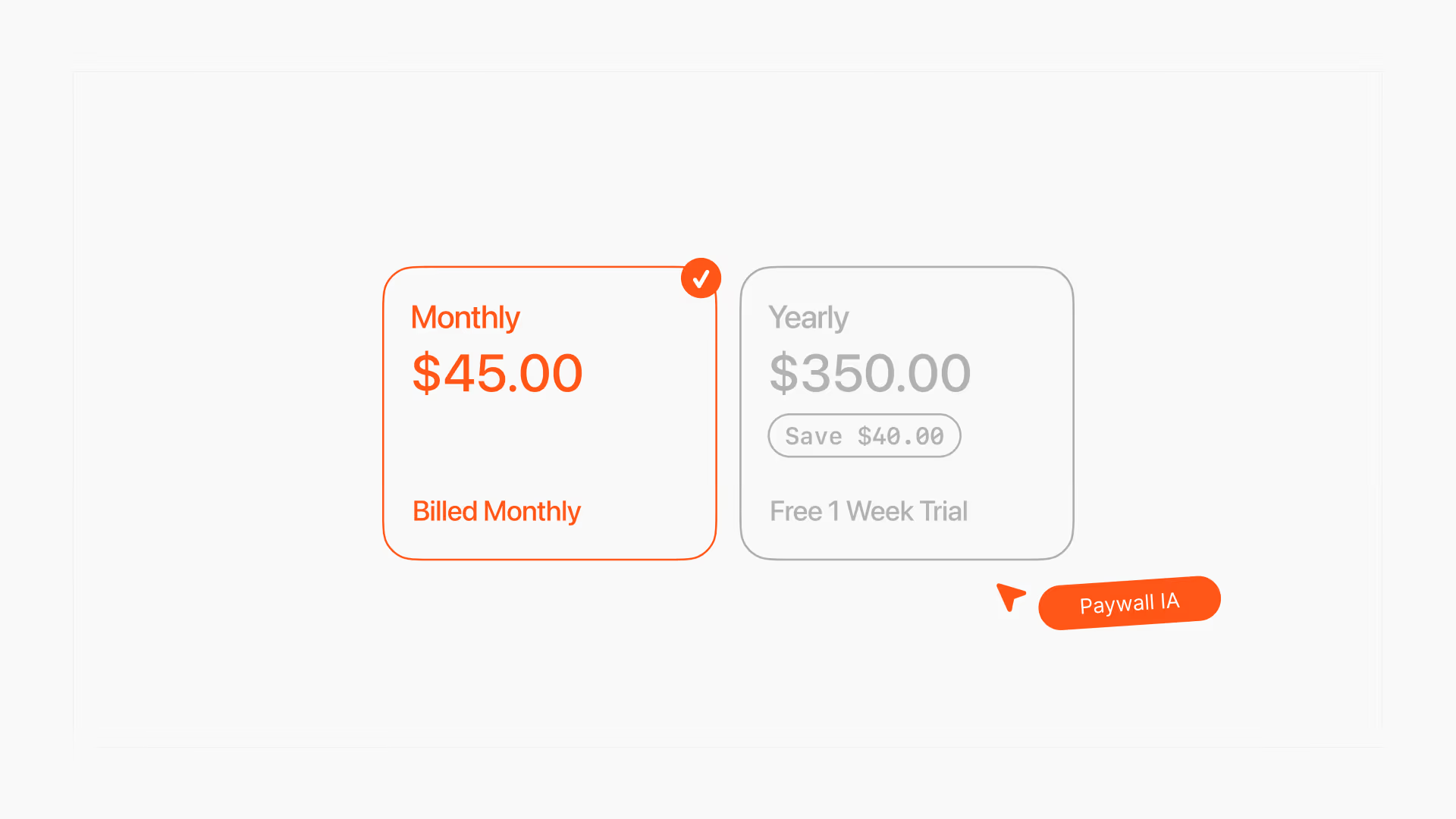
Displaying the annual price brought back to a daily or monthly cost is particularly effective on AI apps. "€1.50/day for an AI assistant available 24 hours a day" positions differently from "€549/year." According to RevenueCat, presenting the annual plan as "per month" increases trial starts by 30% and the annual adoption rate by 10%.
An assumed premium price
The best-performing AI apps do not try to be the cheapest. They try to justify a higher price by the quality of the result. A paywall that apologizes for its price (a permanent discount, an "accessible" plan) weakens the perception of value. A price that reflects what your app actually does is a signal of confidence, not a brake.
Trial on the annual plan only
An effective tactic on AI apps: offer the trial only on the annual plan, not on the monthly. That naturally steers motivated users toward long-term commitment, and avoids feeding a flow of short trials with a low conversion rate.
Hard paywall or freemium: what to choose for an AI app?
The answer depends on the maturity of your product, but the direction is clear.
For an AI app in a launch phase, a hard paywall with a trial is almost always the best option. Users who arrive with strong intent are ready to commit directly. The hard paywall filters the curious and leaves you with high-intent users, exactly the ones from whom you should build your product.
As your app grows and you look to widen your base, a freemium model with usage limits becomes relevant: X free generations per month, then the paywall. It is the model of ChatGPT and of most consumer AI tools. It lets people experience the value without commitment, and lets you target with the paywall the users who have used up their quota and want more.
What the data advises against for monetizing an AI application: freemium with no clear usage limit. If the user can do everything for free without ever hitting friction, there is no natural reason to go to the checkout.
Monetization mistakes specific to AI apps
Copying the paywall of a fitness app or a meditation app. The user profile is different, the buying behavior is different, the tolerance for price is different. A paywall built around "transform your life" does not speak to someone looking for a productivity tool.
Underpricing out of fear of competition. Generative AI has trained users to pay for quality. An AI app at €2.99/month is perceived as less reliable than an app at €14.99/month, not as a bargain.
Ignoring involuntary churn on Android. According to RevenueCat, about 31% of cancellations on Google Play are due to billing problems, versus 14% on the App Store. For an AI app looking to maximize LTV, this lever is often neglected.
Placing the paywall before the aha moment. Even for a high-intent AI app, the user has to have had a concrete demonstration of the value before paying. A fast generation, an impressive result, a "wow," then the paywall. The sequence stays the same, even if it can be shorter.
FAQ
Which pricing model should you choose for an AI app?
The annual plan with a trial is the best-performing model in 1-year LTV for AI apps: €66.70 on average versus €49.92 for classic apps in the same configuration. Presenting that plan as a monthly or daily cost increases trial starts by 30% according to RevenueCat. A freemium with usage limits is relevant from a certain size, provided the limits create real friction.
Should you offer a free trial on an AI app?
Not necessarily in the same way as on a fitness app. AI apps get 14% more direct purchases than average, which indicates that part of users pay without a trial. The trial remains useful for reducing perceived risk, but it should coexist with a clearly visible direct-purchase option and ideally be reserved for the annual plan to steer toward long-term commitment.
Why is churn higher on AI apps?
AI apps churned 30% faster than non-AI apps according to RevenueCat SOSA 2026. Several factors explain this: more episodic use (the user pays for a precise task then disengages), strong competition between similar AI tools, and the newness of the sector, which still generates a lot of exploration rather than lasting engagement. It is not a fate, but it is a reality to build into the pricing strategy.
Is React Native suited to developing an AI app?
React Native is the framework with the best median revenue per install according to RevenueCat SOSA 2026: 2.5% D35 conversion versus 2.0% for native and 1.8% for Flutter. For an AI app looking to iterate fast on onboarding and the paywall, that is a concrete advantage: a single iOS and Android codebase, short update cycles, and easy integration with monetization SDKs (RevenueCat, Adapty, Superwall).
Also read
AI integration in your mobile app: what you need to know
Integrating AI into a mobile app means calling Azure, OpenAI, or Google Cloud, not training a model. Responses take 1 to 8 seconds, and API keys never go through the client.
Hard paywall vs soft paywall: how to choose
According to RevenueCat, a hard paywall converts at about 10.7% from install, versus 2.1% for freemium. Adapty, which measures the paywall view, gives the advantage to the soft paywall.
How do you monetize a mobile AI application?
The best-performing strategy for monetizing an AI application combines an annual plan with a trial displayed as a monthly cost, a direct-purchase option visible on the paywall, and an assumed premium price. AI apps generate 41% more revenue per paying user than classic apps according to RevenueCat SOSA 2026, but convert twice as poorly to trial. The challenge is therefore not to maximize trial volume, but value per payer.