Mobile app rebuild: is your app losing money?
A mobile app rebuild is not always a rewrite of the code. At Sticker Editor, the onboarding and the screenshots alone produced +20% conversion.


Article summary
- Targeted optimization touches the onboarding, the paywall, or the screenshots without rebuilding the app. At Sticker Editor, it produced +20% conversion.
- If more than 40% of users drop off before the paywall, the problem is at the entrance. RevenueCat indicates that 55% of trial cancellations happen on day 0.
- Under 4.0 stars, visibility is penalized: 90% of apps featured by the App Store have a rating of at least 4.0 (AppTweak 2025).
- The mobile app audit is €1,500. Targeted optimization sits between €3,000 and €8,000, over 3 to 6 weeks.
- A rewrite is required if the framework is no longer supported, if the debt makes every update dangerous, or to unify Swift and Kotlin in React Native.
Summarize this article with
Most founders wait too long before rebuilding their app. Not because they do not see the problems. They see them. Because they do not know whether those problems really cost something, and whether a rebuild is worth the investment.
firstapp regularly works with founders who arrive with an app that runs but does not perform. The onboarding leaks, the paywall does not convert, the App Store rating is stuck at 3.8. The question is not "should we rebuild". It is "how much does this app cost you each month by staying as it is?"
This guide gives you the concrete signals, the decision criteria, and the steps to approach a mobile app rebuild properly.
1. What "rebuild" really means
The word "rebuild" covers two very different realities. Confusing the two is the first source of budget overrun.
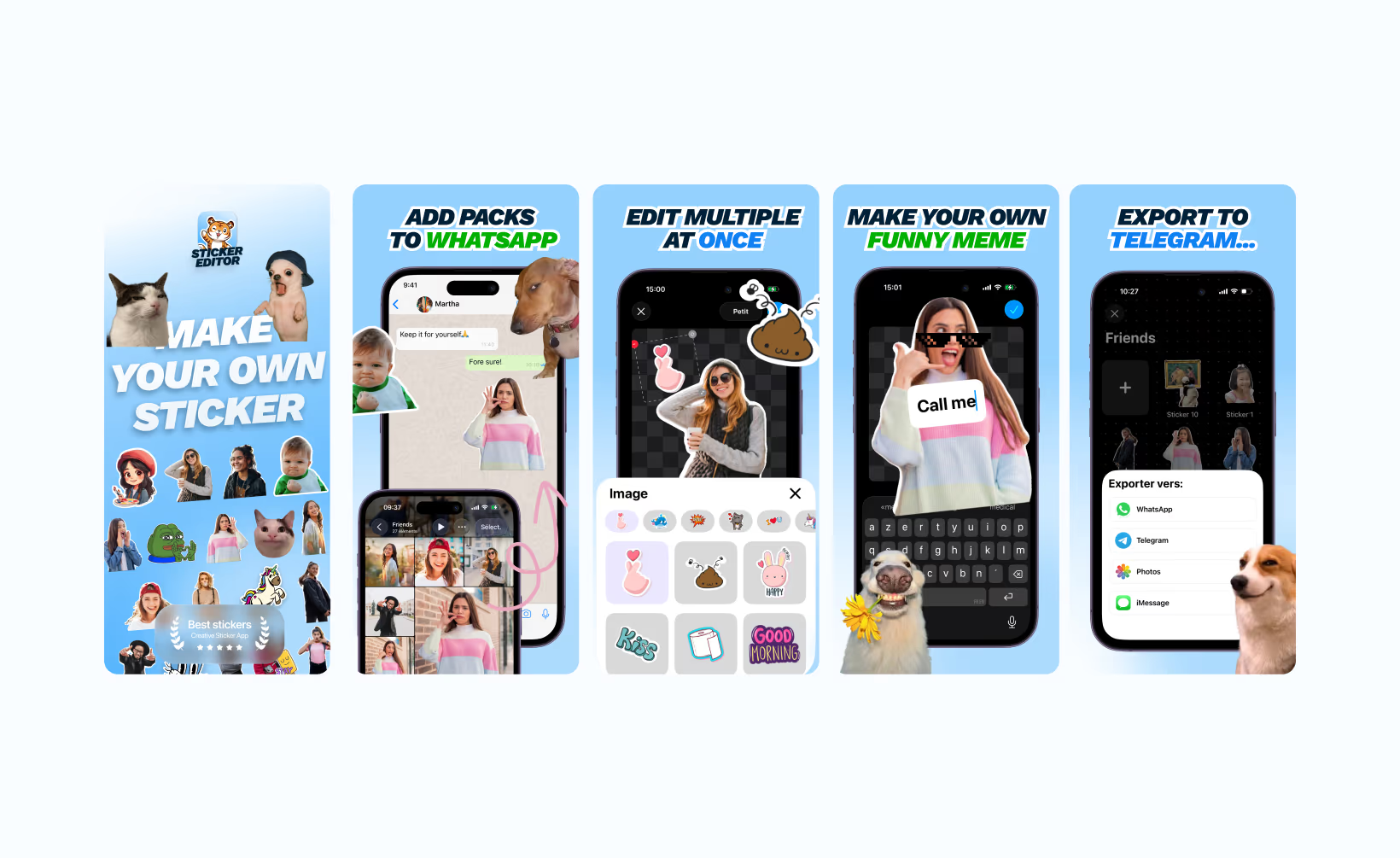
The targeted optimization applies when the product is solid but specific points underperform: an onboarding that loses 40% of users on the second screen, a badly structured paywall, App Store screenshots that do not convert. You touch those specific elements without rebuilding the rest. That is what we did at Sticker Editor, an onboarding and screenshots rebuild only, without touching the app's code, with +20% conversion.
A full rewrite is required when the technical base itself is the block: an unmanageable legacy codebase, an obsolete framework, technical debt accumulated over several years. It is a heavier investment, but sometimes the only one that actually frees the product.
The majority of cases we see belong to the first category. Before talking about a rewrite, check that the problem is not in the onboarding or the paywall.
Newsletter
Once a week.
Last issue
We opened 10 apps to see how they sell a subscription.
+534 people read us each week
2. The 5 signals that show your app is losing money
Your onboarding completion rate is below 60%
If more than 40% of your users drop off before reaching the paywall, you lose potential subscribers every day. According to RevenueCat (State of Subscription Apps 2026), 55% of trial cancellations happen on Day 0, before the user has actually used the app. This is not a product problem. It is an onboarding problem. Our guide on mobile onboarding optimization details the exact mechanics that make users leave in the first minutes.
Your trial-to-paid conversion is below the market
According to RevenueCat (SOSA 2026), a trial of 17 days or more converts at a median of 42.5%, against 25.5% for a short trial of 4 days or less. If your rate is clearly below these benchmarks, the trial length or the paywall structure is probably the cause. Both can be fixed without a rewrite. Our article on mobile paywall optimization shows you how to structure an offer that converts.
Your App Store rating is below 4.0 stars
According to AppTweak (ASO Benchmarks 2025), 90% of apps featured by the App Store have a rating of 4.0 or higher. Below that, your organic visibility is structurally penalized and users hesitate to download. The rating is often a symptom. Bad reviews point to the real problem (onboarding, recurring bugs, value that is poorly perceived). Reading our guide on App Store ASO will give you the levers to lift both your rating and your organic visibility.
Your codebase blocks your iterations
If every change takes two weeks because the code has become unmanageable, or if some parts of the app can no longer be touched "because it might break everything", you pay technical debt on every iteration. Unlike the previous three, this signal is not fixed with targeted optimization.
Your users have been reporting the same friction for months
App Store reviews that come back to the same points, "sign-up is too long", "I don't understand what the subscription is for", "the app is slow to start", are not isolated reviews. They are data. If you ignore them, you lose users every week who could have converted. And if you do not yet have enough reviews to spot trends, our guide on how to get your first 100 App Store reviews explains how to speed up that collection.
3. Targeted optimization or a full rewrite: how to decide
When targeted optimization is enough
Optimization is the right choice when the signals point to surface elements: onboarding, paywall, screenshots, sign-up flow, trial timing. These elements have a direct impact on revenue and can be changed without touching the technical architecture.
If your app runs, if the main features work, and if the problem is "people don't understand the value" or "people leave before the paywall", start there. It is the most frequent case, and by far the least expensive.
When a full rewrite is required
A rewrite becomes unavoidable in three precise situations: the framework you use is no longer supported and causes compatibility problems with new iOS/Android versions, technical debt makes every update dangerous and expensive, or you need to migrate from separate native development (Swift + Kotlin) to a unified React Native codebase to reduce your maintenance costs. These situations are often the result of mistakes made at the initial build. Our article on mobile app creation mistakes lists them all so you do not repeat them during the rebuild.
In that last case, the migration can look expensive in the short term. It then frees the team to iterate on what actually matters, the onboarding, the paywall, retention, without maintaining two separate applications.
4. What we audit before touching the code
A mobile app rebuild without a prior audit is renovating a house without looking at the foundations. The first step is to understand exactly what is not working, and why.
The product audit
The product audit analyzes the user path from opening the app to the first payment: completion rate of each onboarding screen, paywall view rate, trial start rate, trial-to-paid conversion, D30 churn. These metrics show precisely where users drop off and let you prioritize the work before committing a budget. If you do not yet know which ones to track first, our article on the essential metrics and KPIs of a mobile app gives you the full dashboard with the 2026 benchmarks.
At firstapp, the mobile app audit is €1,500. It covers the onboarding, the paywall, ASO, and the overall experience, with recommendations prioritized by revenue impact. It is systematically the first step before any rebuild decision.
The technical audit
The technical audit evaluates the state of the code: accumulated debt, obsolete dependencies, startup performance, compatibility with the latest iOS and Android versions. It answers a simple question: can we iterate properly on this base, or do we need to start from something clean?
5. Sticker Editor: +20% conversion after the rebuild
Sticker Editor is an application firstapp works with. The product worked. Users downloaded, created stickers, shared. But the store conversion rate was not taking off.
We worked on two elements: the onboarding and the App Store screenshots. Not the application's code, not the features. Only the entrance into the product and how it is presented on the store.
Result: +20% conversion.
This case illustrates what we see regularly: the problem is not always in the app itself. It is often in how the app is presented and in the path of the first minutes. An onboarding and ASO rebuild can generate more impact than a full rewrite, at a fraction of the cost.
6. Real budget and timeline
The budget of a rebuild depends directly on its scope.
Targeted optimization, onboarding, paywall, screenshots, UX adjustments, sits between €3,000 and €8,000 depending on complexity, with a timeline of 3 to 6 weeks.
A partial rewrite, meaning the migration of one or more modules to a more recent stack, generally sits between €10,000 and €25,000.
A full rewrite with a migration to React Native and a complete rebuild of the experience is scoped on request. You will find the detailed ranges by case in our article on the mobile app quote.
To choose your rebuild partner for your case, our comparison of the best mobile app creation agencies gives you the criteria that actually matter.
One last point on timing: if your onboarding loses 40% of your users every day, every week of waiting has a real cost. That is not a reason to rush the decision. It is a reason not to wait six months to start the audit.
7. Calculate the return before deciding
The question that should come before any rebuild decision: what MRR is your app running at today, and what MRR is realistically reachable with healthy metrics?
If your trial-to-paid conversion rate is at 10% when your category benchmark is at 30%, and you have 1,000 trials a month, you are leaving about 200 extra subscribers on the table every month. Calculate their value over 12 months taking your ARPU and your churn into account, and you have your potential ROI.
Our simulator in the article how much a mobile app makes lets you project the impact of an improvement in your metrics on your real revenue, with your own figures. It is the right starting point before committing a budget.
For founders wondering about the technical stack of a rebuilt app, our article React Native agency details why it is the dominant choice in 2026 for B2C apps.
8. Questions about rebuilding an app
What is the difference between a rebuild and a mobile app update?
An update fixes bugs and adds features within the existing scope. A mobile app rebuild questions structural elements: the onboarding, the paywall, the technical architecture, or the overall user experience. The two sometimes overlap, but a rebuild implies a deliberate decision to change something that underperforms, not just to maintain what exists.
How much does a mobile app rebuild cost?
The cost depends on the scope. A targeted rebuild, onboarding, paywall, ASO, sits between €3,000 and €8,000. A partial rewrite goes up to €10,000–€25,000. A full rewrite is scoped on request. Our article on the mobile app quote details the ranges by case.
Should you keep the existing code or rewrite everything?
If the code lets you iterate normally and the problems are in the user experience, keep it and work on the onboarding and the paywall first. If every change takes two weeks because the technical debt is unmanageable, a rewrite is probably the shortest path to an app that performs, and over the long term, the least expensive.
Which technology should you choose for a mobile app rebuild?
For B2C apps targeting iOS and Android, React Native is the dominant choice in 2026. A single codebase, performance close to native on nearly every use case, a mature ecosystem. According to RevenueCat data (SOSA 2026), React Native apps show the best median download-to-paid conversion rate among cross-platform frameworks. Our React Native agency page details the reasons for this choice.
How long does a mobile app rebuild take?
Targeted optimization (onboarding, paywall, ASO) takes 3 to 6 weeks. A partial rewrite, 6 to 10 weeks. A full rewrite with a React Native migration, 8 to 14 weeks depending on functional complexity. The prior audit phase takes 1 to 2 weeks and conditions everything. Do not skip it to go faster.
Your app runs but does not convert the way it should. A rebuild is not an expense. It is an investment with a measurable return. The first step is to quantify exactly what your current metrics are costing you.Talk about your project
Also read

Sticker Editor: onboarding, double paywall, and ASO
On Sticker Editor, the winning screenshot variant produced +20% downloads, after four to five tests. Onboarding has you create a sticker before the paywall, then a second screen offers a 6-month plan.
Mobile app quote: estimate your budget in 7 steps
A quote at €3,000 and a quote at €80,000 can describe the same feature. The gap comes from what is included, what is missing, and what will be billed later.
How do you know if your onboarding needs a rebuild?
The most reliable signal: your completion rate screen by screen. If fewer than 60% of your users reach the paywall, the onboarding is a problem. According to RevenueCat (SOSA 2026), 55% of trial cancellations happen on Day 0, before the user has had time to discover the product. It is the clearest sign that the problem is at the entrance, not in the product itself.